
Comparisons · Updated 3 August 2026
Best Home EV Charger in Australia (2026): Zappi vs Tesla vs Wallbox vs Wattpilot
Four chargers cover most Australian homes. The right one depends on your solar, your switchboard and your car far more than on the badge on the front of it.
- 9 min read
- Written for Victoria
- 2026 figures
The short answer
For most Australian homes a single-phase 7kW charger is the right answer, installed for $1,200 to $2,200 and adding roughly 40 to 50km of range per hour at 7.4kW. The Zappi v2.1 suits solar households that want surplus only charging, the Tesla Wall Connector Gen 3 suits Tesla owners wanting the tidiest tethered unit, the Wallbox Pulsar Plus suits tight garages and open protocol control, and the Fronius Wattpilot suits homes already running a Fronius inverter. Three-phase 22kW capable installations run $2,500 to $3,000 or more.
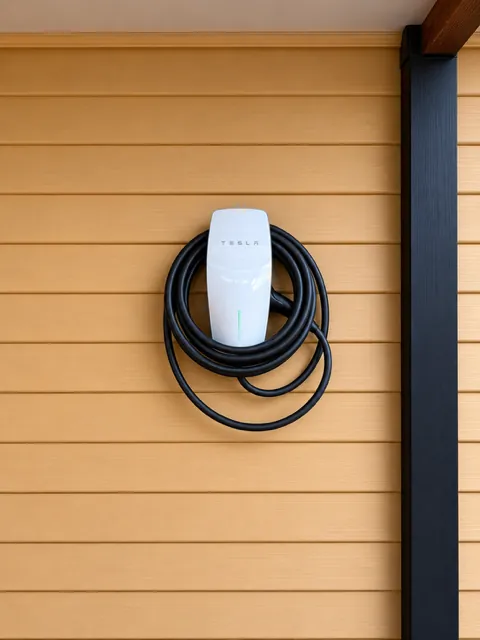
From one of our jobs
A Tesla Wall Connector on a dedicated 32A circuit
Photographed on site in Melbourne’s west. REC 37223.
- Single-phase 7kW installed
- $1,200 - $2,200
- Three-phase 22kW capable
- $2,500 - $3,000+
- Range added at 7.4kW
- 40 - 50km per hour
- Switchboard upgrade if needed
- +$800 - $2,500
The installation decides more than the badge does
Most of the money in a home charging setup is not the charger. It is the dedicated circuit that has to get from your switchboard to wherever the car parks, and the compliance work that makes it safe to leave running unattended for eight hours a night. A single-phase 7kW charger supplied and installed runs $1,200 to $2,200. A three-phase 22kW capable installation runs $2,500 to $3,000 or more. If the board has no spare capacity, no physical room for the new protective device, or no RCD protection, add $800 to $2,500 for a switchboard upgrade before the charger circuit exists at all.
Hold that in mind while you compare hardware online, because a $300 difference between two chargers is easily swallowed by a $600 difference in cable run. Position first, product second. We walk the actual parking spot before quoting any EV charger installation, because a wall behind the meter box and a detached rear garage across a driveway are two very different jobs.
On speed, at 7.4kW you add roughly 40 to 50 kilometres of range per hour. A household driving 40 to 60 kilometres a day replaces that in about an hour and a half, and an overnight charge covers it several times over. Very few Australian homes have a genuine need for more. Many vehicles cannot accept 22kW on AC regardless of what the wall unit can supply, so three phase earns its keep when the supply is already at the property or two cars share one unit, not as a default upgrade. The EV charger installation cost guide breaks the pricing down line by line.
Solar excess charging, which is where the four genuinely differ
This is the one feature that separates these units in a way you will actually notice. Feed-in tariffs are low enough now that exported generation returns very little, so pushing surplus into the car instead of the grid is one of the better uses of a rooftop array. If you have solar, decide this question first.
The Zappi v2.1 was designed around this job. It uses its own current sensors fitted at the switchboard to see what your house is exporting, then modulates the charge rate to follow the surplus. It can be set to charge only from excess generation, to top up from the grid when surplus is short, or to ignore solar entirely and charge flat out. The trade-off is a physically larger unit and a slightly longer install, because those sensors have to be fitted and commissioned at the board rather than just hung on the wall.
The Fronius Wattpilot is built to talk to a Fronius inverter and use the metering that already exists in that system. In a house with a Fronius inverter on the wall it is the tidiest solar integration of the four, because the two products were designed to work together. In a house running a different inverter brand the argument for it weakens considerably.
The Wallbox Pulsar Plus can follow surplus generation when it is paired with the manufacturer energy meter, which is an additional component rather than something included in the base unit. Without it, the Pulsar Plus is a well made scheduled charger rather than a solar diverter.
The Tesla Wall Connector Gen 3 takes a different approach. Control sits with the vehicle and the app rather than with a diversion mode in the wall unit, and surplus following is tied to the wider Tesla energy ecosystem rather than being a standalone charger function. In a Tesla household, particularly one with Tesla battery storage, that is coherent and simple. In a mixed household it is less flexible than the alternatives.
One caveat applies to all four. Solar diversion is only worth paying for if the car is home during daylight hours. If it leaves at 7am and returns at 6pm, it charges on grid power no matter which unit is on the wall, and a simpler charger on a timer may serve you better.
The four side by side
These are the practical differences rather than the spec sheet ones. Firmware and app features move constantly on all four products, so treat this as a starting point for the conversation with your installer rather than a final answer.
| Charger | Cable | Solar surplus charging | Best suited to |
|---|---|---|---|
| Zappi v2.1 | Tethered or socket versions | Native, using its own sensors fitted at the switchboard | Solar households that want genuine surplus only charging |
| Tesla Wall Connector (Gen 3) | Tethered | Through vehicle and app scheduling rather than a diversion mode in the unit | Tesla households wanting the simplest, tidiest install |
| Wallbox Pulsar Plus | Tethered | Available when paired with the manufacturer energy meter | Tight garages, and owners who want open protocol control |
| Fronius Wattpilot | Socket, with a portable model in the range | Designed around a Fronius inverter and its existing metering | Homes already running a Fronius inverter |
Model variants, connectors, cable lengths and app features change with each product revision. Confirm the exact variant and current feature set on your written quote rather than from a review published a year ago. Single-phase and three-phase versions exist across the range.
Tethered or socket, and the other hardware decisions
A tethered unit has the cable permanently attached. You walk up, plug in, and there is nothing to carry or store. It is the more pleasant daily experience by a clear margin, and it is why most people who have owned both end up preferring tethered.
A socket unit takes any cable you plug into it. That matters in three situations: if you own two cars with different connectors, if you want to keep the wall unit if the connector standard shifts, or if the charger is in a location where a permanently hanging cable would be exposed to weather or interference. It is also generally the neater looking installation when the charger is on a street facing wall.
Tethered
Better daily experience, nothing to store or carry, cable length fixed at purchase. Check the cable actually reaches your charge port from where the car parks.
Socket
More flexible, tidier on the wall, and future proof if connectors change. You handle a cable every time and you have to store it somewhere.
Cable length
The single most common regret. A charger on the wrong side of the garage means a cable stretched over the bonnet every night, which people tolerate for about a fortnight.
Weather rating
All four are rated for outdoor use, but a unit under an eave will look better in five years than one baking in western sun on an exposed wall.
Apps, OCPP and how locked in you are
OCPP is the open protocol that lets a charger be managed by software other than the manufacturer app. In a home context it matters for two reasons. The first is that some electricity retailers and smart charging programs want to control when your car draws power in exchange for a better rate, and an OCPP capable charger is far easier to enrol in that kind of arrangement. The second is longevity. A charger that speaks an open protocol is not dependent on one company continuing to maintain one app.
The Wallbox Pulsar Plus is the one most commonly chosen for this reason, because open protocol support has been part of its positioning from the start. The Zappi sits inside its own well developed ecosystem alongside the rest of the manufacturer range, which is excellent if you are buying into that ecosystem and less flexible if you are not. The Wattpilot lives inside the Fronius app environment for the same reason. The Tesla unit is the most closed of the four and the most polished if you are already a Tesla owner.
App quality is worth weighing, because you will use it most days for a decade. Tesla is smoothest for Tesla drivers, since charging control lives in the car app rather than a second one. The Zappi app is functional and detailed rather than beautiful, which suits people who want to see exactly what their surplus is doing. Wallbox and Fronius sit in between. Ask your installer to open the app on their phone before you commit.
Load management, and the switchboard question
A home charger draws a high, sustained load for hours at a time, which is precisely the condition that finds weaknesses in an older installation. That is why the board gets assessed before the charger gets chosen, not after.
Where the switchboard or the supply is tight, load management is often cheaper than upgrading the supply. All four of these chargers can throttle their output, either to a set limit or in response to a sensor watching the main incoming supply. For a car sitting at home for ten hours, a reduced charge rate makes no practical difference to your morning and can avoid a four figure upgrade.
The other case is two vehicles. If you expect a second EV within a few years, say so at quote stage. Sizing the circuit and the board once for two cars is materially cheaper than paying an electrician to open the same enclosure twice, and it is the most common avoidable cost we see in this category. The switchboard upgrade cost guide covers what those tiers look like, and in older housing stock across the west the difference between a 1950s board and a 2015 estate board is usually the difference between two quotes on the same street.
Warranty, support, and who each one actually suits
Warranty terms differ by brand and change with model year, so read the actual document rather than a summary in a comparison article. What matters as much as the number of years is who honours it, how a replacement unit is handled, and whether the person who installed it will still be trading when you need them. Every charger we install carries a 100% workmanship guarantee on top of the manufacturer warranty on the hardware.
A permanently connected charger is prescribed electrical work in Victoria. It must be installed by a licensed electrician and a Registered Electrical Contractor must issue a Certificate of Electrical Safety on completion. Your distribution network may also need to be notified of the new load and may have requirements about load management. Both of those are the installer responsibility, not yours, and both should be mentioned on the quote. Pivot Trade Services holds REC 37223 and SAA accreditation S3962281.
The honest summary is that all four are good chargers and none will disappoint at the basic job of putting energy into a car overnight. The decision is about matching the unit to your circumstances.
Choose the Zappi if
You have solar, the car is often home during the day, and you genuinely want to charge only on surplus. It does that job better than the others and it is the reason most people buy one.
Choose the Tesla Wall Connector if
You drive a Tesla, you want the tidiest looking unit and the least app friction, and you are comfortable inside one ecosystem.
Choose the Wallbox Pulsar Plus if
Space is tight, you want open protocol flexibility for future retailer programs, and native solar diversion is not your first priority.
Choose the Fronius Wattpilot if
You already run a Fronius inverter. The integration is the whole argument, and without that inverter the argument mostly disappears.
Choose none of them yet if
Your board has not been assessed. Get the electrical work scoped first, because it decides more of your final cost than the hardware does. Talk it through on our contact page.
Free download
The Melbourne Home EV Charger Buyer's Guide
What a charger actually costs, how to tell whether you need three phase, and the six questions that separate a real quote from a cheap one. Four pages, no email required.
PDF · 4 pages · 2026 edition
Figures in this guide are indicative and were accurate at the time of writing (3 August 2026). Rebate values, eligibility rules and certificate-linked discounts change regularly. Confirm current amounts with the program administrator, and treat your written quote as the accurate figure for your property.
Answers
Frequently asked questions
There is no single winner. For solar households wanting surplus only charging the Zappi v2.1 is the strongest, for Tesla owners the Wall Connector Gen 3 is the simplest, for tight spaces and open protocol control the Wallbox Pulsar Plus, and for homes with a Fronius inverter the Wattpilot. All four charge a car reliably, so match the unit to your solar, your car and your board.
If you own a Tesla and no solar, the Wall Connector is tidier, cheaper to install and easier to live with. If you have solar and want the car to charge only on genuine surplus, the Zappi does that natively using its own sensors at the switchboard and the Tesla does not. Solar excess behaviour is the real dividing line between the two.
Rarely. At 7.4kW you add roughly 40 to 50 kilometres of range per hour, which covers typical daily driving in about ninety minutes. Three phase is worth it when the supply already exists at the property, when two vehicles share one charger, or when you regularly need a fast turnaround. Many vehicles cannot accept 22kW on AC anyway, so the capability sits unused.
Two things. It makes a charger easier to enrol in retailer smart charging programs that pay you for flexible charging times, and it means the unit is not dependent on one manufacturer continuing to maintain one app. If neither of those matters to you, OCPP support is a nice to have rather than a deciding factor.
Tethered is the better daily experience because there is nothing to carry or store, and most people who have used both prefer it. A socket unit suits households with two different connectors, exposed wall positions, or anyone who wants the option to change cables later. Whichever you choose, check the cable actually reaches your charge port from where the car parks.
Sometimes, with load management, and sometimes not at all. A charger needs its own dedicated circuit with appropriate protection, so a board with no spare ways or no RCD protection has to be dealt with first, which adds $800 to $2,500 depending on scope. We assess the board before recommending a charger rather than after, because it changes both the price and the sensible product choice.
Yes, with the right hardware. The Zappi does it natively, the Wattpilot does it through a Fronius inverter, and the Pulsar Plus does it with the manufacturer energy meter added. It only pays if the car is home during daylight. A commuter car that leaves at 7am charges on grid power regardless of which unit is on the wall.
A licensed electrician, and a Registered Electrical Contractor must issue a Certificate of Electrical Safety for the work. The distribution network may also need notification of the new load. Both are the installer responsibility. Pivot Trade Services holds REC 37223 and every installation carries a 100% workmanship guarantee on top of the manufacturer warranty.
Browse every cost, rebate and comparison guide in the Pivot guides library, or claim the $60 off your first job voucher.
Want this priced for your place?
Tell us what you need and we will give you a written price, not a range that moves on the day.
- Free
- On-site quotes
- Fixed
- Written pricing
- 100%
- Workmanship guarantee
- 5.0★
- 69 Google reviews