
Sized properly, installed once, running for less
Heating and Cooling Installation and Service
Two things go wrong with heating and cooling in Melbourne homes. The system is the wrong type for the house, or it is the wrong size for the rooms. Both are decided before installation and neither can be fixed afterwards without spending the money again.
- REC 37223
- Fixed written quotes
- 100% workmanship guarantee
The short answer
Reverse cycle air conditioning delivers 3 to 4 units of heat for every unit of electricity, against 80 to 92 percent conversion for gas heating. Pivot Trade Services installs and services split systems, multi-head systems, ducted refrigerated and evaporative cooling across Melbourne’s western suburbs, including Mitsubishi Electric equipment. Sizing is calculated from room volume, glazing, orientation and insulation rather than floor area alone. Victorian Energy Upgrades discounts apply to eligible replacements on properties at least two years old.
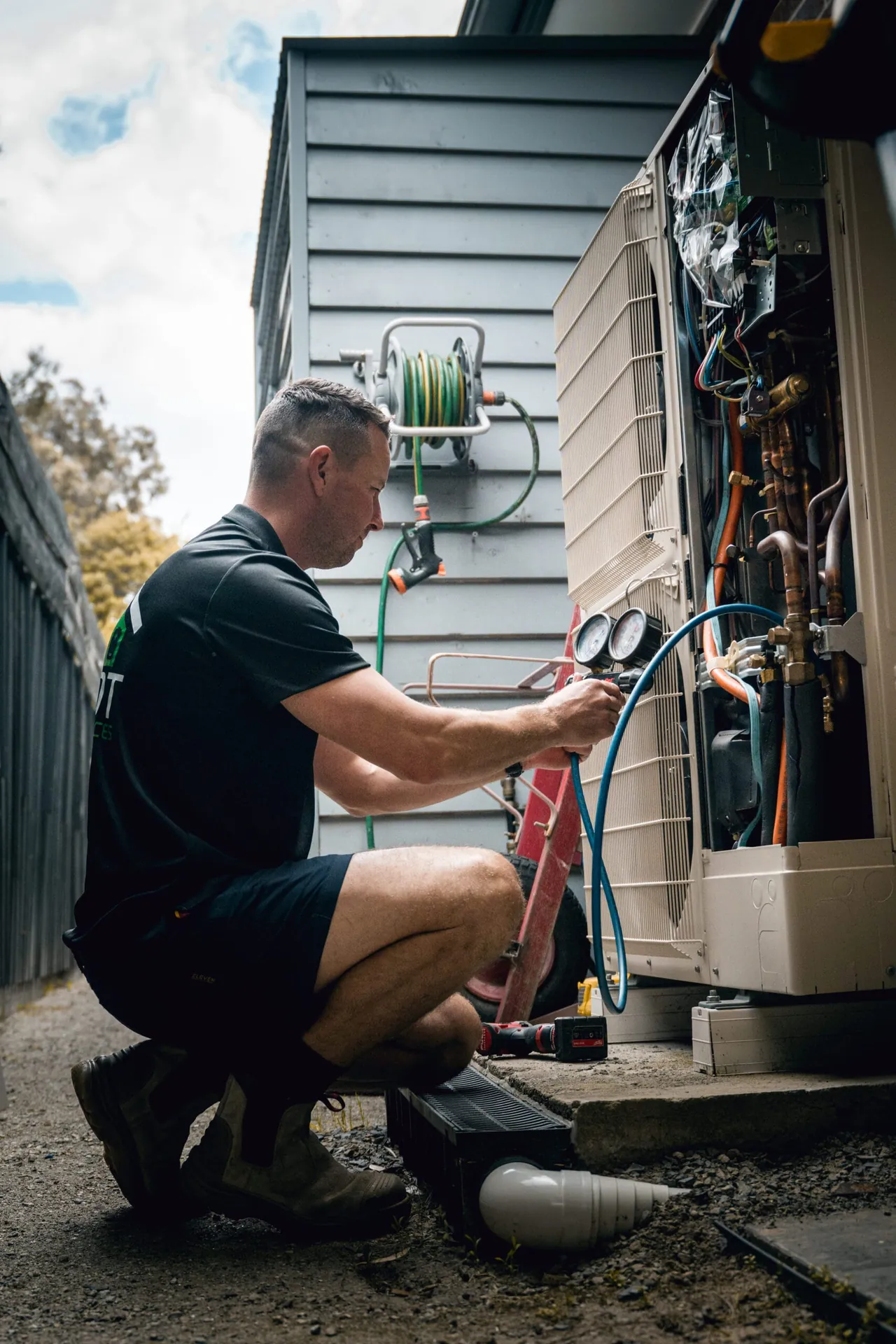
From one of our jobs
Gauges on during a service, checking the charge
Photographed on site in Melbourne’s west. REC 37223.
We install and service split systems, multi-head systems, ducted refrigerated and evaporative cooling across the western suburbs, with Mitsubishi Electric as our default for reverse cycle. This page is mostly about the decisions that come before equipment selection, because that is where the money is won or lost.
Ducted or split: a decision framework
The honest answer is that ducted suits fewer homes than it gets sold to. It is the right choice when you want consistent conditions through the whole house, you have the roof or underfloor space for ductwork, and you are prepared to pay both the higher upfront cost and the higher running cost of conditioning space you are not in.
Splits win when your usage is concentrated. If the household spends its evenings in the living area and its nights in two bedrooms, three splits will cost less to buy, far less to run, and give you independent control of each zone. They are also easier to repair, and a failure only takes out one room instead of the entire house.
Multi-head systems sit between the two, running several indoor heads off one outdoor unit. They save external space and tidy up the look of a home with several splits, at the cost of some flexibility, since the heads share a compressor and a fault in it affects all of them.
Choose ducted if
You want whole-house consistency, you have adequate roof space and ceiling height for ducts, you are renovating anyway, and zoning can be set up properly rather than as an afterthought.
Choose splits if
Your usage is concentrated in a few rooms, budget matters, you want independent control, or your roof space is tight, shallow or already full of insulation and solar cabling.
Choose multi-head if
You want several rooms conditioned but cannot fit or do not want multiple outdoor units, which is common on narrow inner-west blocks in Yarraville, Seddon and Footscray.
Consider evaporative if
You want cheap whole-house cooling, you can accept that it needs windows open and loses effectiveness in humidity, and you already have separate heating.
Sizing, and why floor area is not enough
The most common fault we find in existing installations is a unit that is the wrong capacity. Oversized units short cycle, which means they reach temperature quickly, shut off, and never run long enough to dehumidify or to operate at their efficient part-load range. Undersized units run flat out and still cannot hold temperature on a 40 degree day.
Correct sizing comes from a heat load calculation, which considers room volume rather than floor area, glazing area and orientation, ceiling insulation, wall construction, air leakage, and how many people are typically in the room. A west-facing living room with large windows in Point Cook needs substantially more capacity than an identically sized south-facing room in a well insulated Newport townhouse.
Rules of thumb such as a fixed number of watts per square metre are how the wrong unit gets sold. They ignore every variable that actually matters, and they are the reason so many homes have a unit that struggles in exactly the conditions it was bought for.
Running costs: reverse cycle versus gas
Reverse cycle heating delivers 3 to 4 units of heat for every unit of electricity, because it moves heat rather than producing it. Gas heating converts fuel to heat at 80 to 92 percent, and cannot exceed 100 percent by definition. That efficiency gap is the reason electric heating now costs less to run in most Victorian homes despite electricity costing more per unit than gas.
The comparison gets more one-sided if you have solar. Running reverse cycle during daylight hours uses generation you would otherwise export for under 5 cents, rather than importing at 30 to 45 cents or burning gas. Pre-heating or pre-cooling the house before the evening peak is one of the simplest ways to lower a bill.
There is also the gas supply charge. If heating is your last gas appliance, going all electric lets you abolish the connection and stop paying a daily charge regardless of how little gas you use.
Replacing gas ducted heating
A lot of western suburbs homes have gas ducted systems from the 1990s and 2000s reaching end of life. There are three sensible replacement paths and they suit different houses.
Ducted reverse cycle can sometimes reuse existing ductwork, which reduces cost, but only if the ducts are in good condition, correctly sized for airflow and adequately sealed. Old ducting is frequently undersized for refrigerated air and leaking badly into the roof space, in which case reusing it wastes the efficiency you just paid for.
The second path is replacing a whole-house ducted system with a set of splits in the rooms you actually use. It is often cheaper to install and always cheaper to run. The third is a hybrid, retaining evaporative cooling if it exists and adding reverse cycle splits for heating and for the humid days evaporative cannot handle.
The electrical side
Air conditioning is an electrical installation, and this is where a lot of jobs get complicated on the day. A ducted reverse cycle system, or several splits added at once, is a substantial new load on a board that may already be full.
We check the switchboard before quoting, not after. That includes spare ways, main switch and supply capacity, and whether existing circuits are protected correctly. If a switchboard upgrade is needed, it appears on the quote at $800 to $3,500 or more rather than arriving as a variation. Being one contractor for both trades is what makes this straightforward.
Outdoor unit placement also matters more in coastal suburbs. Salt air off the bay in Altona, Seaholme and Williamstown attacks condenser coils and fixings, so placement, mounting hardware and periodic washing all affect how long the unit lasts.
Service, maintenance and repairs
Most air conditioning failures are preventable. Blocked filters, dirty coils, blocked condensate drains and low refrigerant charge account for the large majority of callouts, and every one of them shows up as reduced performance well before it becomes a breakdown.
A system that is not cooling as well as last summer is telling you something. So is one that runs constantly, ices up, drips inside, or trips a breaker. Booking a service in spring rather than during the first 38 degree week is both cheaper and considerably faster.
We service and repair what we install and what we did not, including filter replacement, coil cleaning, drain clearing, electrical fault finding and refrigerant work.
| System type | Best suited to | Key trade-off |
|---|---|---|
| Single split | One room or open plan living area | No whole-house coverage |
| Multi-head split | Several rooms, limited outdoor space | Shared compressor, less independence |
| Ducted reverse cycle | Whole-house consistency, adequate roof space | Highest upfront and running cost |
| Evaporative cooling | Cheap whole-house cooling in dry heat | Needs windows open, poor in humidity |
| Gas ducted heating | Existing systems only | 80-92 percent efficient versus 300-400 for reverse cycle |
Victorian Energy Upgrades discounts apply to eligible replacements where the property is at least two years old, with a $200 including GST minimum contribution and no income test.
What a proper quote should tell you
- 1The capacity in kW and the reasoning behind it, not just a model number.
- 2Whether existing ductwork is being reused, and its condition if so.
- 3Where the outdoor unit goes and how noise to neighbours was considered.
- 4What switchboard or circuit work is included.
- 5Which zones or rooms are covered and how they are controlled.
- 6Whether a Victorian Energy Upgrades discount applies and how much.
- 7What the warranty covers on equipment versus installation.
How the job runs
- 01
Heat load assessment
We measure rooms, note glazing area and orientation, check ceiling insulation and construction, and calculate required capacity properly rather than applying a watts per square metre shortcut.
- 02
System type recommendation
We advise ducted, multi-head, splits or a hybrid based on how you actually use the house, then confirm outdoor unit placement, pipe routes and condensate drainage.
- 03
Electrical and rebate check
Switchboard capacity is assessed and any required work is priced upfront, and we confirm Victorian Energy Upgrades eligibility so the discount appears on the quote.
- 04
Installation and commissioning
Indoor and outdoor units installed, refrigerant lines pressure tested and evacuated, electrical work certified with a Certificate of Electrical Safety, and performance verified before handover.
Everything under heating & cooling
- Reverse Cycle Ducted HeatingWhole home warmth from one electric system
- Split System HeatingRoom by room heating without a gas connection
- Heater Installation & RepairsFix it, or replace it, with the numbers to decide
- Ducted CoolingOne system, every room, properly zoned
- Split System Air ConditioningSized, sited and commissioned the right way
- Evaporative CoolingCheap to run on dry days, honest about the rest
- Cooling System Installations & RepairsDiagnose the fault before replacing the box
- Heating & Cooling MaintenanceAn annual programme, not a one off visit
- System Check-UpsA measured inspection, not a sales visit
- Filter ReplacementThe cheapest job with the biggest effect
- Energy Efficient UpgradesLower running costs, discount off the invoice
- Sustainable Heating & Cooling OptionsA realistic path off gas, in the right order
Recent work
HVAC Heating & Cooling we have done around Melbourne's west
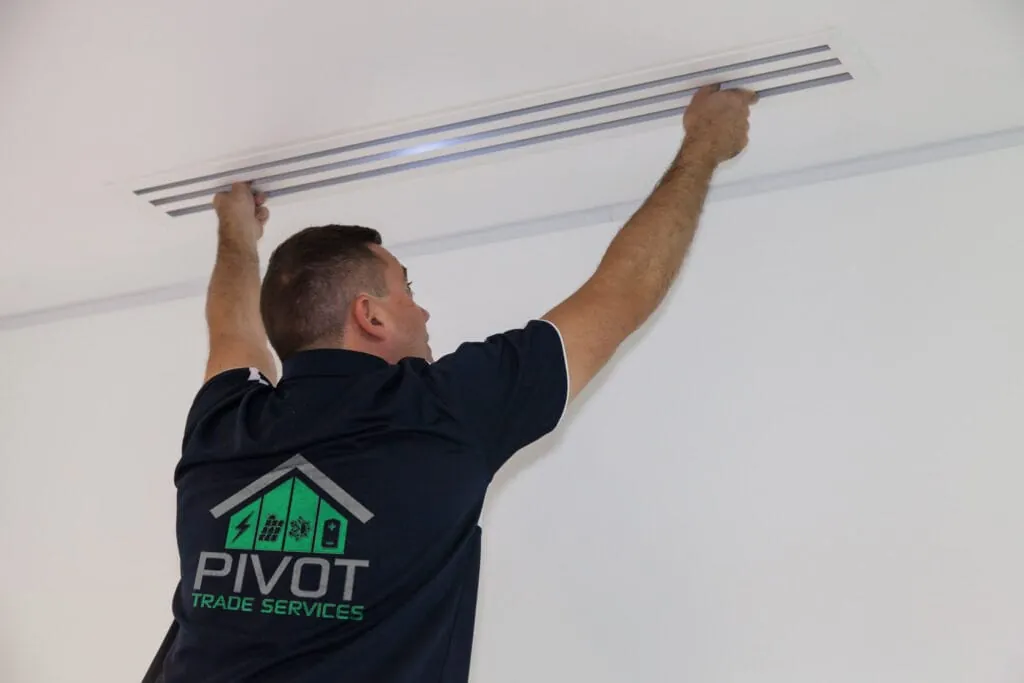
Fitting a linear diffuser on a ducted changeover 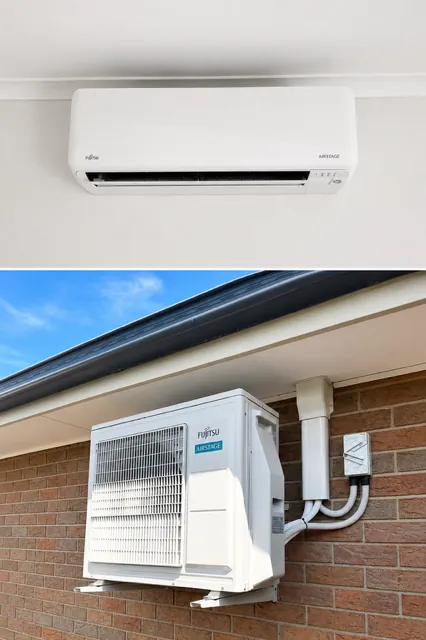
The indoor head and the outdoor unit that runs it 
Multi-head systems share one outdoor unit 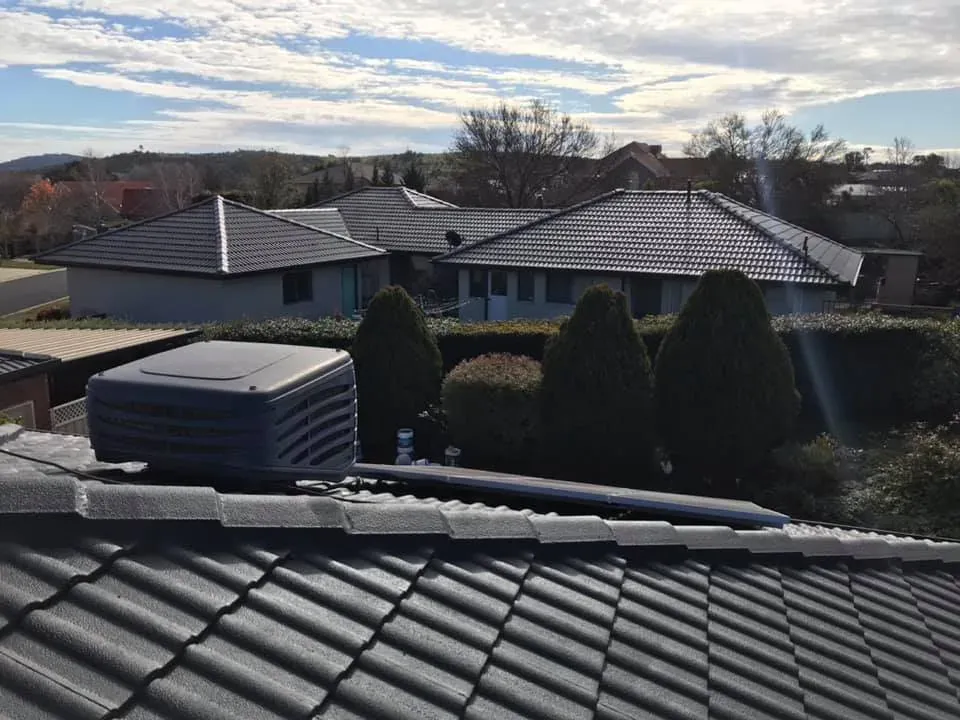
Evaporative units live on the roof, so access matters
Photographs from our own jobs. No two switchboards, roofs or run lengths are the same, which is why we quote in writing after seeing yours.
Licensed and accredited work by a local team. Read about Pivot Trade Services or see recent jobs across the western suburbs.
Answers
Frequently asked questions
It depends on room volume, glazing, orientation, insulation and occupancy, not floor area alone. A west-facing open plan area with large windows can need close to double the capacity of a shaded, well insulated room of identical size. We calculate it on site, because guessing produces either short cycling or a unit that never keeps up.
In Melbourne it can be, for dry heat, and it is cheap to run because it is essentially a fan and a water pump. The limitations are real though. It needs windows open to work, it becomes ineffective in humid conditions, and it provides no heating. Many households pair it with reverse cycle splits rather than choosing between them.
Sometimes, but not automatically. Ductwork sized for gas ducted heating is often too small for the airflow refrigerated systems need, and old flexible duct in a roof space is frequently crushed, disconnected or leaking. We inspect it before quoting. Reusing bad ductwork undermines the efficiency of the equipment you just bought.
If you are installing ducted, yes. Without zoning you condition the entire house every time you want one room comfortable, which is where ducted running costs get their reputation. Zoning needs to be designed with the duct layout rather than added on, and there are minimum airflow requirements that limit how few zones can run at once.
Almost always a blocked condensate drain. The indoor coil condenses moisture out of the air, and that water has to drain away. Dust, mould or an insect nest in the drain line backs it up into the tray and then into your wall. It is a common service item and much cheaper to clear than to repair the water damage.
Filters need cleaning or replacing several times a year depending on use and dust levels, and that is something most people can do themselves. A full service, covering coil cleaning, drain clearing, electrical checks and refrigerant pressures, is worth booking annually before summer for ducted systems and every year or two for splits.
Yes. Modern inverter systems maintain useful output well below Melbourne’s minimum temperatures, and capacity ratings quoted at low ambient temperatures are what to compare when shopping. Efficiency falls as it gets colder, but even at reduced performance the system moves considerably more heat energy than the electricity it consumes.
Yes, and it needs planning. Upper floors run hotter, pipe runs are longer, and outdoor unit placement is more constrained. Options include separate systems per floor, a zoned ducted system with proper airflow balancing, or multi-head splits. What we avoid is one undersized system trying to condition both levels through a single thermostat.
Get a fixed quote on hvac heating & cooling
Tell us what you need and we will give you a written price, not a range that moves on the day.
- Free
- On-site quotes
- Fixed
- Written pricing
- 100%
- Workmanship guarantee
- 5.0★
- 69 Google reviews