
Solar on the roof, a battery going in and a car to charge
Electrician in Point Cook
Point Cook is where we most often do the whole stack. Solar already on the roof from the original build or an early upgrade, a battery going in, and an EV charger that has to share a single-phase supply with both. The estate housing is modern, the boards are generally compliant, and the interesting engineering is in capacity rather than safety.
- Point Cook 3030
- Powercor network
- REC 37223
The short answer
Pivot Trade Services is a licensed electrician serving Point Cook 3030 under REC 37223 and SAA accreditation S3962281, twelve kilometres from our Altona base. We install EV chargers, solar, batteries, heat pump hot water, ducted and split systems, and we handle switchboard work. Point Cook is on the Powercor network, and because so many homes here already have solar and an EV, the usual question is spare supply capacity rather than compliance.
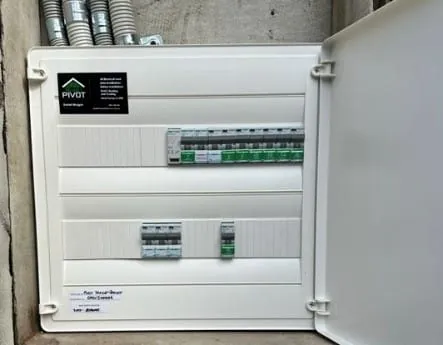
From one of our jobs
Every circuit labelled before we hand it back
Photographed on site in Melbourne’s west. REC 37223.
That is the opposite of most suburbs we cover. In Newport or Seaholme the first job is making the installation safe. In Point Cook the first job is working out how much headroom the supply actually has, and what has to be managed so that three large loads can coexist without tripping the main switch on a hot Saturday.
Modern boards, and the question that replaces compliance
Homes built here from the early 2000s onward generally have RCD protection and a properly built board. There are exceptions, and we still check, but for most Point Cook addresses the safety conversation is short.
The real question is what is left. A modern estate board can still be physically full after solar, a second air conditioner and a spa circuit have been added. It can also be perfectly fine on space while the main switch and consumer mains have very little headroom for another continuous load. Those are two different problems with two different answers, and the site check separates them.
Spare ways
Physical room for the next device. Cheap to solve, and often the only thing standing between you and a charger.
Main switch and mains capacity
A 32A charger running for hours is a different proposition to an oven that peaks for ten minutes.
Existing solar circuits
An inverter already on the board changes how a battery and charger are arranged, so we plan all three together where we can.
Complex roofs make solar a design job
Point Cook roofs are modern hip-and-valley tile with multiple orientations and short unbroken runs. Many homes have limited eaves and tight setbacks, and plenty are double-storey. That is a harder design than a broad single-storey roof in Hoppers Crossing, even though the houses are newer.
It means panel layout has to be modelled properly across several faces, and it often means a mix of orientations with the inverter configured to suit. A 6.6kW system remains $4,500 to $8,500 before STCs and roughly $3,000 to $6,000 after, but two Point Cook houses on the same street can support quite different array sizes depending on how the roof is broken up. Where an existing system is already up, we work around it rather than pretending it is not there.
Three big loads on one supply
Solar, a battery and an EV charger on a single-phase supply is the standard Point Cook combination, and it is the one that needs thought. A 10kWh battery is $8,000 to $12,000 before rebates and around $5,500 to $9,500 after. A single-phase 7kW charger is $1,200 to $2,200. Individually neither is difficult. Together, on a house that also runs ducted cooling in February, the supply is the constraint.
The tool for that is load management. A current transformer on the main supply lets the charger back off automatically when the house demand rises, instead of the main switch tripping at dinner time. It costs a few hundred dollars and it is far cheaper than a supply upgrade. A smart charger can also be set to take surplus solar rather than grid, which is worth having when a car sits at home during the day.
Load management device
Lets a full 32A charger coexist with a house that occasionally draws hard, without a supply upgrade.
Solar-aware charging
A current transformer lets the charger track export and put surplus generation into the car instead of the grid.
Battery backup circuits
Decide early which circuits stay live in an outage, because it changes how the board is arranged during installation.
Order of works
Board, then solar, then hot water and heating, then battery, then charger, is usually the cheapest sequence.
Double-storey homes and how they get conditioned
A lot of Point Cook housing is two storeys with an integrated garage, which pushes heating and cooling toward ducted or multi-head systems rather than a single split. Upstairs bedrooms get hot in a way that a downstairs living room split will never fix.
Ducted works where there is roof space and a run that can reach the upper floor. Where it cannot, a multi-head system with an outdoor unit serving several rooms is usually the better answer, and it avoids four separate condensers on a tight side setback. A split system installed is $2,500 to $7,500 depending on capacity and pipe run, and on a double-storey home the pipe run is a real part of that number.
Twelve kilometres out, and how we book it
Point Cook is twelve kilometres from our workshop in Altona, out past Laverton and the RAAF Williams boundary. That is a planned trip rather than a five-minute one, and we are straight about it: we book Point Cook work with a time window and we get there, but we do not claim to be around the corner.
What we do bring is one contractor across the whole job. The solar, the battery, the charger and the board work are the same licensed team under REC 37223 and SAA S3962281, so nobody is pricing around somebody else’s installation, and the 100% workmanship guarantee covers all of it.
On the ground
What we see in Point Cook homes
- Compliant modern boards that are physically full, so the next addition needs the enclosure reworked rather than the protection upgraded.
- Original builder solar that was sized to a rebate rather than the household, now sitting alongside an EV that uses more than the system makes.
- Hip-and-valley roofs where the usable panel area is much smaller than the roof footprint suggests.
- Single-phase supplies being asked to run ducted cooling, a battery and a 32A charger at the same time.
- Tight side setbacks that limit where a second outdoor condenser can physically go.
Licensed and accredited work by a local team. Read about Pivot Trade Services or see recent jobs across the western suburbs.
Answers
Point Cook questions
Usually yes, and Point Cook is where we do this most often. The existing inverter determines whether a battery pairs with it directly or needs its own hybrid or AC-coupled arrangement. The charger is a separate circuit either way. We look at the board, the inverter model and your consumption data together, because the right battery size depends on what you actually use after dark rather than on the array size.
Often yes, with load management. A current transformer on the main supply lets the charger reduce its draw automatically when the house demand climbs, so a hot evening with the ducted running does not trip the main switch. That is a few hundred dollars and avoids a supply upgrade in most cases. Where the supply is genuinely marginal, we will tell you before you buy the charger.
Roof geometry, almost certainly. Point Cook roofs are hip-and-valley with multiple faces and short unbroken runs, and two houses on the same street can differ a lot in usable panel area. Setbacks, eaves, skylights and existing equipment all reduce it further. We design to the roof you have rather than quoting a headline system size and then discovering it does not fit on installation day.
It depends on whether the ductwork can reach the upper floor properly. Where roof space and riser access allow it, ducted conditions the whole house evenly and is the better long-term answer. Where it cannot, a multi-head system serving several rooms from one outdoor unit is usually better than four separate splits, particularly given how tight the side setbacks are on estate blocks.
Twelve kilometres. Our workshop is at 11/23-25 Jordan Close, Altona 3018, so Point Cook is a planned run rather than a two-minute one. We book it with a time window and we turn up in it. For a full solar, battery and charger package that is not an issue, because the job is scheduled anyway. For an urgent fault, Altona and Laverton customers will always be closer than you are and we would rather say so.
Powercor, as the distributor for this area. Export limits and approval conditions vary by location and by what is already connected on your part of the network, so the answer is not the same for every address. We lodge the application, deal with the conditions that come back, and configure the inverter accordingly rather than leaving you to chase it.
Other work we do in Point Cook
- Solar installation in Point CookEstate roofs, EVs and second systems
- Home battery in Point CookThe suburb where the full stack happens
- EV charger in Point CookWhere the charger has to share the house with solar and a battery
- Split system in Point CookDouble storey estate homes and the upstairs problem
- Heat pump hot water in Point CookAdding one more load to an already busy switchboard
Get a Point Cook quote
Tell us the address and what you need. We quote Point Cook 3030 and the surrounding western suburbs in writing, with no obligation.
- Free
- On-site quotes
- Fixed
- Written pricing
- 100%
- Workmanship guarantee
- 5.0★
- 69 Google reviews