
Sixty years of building, and a hill that changes the spec
Electrician in Highton
Highton was rural until the mid 1950s and has been building ever since. That gives it the most orderly housing profile in the region: 1960s brick veneer through the older streets near Highton Village, 1970s and 80s through the middle, and current construction on the north west edge toward Wandana Heights.
- Highton 3216
- Powercor network
- REC 37223
The short answer
Pivot Trade Services is a licensed electrician working in Highton 3216 under REC 37223, about 65km from our Altona workshop. We cover switchboards, safety switches, fault finding, power points, lighting, smoke alarms, solar, batteries and EV charging. Highton is on the Powercor network. Because it has been built continuously since the late 1950s, the switchboard age here tracks the build year more reliably than anywhere else in Geelong, and the elevated Barrabool Hills position makes wind loading a real design input.
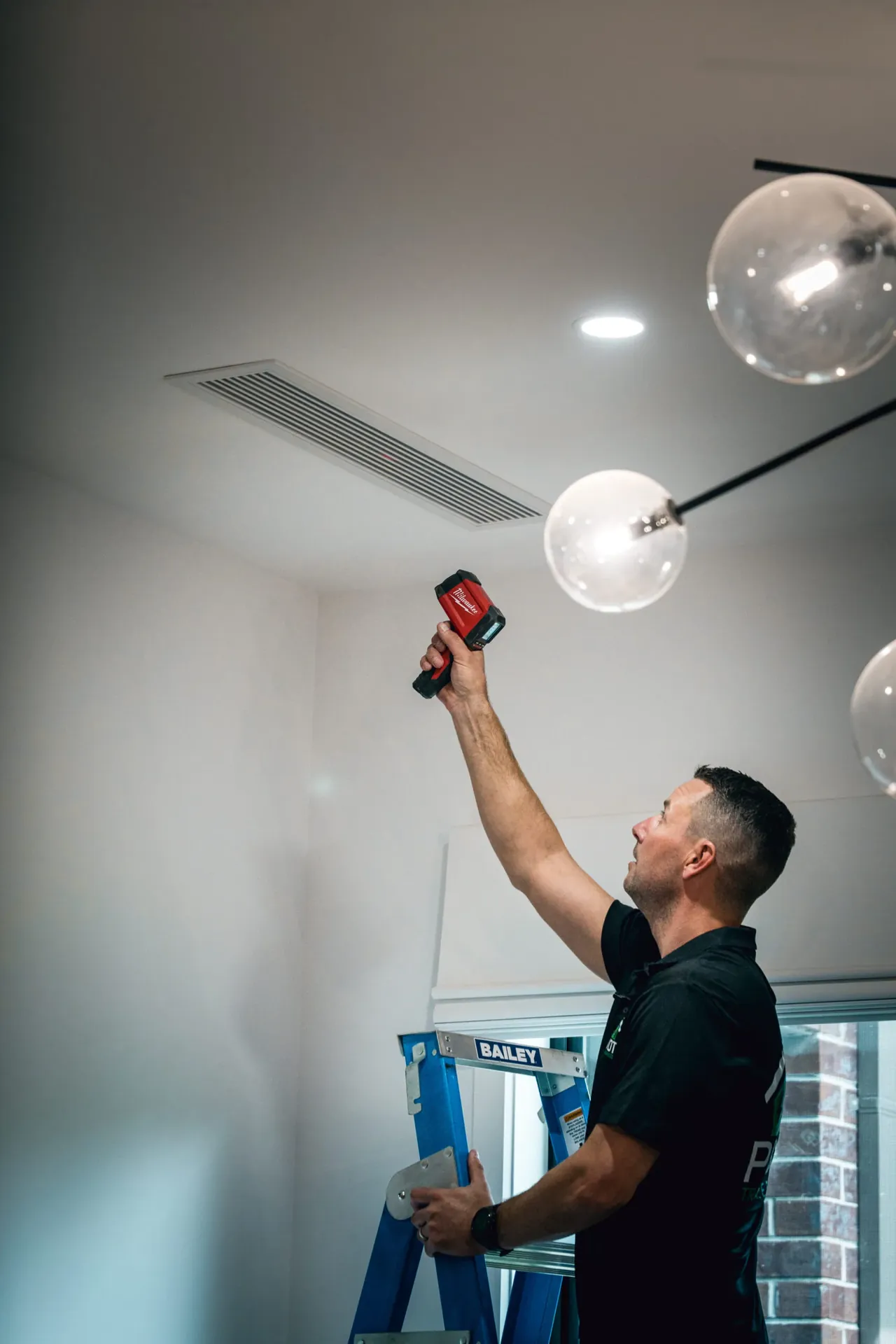
From one of our jobs
Pendant lighting and a ducted return in one visit
Photographed on site in Melbourne’s west. REC 37223.
For an electrician that is genuinely useful. In most suburbs you open the board and find out. In Highton the build year tells you most of what you need to know before you get there, which makes it easier to have a sensible conversation about cost before the site visit rather than after it.
The board age tracks the build year
A 1960s Highton house near Barrabool Road usually has original protection or an early upgrade, and often no RCDs at all. A 1980s house typically has breakers and a partial safety switch retrofit. Anything from the 2000s on has a compliant board with RCBOs and the question becomes spare capacity rather than safety.
That means the first conversation is short. An RCBO refit into a sound enclosure starts around $800 and a full replacement runs toward $3,500, and we can usually tell you which end of that range you are at from the decade of the house, then confirm it when the board is open.
1960s stock
Original boards and missing RCD protection are common, so protection comes before anything that adds load.
1980s stock
Breakers but partial safety switch coverage, which is the most common half measure we find in Highton.
Post 2000 stock
Compliant boards where the real question is how many spare ways are left for a charger or a heat pump.
Wind on the escarpment, and why the mounting spec changes
The elevation that gives Highton its views and its solar yield also makes it windier than the flat suburbs down on the plain. Wind loading on roof mounted equipment is a design input here rather than a formality, and the mounting hardware we would use in a sheltered Norlane street is not what we would use on an exposed Barrabool Hills roof.
That covers rail specification, fastener type and spacing, and how far a panel row is allowed to sit from the roof edge, where uplift is worst. It costs a little more per kilowatt. It is considerably cheaper than a service call after a strong north westerly.
Rail and fixing spec
Chosen for the actual exposure of the roof, not the same bill of materials used on every job.
Edge setbacks
Uplift is worst at the roof perimeter, so the layout keeps rows back from the edges on exposed sites.
Antenna and outdoor gear
Masts, conduit saddles and enclosure lids all take the same wind, and they are specified accordingly.
Long runs from the street to the meter position
Houses on the escarpment often sit well back or well above the street, and the run from the point of supply to the meter position can be long. That single measurement is the biggest cost variable on a supply upgrade in Highton, and it also affects voltage drop on anything drawing hard at the far end of the property.
We measure it rather than estimate it. Where a supply upgrade would be expensive because of the distance, it is worth checking whether load management or a rebalanced board gets you what you actually need for less, particularly if the goal is an EV charger rather than a workshop.
Voltage drop
Long runs to an elevated house make cable size a calculation rather than a default, especially with a continuous load on the end.
Supply upgrade cost
Driven by the distance from the street and what has to be crossed to get there, so it is quoted after a measurement.
Cheaper alternatives
Load management can avoid a supply upgrade entirely where the constraint is peak draw rather than total capacity.
Solar numbers that beat the Geelong average
Highton sits high with concrete tile and Colorbond hips at 20 to 25 degrees and very little overshadowing from neighbours, which is close to ideal. A 6.6kW system is typically $4,500 to $8,500 before STCs and roughly $3,000 to $6,000 after, and on a standard Highton roof it goes on without the constraints you get in the heritage streets.
A 10kWh battery on top of that runs $8,000 to $12,000 before rebates and around $5,500 to $9,500 after. On the newer north west subdivisions the garages run to the boundary and access tightens, which affects where an inverter and battery can be mounted, so we look at the wall space as well as the roof.
Little neighbour shading
The elevated blocks are the reason Highton yields are usually better than the flat suburbs, and it shows in the modelling.
Battery siting
Garage wall space on the newer subdivisions is tighter than it looks once the door tracks and shelving are accounted for.
Export approval
Powercor is the distributor across Geelong and our own area, so the connection application is familiar paperwork.
Sixty five kilometres, booked as planned work
Our workshop is in Altona, about 65km from Highton. There is no same day attendance from that distance and we do not pretend otherwise. Geelong work goes in the diary in blocks, several jobs on one run, and you get told the week rather than an hour on a specific morning.
For the work Highton actually needs, board upgrades, solar, batteries, chargers and additional circuits, that is planned work anyway. We do the site check properly, measure the runs that matter on a hillside block, and hold electrical under REC 37223 and solar under SAA S3962281 with a 100% workmanship guarantee.
Measured quotes
On an escarpment block the run lengths are the price, so they are measured rather than guessed from an aerial view.
Grouped trips
Booking Highton work alongside other Geelong jobs keeps the travel out of the quote.
One contractor
Board, solar, battery and charger under the same licences, so the sequence of works is somebody’s actual responsibility.
On the ground
What we see in Highton homes
- Switchboard vintage that lines up with the build year street by street, from 1960s original boards near Highton Village to current RCBO boards on the north west edge.
- Roof mounted equipment on exposed Barrabool Hills blocks where standard mounting hardware is not the right specification.
- Long runs from the street to the meter position on houses set high or well back from the road.
- Newer subdivisions where the garage runs to the boundary, leaving a narrow access path and limited wall space for an inverter and battery.
Licensed and accredited work by a local team. Read about Pivot Trade Services or see recent jobs across the western suburbs.
Answers
Highton questions
It changes two things. The yield is usually better than the Geelong average because there is very little overshadowing from neighbours at that elevation. The mounting specification also has to account for higher wind exposure, which means different rail and fastener choices and keeping panel rows back from the roof edge where uplift is worst. Same panels, different hardware underneath them.
In Highton, roughly yes, which is unusual. The suburb has been built continuously since the late 1950s so the board vintage tracks the build year closely. A 1960s house near Barrabool Road usually needs protection brought up to standard. A 2000s house on the north west edge usually just needs spare ways checked. We still open the board before pricing, but the starting estimate is better here than most places.
Distance from the street to the meter position, most likely. Escarpment houses in Highton often sit high or well back, and that run is the single biggest variable on an upgrade. It also affects cable sizing because of voltage drop. Before committing, it is worth checking whether load management solves the real problem, which is often peak demand rather than total capacity.
It depends on the decade. In a 1960s or 70s Highton house it is usually the board, which has neither spare ways nor RCD protection on the existing circuits. In post 2000 housing it is more often the run length from the board to where you park. A single phase 7kW charger is typically $1,200 to $2,200 installed, with the cable route being the main variable here.
No. We work from Altona, about 65km away, and we book Geelong region jobs in blocks with a week given rather than an hour. That suits planned work, which is nearly everything Highton needs. If you have a live fault this evening, call someone based in Geelong. We would rather turn the job down than give you an arrival time we cannot hold.
We do. Powercor is the distributor for Highton and for our own area, so the connection application, export limit conditions and any meter exchange follow a process we lodge regularly. We submit it, deal with whatever conditions come back and configure the inverter to match, rather than leaving you between the retailer and the distributor.
Other work we do in Highton
- Solar installation in HightonThe best yield in Geelong, and the most wind
- Home battery in HightonGood generation, long cable runs
- EV charger in HightonThe build year decides the board, and the board decides the price
- Split system in HightonElevated, windier, and the sizing follows the view
- Heat pump hot water in HightonBoard vintage tracks the build year here
Get a Highton quote
Tell us the address and what you need. We quote Highton 3216 and the surrounding western suburbs in writing, with no obligation.
- Free
- On-site quotes
- Fixed
- Written pricing
- 100%
- Workmanship guarantee
- 5.0★
- 69 Google reviews