
Rebates & incentives · Updated 3 August 2026
Heat Pump Hot Water Rebates in Victoria (2026 Guide)
Three separate incentives can apply to the same heat pump hot water system in Victoria, and stacked they commonly total $3,000 or more. Here is how each one works and what you actually pay.
- 9 min read
- Written for Victoria
- 2026 figures
The short answer
Victorian households replacing a hot water system with a heat pump can commonly access combined rebates of $3,000 or more. Solar Homes contributes up to $1,000, or up to $1,400 for a locally made product, Victorian Energy Upgrades applies a discount directly to the invoice, and federal STCs are worth roughly $300 to $600. A system costs $3,000 to $4,500 supplied and installed before incentives, leaving most households paying a few hundred dollars up to about $1,500.
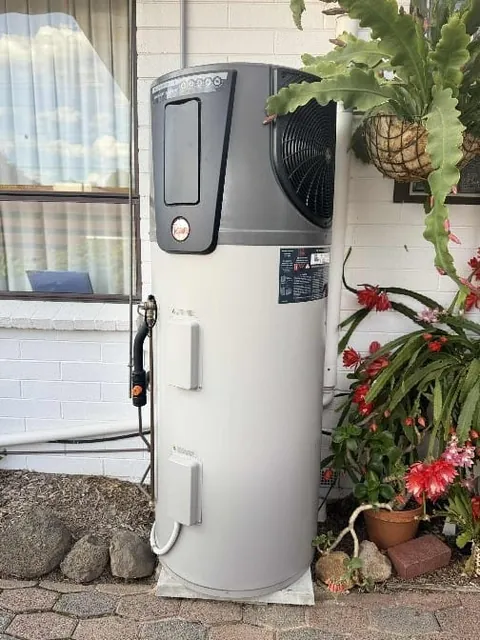
From one of our jobs
Same footprint, roughly a third of the running cost
Photographed on site in Melbourne’s west. REC 37223.
- Combined rebates
- $3,000 or more
- Solar Homes
- Up to $1,000 - $1,400
- Federal STCs
- $300 - $600
- Installed before rebates
- $3,000 - $4,500
- Typical out of pocket
- A few hundred to $1,500
Why hot water attracts so much support
Hot water is usually the second largest energy use in a house after heating, and on an old electric storage tank it is often the largest single item on the bill. A heat pump does the same job using roughly one third the energy of conventional electric storage, because it moves heat from the outside air into the tank rather than making heat with an element.
That combination of high consumption and a well proven replacement is exactly what incentive programs are designed for. It is the reason hot water currently carries more layered support than any other single appliance swap available to a Victorian household, and why the installed price and the price you actually pay look so different.
The three incentives, and how they differ
These are separate programs with separate rules, separate administrators and separate eligibility. They are not one rebate with three names, and in most cases they can be used on the same job.
Solar Victoria Solar Homes hot water rebate
Up to $1,000, or up to $1,400 for a locally made product. Applied for through Solar Victoria and subject to eligibility criteria including a combined household income cap of $150,000 from 1 July 2026.
Victorian Energy Upgrades (VEU)
Not a rebate you claim. It is an upfront discount applied directly to your installation invoice, with no income test. The value varies with the certificate market rather than being a fixed figure.
Federal small scale technology certificates (STCs)
Worth roughly $300 to $600 on a domestic system. Normally assigned to the installer and taken off the price rather than paid to you as cash.
What the numbers look like in practice
A heat pump hot water system supplied and installed costs $3,000 to $4,500 before incentives, depending on tank size, brand and how much work the changeover involves. Once the three incentives are applied, the amount most Victorian households actually pay lands somewhere between a few hundred dollars and about $1,500.
The spread within that range comes from which incentives you qualify for and what the certificate market is doing at the time. A household that qualifies for the locally made Solar Homes amount, on a property old enough for VEU, buying a system with a good STC value, will be at the bottom of that range. A household that misses the income cap will be nearer the top.
| Item | Detail | Amount |
|---|---|---|
| Supplied and installed | Typical domestic system before incentives | $3,000 - $4,500 |
| Solar Homes rebate | Up to $1,400 for a locally made product | Up to $1,000 - $1,400 |
| Victorian Energy Upgrades | Discount applied directly to the invoice | Varies with certificate market |
| Federal STCs | Assigned to installer, deducted from price | $300 - $600 |
| Typical amount payable | After stacking available incentives | A few hundred up to $1,500 |
Combined support commonly totals $3,000 or more. VEU carries a minimum customer contribution of $200 including GST. All amounts are confirmed in writing at quote rather than assumed, because the VEU component moves with the certificate market.
The eligibility rules that catch people out
The rules are not complicated but they are different for each program, and the mistake people make is assuming that qualifying for one means qualifying for all three.
Solar Homes carries a combined household income cap of $150,000 from 1 July 2026. That is combined, not individual, and it is the criterion that most commonly rules a household out of the Solar Homes portion while leaving the other two available.
Victorian Energy Upgrades has no income test at all, which makes it the most broadly available of the three. What it does require is that the property is at least two years old, and it carries a minimum customer contribution of $200 including GST. That contribution is deliberate: the program is designed so the customer always pays something toward the work rather than receiving it for nothing.
Federal STCs apply broadly and are tied to the equipment and the installation rather than to your income. They are the least conditional of the three and, in practice, the one you are least likely to need to think about, because the installer normally handles the assignment and simply shows the deduction on your price.
Why the VEU amount is never quoted as a fixed number
This is the part that causes the most confusion. Victorian Energy Upgrades works through certificates that are created when an eligible upgrade is installed and then traded. The value of those certificates moves with the market, which means the discount applied to your invoice this month may not be the same as the one applied three months ago.
Any contractor quoting you a precise, guaranteed VEU figure a long way in advance is telling you something they cannot actually control. The honest approach is to confirm the current amount in writing at the time of quote, which is what we do. The program was also commencing 30 September 2026, which is another reason to work from a current written figure rather than a number someone remembers from last year.
Getting the most out of the system once it is in
The rebates make the purchase cheap. The running cost is where the ongoing benefit sits, and a couple of settings make a real difference to it.
The first is the timer. Set the unit to heat in the early afternoon rather than overnight. That runs the compressor in the warmest air of the day, which is when a heat pump is most efficient, and on a home with solar it means the tank absorbs generation that would otherwise be exported for a few cents. Feed-in rates are low enough now that this is close to free hot water.
The second is sizing. A heat pump reheats more slowly than a gas instantaneous unit, so a tank that is too small shows up as the last person in the morning getting a cold shower. As a general guide, 170 to 220 litres suits one or two people, 250 to 280 litres suits three or four, and 300 litres or more suits five or more. Size for the busiest morning rather than the average one.
The third is placement, which is not a running cost issue but is the thing people complain about. A heat pump has a compressor and a fan. Sited under a bedroom window or hard against a narrow boundary it will be heard. Sited sensibly, with clear airflow and the discharge pointed away from windows, it is a non issue.
How the process actually runs
The sequence matters because two of the three incentives have to be dealt with before the work rather than after it. A quote should already carry the VEU discount and the STC deduction on its face, so the number you are looking at is what you will pay, not a headline price with paperwork to follow.
On site, the assessment covers the existing system, the tank position, where a heat pump can physically sit with clear airflow, the condition of the switchboard, and whether a dedicated circuit and isolator can be added compliantly. That last point is the one that most often changes a quote, particularly on older homes with fuse boards or boards without RCD protection.
On the day, a straightforward like for like changeover on an existing slab is usually a single day. Add a switchboard upgrade, a new base or a relocation to a different part of the property and it can run into a second day. A Certificate of Electrical Safety is issued for the electrical work on completion.
Choosing an installer for rebate work
Incentive programs only pay out on work done by accredited installers using approved products, which narrows the field. It also means that a very cheap quote is sometimes cheap because the product or the installer sits outside the program, in which case the rebates you were counting on will not materialise.
The questions worth asking are direct. Is the product on the approved list for each program you are claiming. Is the discount shown on the quote or promised verbally. Who lodges what, and when. What happens if the certificate value moves between quote and installation. A contractor who cannot answer those cleanly is not a contractor you want handling a claim.
Pivot Trade Services holds REC 37223 and SAA accreditation S3962281, ABN 87 689 296 937, and installs across Melbourne west from our workshop in Altona. Every installation carries a 100% workmanship guarantee on top of the manufacturer warranty, and the net figure after incentives goes on the quote in writing.
Figures in this guide are indicative and were accurate at the time of writing (3 August 2026). Rebate values, eligibility rules and certificate-linked discounts change regularly. Confirm current amounts with the program administrator, and treat your written quote as the accurate figure for your property.
Answers
Frequently asked questions
Combined support commonly totals $3,000 or more once Solar Homes, Victorian Energy Upgrades and federal STCs are stacked on the same job. Against a supplied and installed cost of $3,000 to $4,500, that leaves most households paying from a few hundred dollars up to about $1,500.
In many cases yes, but they have different rules. Solar Homes has a combined household income cap of $150,000 from 1 July 2026. VEU has no income test but requires the property to be at least two years old and carries a minimum customer contribution of $200 including GST. STCs are federal and apply broadly. We check all three against your circumstances and show the net figure.
Because VEU is an upfront invoice discount funded by certificates whose value moves with the market, not a fixed government payment. The honest approach is to confirm the current amount in writing at quote. The program was also commencing 30 September 2026, so an old number is not a reliable guide.
A rebate is something you or your installer claims, often after the work, through a program such as Solar Homes. An invoice discount, which is how VEU works, comes off the price before you pay it, so there is nothing to claim afterwards and no waiting period. STCs sit in between: they are usually assigned to the installer and appear as a deduction on your price.
A heat pump uses roughly one third the energy of conventional electric storage for the same hot water. The exact saving depends on your household usage, your tariff and whether you shift the heating cycle into a solar generation window. For a household currently running an old element tank, it is usually the largest single appliance saving available.
The combined household income, and the cap is $150,000 from 1 July 2026. That is the criterion that most commonly rules people out of the Solar Homes portion. Importantly, it does not affect Victorian Energy Upgrades, which has no income test, so a household over the cap can still access an invoice discount and STCs.
It depends on the program and on who is applying. VEU is tied to the property being at least two years old rather than to the occupier income, which makes it the more commonly available one on tenanted properties. Solar Homes has separate rental provisions and criteria. We work through which applies to your situation before quoting.
Browse every cost, rebate and comparison guide in the Pivot guides library, or claim the $60 off your first job voucher.
Want this priced for your place?
Tell us what you need and we will give you a written price, not a range that moves on the day.
- Free
- On-site quotes
- Fixed
- Written pricing
- 100%
- Workmanship guarantee
- 5.0★
- 69 Google reviews