
Cost guides · Updated 3 August 2026
EV Charger Installation Cost in Melbourne (2026 Guide)
A single-phase 7kW home charger installed in Melbourne runs $1,200 to $2,200. Three-phase is $2,500 to $3,000 plus, and a switchboard upgrade can add $800 to $2,500 on top.
- 8 min read
- Written for Victoria
- 2026 figures
The short answer
A home EV charger installed in Melbourne costs $1,200 to $2,200 for a single-phase 7kW unit, which is the right choice for most households. A three-phase 22kW capable installation runs $2,500 to $3,000 or more. If the switchboard needs upgrading to accommodate the new circuit, add $800 to $2,500. A 7.4kW charger adds roughly 40 to 50 kilometres of range per hour of charging, which fills most daily driving overnight.
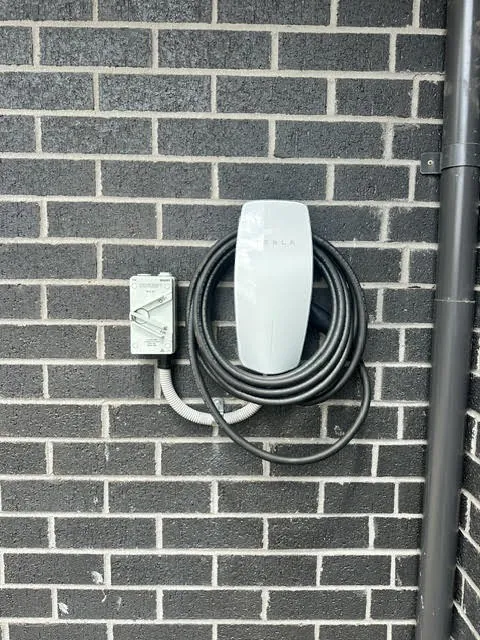
From one of our jobs
A tethered charger, wired back to its own circuit
Photographed on site in Melbourne’s west. REC 37223.
- Single-phase 7kW installed
- $1,200 - $2,200
- Three-phase 22kW capable
- $2,500 - $3,000+
- Switchboard upgrade if needed
- +$800 - $2,500
- Range added at 7.4kW
- 40 - 50km per hour
What you are actually paying for
A home charger installation is three things: the charger itself, a dedicated circuit from the switchboard to wherever the car parks, and the labour and compliance work to connect it safely. The charger is the part people compare online. The circuit is the part that makes two quotes on the same street differ by $600.
Every home charger needs its own dedicated circuit with appropriate protection. It cannot share a circuit with anything else, and it cannot run off a standard outlet as a permanent arrangement. That circuit has to physically get from the board to the parking position, and how far that is, and what it has to pass through on the way, is the single largest variable in the price.
Single-phase or three-phase
A single-phase 7kW charger installed runs $1,200 to $2,200 and suits the large majority of Melbourne homes. At 7.4kW you add roughly 40 to 50 kilometres of range per hour, so an overnight charge comfortably covers typical daily driving several times over. For a household that drives 40 to 60 kilometres a day, the car is full again in a bit over an hour.
A three-phase 22kW capable installation runs $2,500 to $3,000 or more. It is worth considering if the property already has three phase supply, if there are two electric vehicles sharing one charger, or if the driving pattern involves long distances with short windows to recharge. It is not worth paying to bring three phase into a house solely to charge one car faster than you need to, and many vehicles cannot accept 22kW AC anyway.
Single-phase 7kW
The default for most homes. $1,200 to $2,200 installed, roughly 40 to 50km of range per hour at 7.4kW.
Three-phase 22kW capable
$2,500 to $3,000 plus. Makes sense where three phase already exists, or with two vehicles sharing a charger.
Check the car, not just the charger
Many vehicles are limited on AC charging regardless of what the wall unit can supply. Faster hardware does not always mean faster charging.
Load management
Where switchboard capacity is tight, a charger that can throttle to suit available supply is often cheaper than upgrading the supply.
When a switchboard upgrade is needed
This is the line item that surprises people, and it is the reason we look at the board before quoting rather than after. If the switchboard has no spare capacity, no space for the new protective device, or is an older board without RCD protection, it has to be dealt with before a charger circuit can go in. That adds $800 to $2,500 depending on the scope.
It is not wasted money. A board that can take a charger can generally also take the next thing, whether that is a heat pump, an induction cooktop or a battery inverter. Doing it once, sized for what you expect to add, is materially cheaper than modifying the same board three times. That is the most common avoidable cost we see in this category.
| Item | Typical cost |
|---|---|
| Single-phase 7kW charger, supplied and installed | $1,200 - $2,200 |
| Three-phase 22kW capable installation | $2,500 - $3,000+ |
| Switchboard upgrade, if required | +$800 - $2,500 |
Figures assume a residential installation with a reasonable cable run. The distance from the switchboard to the parking position is the largest single variable in the final price.
The five cost drivers
If you want to predict roughly where in the range your quote will land before anyone visits, these are the things to look at.
Cable run distance
The biggest single driver. A charger on the wall directly behind the meter box is cheap. A detached rear garage thirty metres away, with a trench or a conduit run, is not.
Single-phase or three-phase
Three phase means more conductors, larger protective devices and more labour, which is most of the difference between the two price ranges.
Spare switchboard capacity
A modern board with spare ways adds almost nothing. A full or dated board means an upgrade before the charger circuit exists at all.
Charger features
Load management, solar diversion, app control, RFID and integrated cable versus socket all change the hardware cost. Some of those features pay for themselves, some do not.
Mounting style
A wall mount on a solid surface near the board is the simple case. A pedestal mount in a carport or driveway needs a base, a conduit run and more labour.
Charging on your own solar
With feed-in tariffs where they are, exported solar is worth very little, so charging the car from your own generation is one of the better uses of a rooftop array. A number of chargers can do this automatically, following available surplus and modulating the charge rate to match.
Whether that feature is worth paying for depends on your driving pattern. If the car is home during the day, solar diversion is genuinely valuable. If the car leaves at 7am and returns at 6pm every weekday, it will spend most of its charging hours on grid power regardless of what the charger can do, and a simpler unit on a timer may serve you just as well.
Compliance, and what you should receive
A permanently connected EV charger is prescribed electrical work in Victoria. It must be installed by a licensed electrician and a Registered Electrical Contractor must issue a Certificate of Electrical Safety. If a quote does not mention that certificate, ask why.
Your distributor may also need to be notified of the new load, and in some cases will have requirements about load management. That is normal and it is the installer job to handle it rather than yours. Pivot Trade Services holds REC 37223 and SAA accreditation S3962281, and every installation carries a 100% workmanship guarantee on top of the manufacturer warranty on the charger.
Where to put the charger
Position drives cost more than any other decision you make, so it is worth thinking about before you get quotes rather than after. The cheapest position is on a wall close to the switchboard, on the same side of the building, with a clear path for the cable.
From there the cost climbs in predictable steps. Going around the building adds cable. Going through a roof space or under a floor adds labour. Crossing a driveway to a detached garage adds a trench or a conduit run and can double the cable cost on its own. A pedestal in the middle of an open driveway adds a base, a conduit and the labour to install both.
The other consideration is which side the car charges from and how it parks. A charger on the wrong side of the garage means the cable stretched across the bonnet every night, which people tolerate for about a fortnight. Walk the parking position with the electrician and work out where the cable actually needs to reach.
Wall near the board
The cheapest outcome by a clear margin. Short cable run, simple mounting, minimal labour.
Opposite side of the house
Adds cable and labour, often through a roof space or around the perimeter. Still straightforward, just longer.
Detached garage
Usually the most expensive residential case because of the trench or conduit run and the sub-main work involved.
Pedestal mount
Needed where there is no suitable wall. Adds a base, conduit and labour on top of the charger cost.
Keeping the cost down without cutting corners
The two reliable savings are position and planning. Choosing a charger location close to the board, even if it is slightly less convenient than the ideal spot, is usually worth several hundred dollars. And telling the electrician what else you plan to add over the next few years means the board gets designed once rather than modified repeatedly.
Load management is the other one worth knowing about. Where switchboard or supply capacity is tight, a charger that can throttle its output to suit what is available is often considerably cheaper than upgrading the supply to accommodate full output you would rarely use. For a car that sits at home for ten hours overnight, a slightly slower charge rate makes no practical difference.
What is not worth saving on is the circuit itself. Undersized cable, shared circuits and improvised arrangements are how charging installations become problems, and a charger draws a sustained high load for hours at a time, which is precisely the condition that finds weaknesses in an installation.
Free download
The Melbourne Home EV Charger Buyer's Guide
What a charger actually costs, how to tell whether you need three phase, and the six questions that separate a real quote from a cheap one. Four pages, no email required.
PDF · 4 pages · 2026 edition
Figures in this guide are indicative and were accurate at the time of writing (3 August 2026). Rebate values, eligibility rules and certificate-linked discounts change regularly. Confirm current amounts with the program administrator, and treat your written quote as the accurate figure for your property.
Answers
Frequently asked questions
A single-phase 7kW charger supplied and installed runs $1,200 to $2,200, which covers most homes. A three-phase 22kW capable installation is $2,500 to $3,000 or more. If the switchboard needs upgrading to take the new circuit, that adds $800 to $2,500 on top.
For almost every household, yes. At 7.4kW you add roughly 40 to 50 kilometres of range per hour, so a typical day of driving is replaced in about an hour and a half, and an overnight charge fills the battery several times over what most people use. Faster charging mainly helps if you drive long distances with short windows to recharge.
Only if you already have it, or you have a genuine reason such as two vehicles sharing a charger. Installing three phase purely to charge one car faster is rarely good value, and many vehicles cannot accept 22kW on AC anyway, so the extra capability sits unused.
Because a charger needs its own dedicated circuit with appropriate protection, and if the board has no spare capacity, no physical room, or lacks RCD protection, it cannot provide that. Depending on scope that is $800 to $2,500. It also usually covers you for the next appliance, so it is worth sizing it for what you expect to add rather than for the charger alone.
The portable lead that ships with most vehicles is intended as an occasional or travel option, not a permanent daily charging arrangement. It charges slowly and it puts a sustained load on an outlet that was not designed for it. A dedicated wall charger on its own circuit is both faster and the correct way to do it.
Many chargers can follow your surplus generation and modulate the charge rate to match, which is worth having if the car is home during the day. If the car is out from 7am to 6pm on weekdays it will mostly charge on grid power regardless, and a simpler unit on a timer may suit you better.
Yes. Installing a permanently connected charger is prescribed electrical work in Victoria and a Registered Electrical Contractor must issue a Certificate of Electrical Safety. Your electricity distributor may also need to be notified of the new load. Both are the installer responsibility, and both should be mentioned on your quote.
Browse every cost, rebate and comparison guide in the Pivot guides library, or claim the $60 off your first job voucher.
Want this priced for your place?
Tell us what you need and we will give you a written price, not a range that moves on the day.
- Free
- On-site quotes
- Fixed
- Written pricing
- 100%
- Workmanship guarantee
- 5.0★
- 69 Google reviews