
Compliance · Updated 6 August 2026
Gas Hot Water Replacement Rules in Victoria from 1 March 2027
From 1 March 2027, Victorian electrification standards require an existing home replacing an end of life gas hot water system to put in an efficient electric system instead. It is a replacement rule, not a forced early upgrade. This is what that means for your house, in plain terms.
- 11 min read
- Written for Victoria
- 2026 figures
The short answer
From 1 March 2027, Victorian electrification standards require an existing home replacing an end of life gas hot water system to install an efficient electric system instead, according to solar.vic.gov.au. The rule applies at replacement, not as a forced early upgrade, so a working gas unit can stay. Most households choose heat pump hot water, which uses roughly one third of the electricity of conventional electric storage and costs $3,000 to $4,500 installed before incentives.
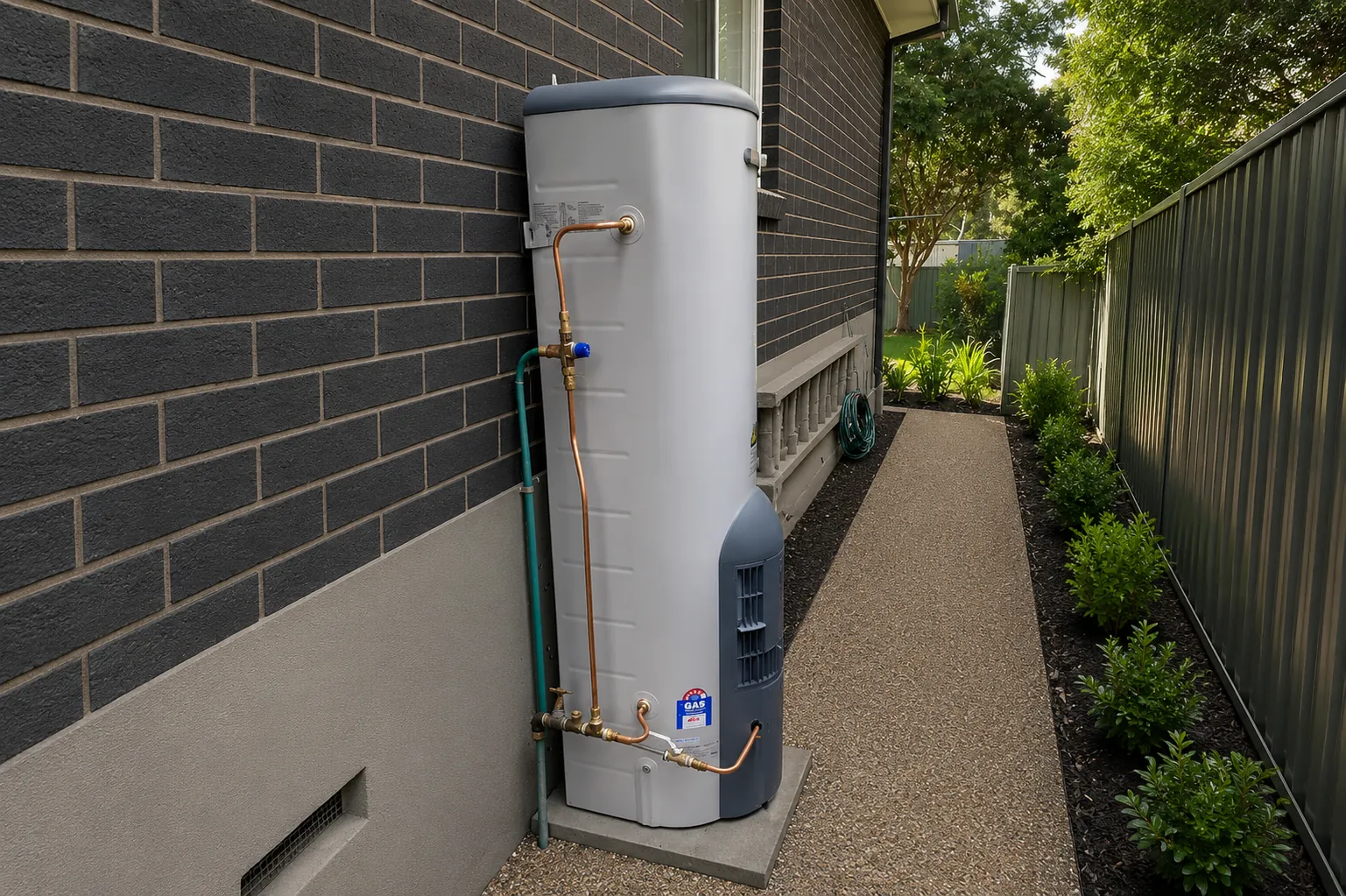
- Rule commences
- 1 March 2027
- Heat pump electricity use
- About one third of electric storage
- Heat pump installed cost
- $3,000 - $4,500 before incentives
- Solar Homes hot water rebate
- Up to $1,000 - $1,400
What the standard actually requires, and when
The short version. From 1 March 2027, Victorian electrification standards require an existing home replacing an end of life gas hot water system to install an efficient electric system in its place. That is the whole rule as it affects a household, and Solar Victoria publishes the current position at solar.vic.gov.au.
Notice what is being described. It is a rule about what goes in when something comes out, triggered by a replacement, and the replacement is triggered by the old unit reaching the end of its life. Nobody is being sent a letter with a deadline to remove working equipment. If your tank is running properly on 2 March 2027, it can keep running.
The confusion comes from two places. A date attached to gas gets repeated without the condition attached to it, so 1 March 2027 travels around as though it were a switch off date. And people selling hot water systems have an interest in a homeowner feeling rushed.
What the rule changes is the decision you make on the day the old unit fails. Before it, a failed gas unit was usually replaced with another gas unit. After it, the replacement has to be efficient electric. So the effect is not that you must act now. It is that a choice you were going to make in a hurry has been made for you, which is a good reason to think about it while you still have hot water.
One caveat before anything else. Standards, program values and eligibility change, sometimes at short notice. Confirm the current requirements with the program administrator, and treat your written quote as the accurate figure rather than a website, including this one.
What "end of life" means in practice
This is the phrase that decides whether the rule touches you, and it is less mysterious than it sounds. End of life is not a birthday. It is the point where the unit is no longer worth repairing, or cannot be repaired.
In the field it looks like one of a handful of things. A tank rusted through and weeping from the base or the seams, which is terminal. A gas control valve failed on a unit old enough that the part is no longer supplied. A cracked heat exchanger on an instantaneous unit. Or a repair quote large enough that spending it means throwing money at a tank with two years left in it.
Age is a guide rather than the test. Gas storage tanks typically last around ten to fifteen years in Melbourne, and instantaneous units often go longer. Hard water, full afternoon sun, salt air near the bay and an anode nobody has ever replaced all shorten that. If your unit is in its second decade, the decision can arrive without warning.
The signal to watch is not one dramatic failure. It is the pattern. Water that runs lukewarm before it runs cold. A relief valve dripping more than it used to. Rust staining on the slab. A pilot that needs relighting. A plumber saying "I can get you another year out of it" for the second time. That is when to plan the electric replacement rather than the next repair.
Planning it, or having it happen to you
There are two ways this goes, and the difference is worth real money.
In the planned version you decide in autumn that the tank is on borrowed time. We work out where a heat pump can physically sit, check whether the switchboard can take another dedicated circuit, confirm which incentives apply, and put a fixed price in writing. You choose a unit on merit, the job is booked for a weekday, and you have hot water the whole time bar the few hours of the changeover.
In the unplanned version the tank splits on a Saturday night with four people in the house. On Sunday, availability decides everything. Whatever unit is on a truck Monday, in whatever position it can be made to fit, with whatever electrical work has to be done on the spot. Nobody is comparing running costs, they are solving a problem.
The gap between those outcomes is not a small premium. It is unit choice, position, electrical scope, and whether the incentive stack was assembled properly or partly missed. If your unit is over ten years old, have the conversation before the tank makes the decision for you. If it has already failed, call us, and where there is a genuine electrical emergency our emergency service covers the western suburbs.
The three electric options, honestly compared
Efficient electric hot water in an existing Victorian home comes down to three broad choices. They are not equivalent, and the right one depends on household size, roof, space and how you use hot water.
A heat pump is the default for most houses, and not because it is fashionable. It works like a refrigerator in reverse, moving heat out of the outside air into the tank rather than generating it with an element, which is why it uses roughly one third of the electricity of conventional electric storage. Supplied and installed it runs $3,000 to $4,500 before incentives, and after the incentives stack most households pay from a few hundred dollars up to about $1,500.
Conventional electric storage is still right in some houses. It is simple, silent, and it fits where a heat pump will not. What it costs you is running cost, roughly three times the electricity for the same output, which over a decade is usually the more expensive decision unless you have solar.
Solar boosted means pairing hot water with generation on the roof, usually panels running a heat pump or an element on a daytime timer, so much of the heating happens on power you would otherwise export for very little. If you are weighing electric against another gas unit on running cost, our heat pump versus gas comparison puts the numbers side by side.
| Option | How it works | Where it suits | Typical cost before incentives |
|---|---|---|---|
| Heat pump hot water | Moves heat from the outside air into the tank, using roughly one third of the electricity of conventional electric storage | Most houses with an outdoor position that has airflow and is not hard against a bedroom wall | $3,000 - $4,500 supplied and installed |
| Electric storage | Heats water with an element in an insulated tank. Simple, silent, more electricity for the same output | Tight spaces, indoor cupboards, small households, homes with solar and daytime heating | Quoted per property, lower up front and higher to run |
| Solar boosted | Solar generation carries a large share of the heating, with a heat pump or element doing the rest | Homes with an existing array, or panels going on at the same time | Quoted per property, depends on the existing solar and inverter |
| Switchboard work where the board cannot take another circuit | Ordinary electrical work, not covered by any hot water incentive | Older boards with no spare ways, no RCD protection or ceramic fuses | $800 - $3,500+ |
Costs are indicative and incentive values move. Confirm current program values and eligibility with the program administrator, and treat the written quote as the accurate figure.
What the changeover physically involves
This part gets skipped in most explanations of the 2027 rule, and it decides whether the job goes smoothly. Gas to electric hot water is not a like for like swap. A gas unit needed a gas line and a flue. An electric unit needs a circuit, and depending on type, somewhere for condensate to go.
It is also work across more than one licence class. The electrical side is prescribed electrical work, so a licensed electrician has to do it and issue a Certificate of Electrical Safety. Refrigerant work on a heat pump requires an ARC licence. Gas work requires a licensed gasfitter, a different licence class again. A contractor who is vague about which of those they hold is telling you something.
A dedicated circuit and isolator
Its own final subcircuit back to the board, correctly sized, with RCD protection and isolation at the unit. It does not share with power points. On older homes around Yarraville and Footscray this is where the cost sits, because the board often has no spare way. Read the switchboard upgrade cost guide before you budget.
The tempering valve
Water to bathroom outlets has to be tempered to a safe temperature while the tank stores hotter than that. Older installations sometimes have no valve, or one so old it no longer regulates. It gets renewed as part of a compliant changeover rather than reused on faith.
A slab, a stand or a bracket
A heat pump is heavier than the gas unit it replaces and has to sit level on something that will still be level in ten years. That means a new pad, a proper stand, or a wall bracket where the ground is unsuitable. A cracked old pad is how you get a leaning tank.
Drainage and condensate
A heat pump produces condensate whenever it runs, and it has to be piped somewhere legitimate rather than left to run down the wall or pool against the footings. Tank relief drainage matters too. This is the most common thing done badly on cheap changeovers.
Placement, clearances and noise
The compressor makes noise, much of it low frequency, and it often runs at night. Manufacturers specify clearances for airflow, and a unit boxed into a narrow side passage will underperform and complain about it. Keep it away from bedroom windows and off the boundary.
The old unit and the gas point
The gas unit is disconnected and removed, and the gas point capped by a licensed gasfitter. If hot water was your last gas appliance, that is the moment to decide whether you keep paying a daily supply charge, and whether the cooktop is next.
How the incentives stack today, and why waiting rarely helps
Hot water is the most heavily supported appliance replacement available to a Victorian household, because three programs land on the same job. That is why the net cost of a heat pump ends up so far below list price.
Victorian Energy Upgrades applies a discount directly to the installation invoice rather than paying you afterwards. There is no income test, the property must be at least two years old, and the minimum customer contribution is $200 including GST. We do not publish a dollar figure for the hot water discount, because it is not a fixed government payment. It is funded by certificates created for your activity and sold into a live market, so the value moves with that market and with the product. It is confirmed in writing at quote.
Solar Homes adds up to $1,000 for heat pump hot water, or up to $1,400 for a locally made product. From 1 July 2026 it carries a combined household income cap of $150,000, the property must be under $3 million, the existing system must be at least three years old, and it is one rebate per address. Federal STCs take off roughly another $300 to $600, declining each year as the deeming period shortens. The arithmetic is worked through in the heat pump hot water rebate guide, and all four programs are mapped in the Victorian energy rebates guide.
On why waiting usually costs more. Every one of these programs has stepped down or tightened rather than grown. VEU air conditioning changes commence on 30 September 2026, with a 20kW abatement cap and a co-payment of $3,000 for ducted and larger multi-splits and $1,000 for smaller ones. The Solar Homes income cap tightened on 1 July 2026. STC value shrinks annually by design. A household hoping the offer improves is betting against the pattern.
All of it needs confirming when you commit. The program is documented at energy.vic.gov.au.
Lead times, and what a queue looks like
What a compliance date does to a trade is bunch up demand. We have seen it with every dated program change: a quiet stretch, a rush in the weeks before, then a period where nothing can be booked quickly at any price.
A planned changeover is usually a one day job, and the wait is normally product availability and a weekday slot. What extends it is the work around the unit. A board upgrade is separate scope with its own lead time. A concrete pad has to cure. A gasfitter to cap the point is a third party in the schedule. Rebate paperwork runs before installation, not after.
The practical advice is unglamorous. If your gas unit is over ten years old, get it assessed and quoted in the twelve months before you need it, and keep the quote. Knowing the position, the circuit and the number means that on the day the tank fails, you make a phone call rather than a decision.
Who should not rush
Most guides on this subject only have one gear, which is urgency. Here is the honest counterweight. Some households should not move early, and a contractor who cannot say so is selling rather than advising.
Your gas unit is only a few years old
The rule is triggered by end of life, not by a date. Scrapping a five year old unit that works in order to comply early throws away most of its service life for nothing. Replace it when it dies and spend the money on insulation instead.
You are about to renovate
If the kitchen, bathroom or laundry is being reworked within a year or two, the tank position, the circuit route and the switchboard scope all change. Doing hot water now and the renovation later often means paying for the same electrical work twice.
The property is about to be sold
A replacement you will not own is somebody else next decision. Disclose the age of the unit honestly and let the buyer make the call with the current rules in front of them.
The house has bigger electrical problems
If there are ceramic fuses, no RCD protection or rubber insulated wiring, hot water is not the first thing to fix. Have the whole installation assessed, because a rewire changes the order of operations and the budget.
Nobody has told you where the unit will go
If a quote does not say where the heat pump will sit, what the clearances are and where condensate drains to, it is not a quote yet. Slow down until it is. That is the one thing that cannot be fixed afterwards.
How we handle a gas to electric hot water changeover
We assess the job rather than the appliance. The existing unit and what failed, the position and clearances available, the drainage and condensate path, the tempering valve, the base, switchboard capacity and whether a new circuit needs board work first, and which incentive programs you genuinely qualify for. Then you get one fixed written price with the discounts on the face of it and the net amount payable underneath.
The trade boundaries are stated up front. Electrical work is done under our REC with a Certificate of Electrical Safety issued on completion. Refrigerant work is done under ARC accreditation. Gas work, including capping the redundant gas point, is done by a licensed gasfitter, which we coordinate rather than perform. It appears as a separate line.
Pivot Trade Services is a licensed electrical, solar and HVAC contractor at 11/23-25 Jordan Close, Altona VIC 3018, holding REC 37223, SAA accreditation S3962281 and ABN 87 689 296 937. Lead electrician Dan Morgan. We hold 5.0 from 69 Google reviews and every installation carries a 100% workmanship guarantee on top of the manufacturer warranty. To get your unit assessed before it decides for you, contact us or call 0401 500 446 or 1300 748 688.
And once more, because it matters more here than on most pages. Standards, program values, product lists and eligibility criteria change. Confirm the current requirements and numbers with the program administrator, and treat your written quote as the accurate figure.
Figures in this guide are indicative and were accurate at the time of writing (6 August 2026). Rebate values, eligibility rules and certificate-linked discounts change regularly. Confirm current amounts with the program administrator, and treat your written quote as the accurate figure for your property.
Answers
Frequently asked questions
No. The standard applies when an existing home replaces an end of life gas hot water system, not on a fixed date to everyone. A gas unit that is working can stay in service. What changes is the replacement decision when it does fail, which is why it is worth planning the electric option while you still have hot water.
The point where the unit cannot be economically repaired. A rusted through tank, a cracked heat exchanger, a failed gas control valve on a unit whose parts are no longer supplied, or a repair quote approaching the cost of a new system. Age is a guide rather than the test, though gas storage tanks in Melbourne typically last around ten to fifteen years.
From 1 March 2027 the electrification standards require an existing home replacing an end of life gas system to install an efficient electric system instead. Before that date, other options remain. Because requirements can change, confirm the current position with the program administrator before ordering anything rather than relying on a summary, including this one.
Cheapest up front is usually conventional electric storage, but cheapest over the life of the system is generally a heat pump, because it uses roughly one third of the electricity for the same hot water and attracts more incentive support. On a ten year view the heat pump normally wins even though its list price is higher.
Supplied and installed a heat pump runs $3,000 to $4,500 before incentives. Once Victorian Energy Upgrades, Solar Homes and federal STCs are stacked, most households pay from a few hundred dollars up to about $1,500. Any switchboard work needed to add the circuit is separate and not covered by the incentives, at $800 to $3,500 or more.
It needs both, plus a gasfitter. The new unit requires a dedicated circuit and isolator, which is prescribed electrical work only a licensed electrician can do, finishing with a Certificate of Electrical Safety. Refrigerant work on a heat pump requires an ARC licence. Capping the redundant gas point requires a licensed gasfitter, a different licence class again, which we coordinate rather than perform.
It can if it is badly placed. The compressor makes noise, much of it low frequency, and it often runs overnight. Placed with the manufacturer clearances, away from bedroom windows and off the boundary line, it is generally unremarkable. Boxed into a narrow side passage against a neighbour wall, it is a problem you cannot fix without moving it.
The pattern has been the other way. The Solar Homes income cap tightened on 1 July 2026, VEU air conditioning changes commence on 30 September 2026, and STC value declines each year as the deeming period shortens. We track the dated changes in the rebate deadlines guide, but nobody can promise a future value, so confirm the current one with the administrator.
Related guides
- Heat Pump Hot Water Rebates in Victoria (2026 Guide)9 min read
- Heat Pump vs Gas Hot Water (2026): Which Should You Install?9 min read
- Victorian Energy Rebates: The Complete 2026 Guide11 min read
- Victorian Energy Rebate Deadlines and Timing, 2026-279 min read
- Switchboard Upgrade Cost in Melbourne (2026 Guide)8 min read
Browse every cost, rebate and comparison guide in the Pivot guides library, or claim the $60 off your first job voucher.
Want this priced for your place?
Tell us what you need and we will give you a written price, not a range that moves on the day.
- Free
- On-site quotes
- Fixed
- Written pricing
- 100%
- Workmanship guarantee
- 5.0★
- 69 Google reviews