
Untangling which circuit came from which decade
Electrician in Yarraville
Yarraville cottages have usually been renovated at least twice. An extension in the eighties, a kitchen in the two thousands, a bathroom since. Each round added circuits, and most of them went back to the same board without anyone removing what was superseded.
- Yarraville 3013
- Jemena network
- REC 37223
The short answer
Pivot Trade Services is a licensed electrician working in Yarraville 3013 under REC 37223, nine kilometres from our Altona workshop. We cover switchboards, rewiring, lighting, power points, fault finding, solar, EV chargers and air conditioning. Yarraville is on the Jemena network, and its heavily renovated Victorian and Edwardian cottages typically carry two or three layers of wiring from different decades sharing one board, which is what makes fault finding here slower than the job looks.
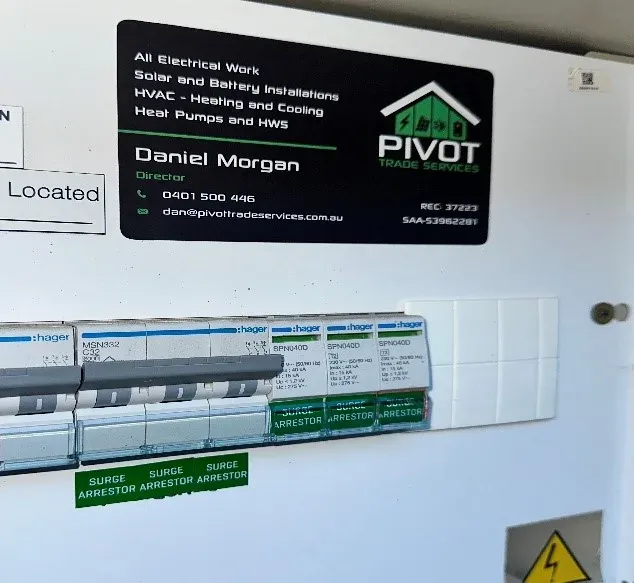
From one of our jobs
Whole-of-home surge protection at the board
Photographed on site in Melbourne’s west. REC 37223.
So our first job in a Yarraville house is normally forensic rather than physical. Work out which circuit came from which decade, what is still live, what is abandoned in a wall cavity, and what is actually feeding the rear extension. Only then does adding a charger, a cooktop or a split system become a sensible conversation.
Layered wiring, and why it slows a fault call down
A cottage that has been renovated in stages ends up with wiring from several eras sharing one installation. Original rubber or early PVC on the front rooms, eighties cable through the extension, and modern cable in the kitchen and bathroom. They meet at the board, often at the same terminal.
That is why a fault call in Yarraville can take longer than the same symptom in a newer suburb. A circuit labelled kitchen may also feed a bedroom light and an outdoor outlet, because that is what was convenient in 1994. We map what is actually there before we start changing things, and where a board is being upgraded we take the opportunity to split the circuits sensibly rather than reproducing the tangle in a new enclosure.
Circuit mapping
Identifying what each circuit really feeds is worth an hour on its own, and it makes every later job cheaper.
Abandoned cable
Superseded circuits left live in a cavity are common here and should be disconnected properly rather than left dead-ended.
Split at the board
A board upgrade is the natural moment to separate overloaded legacy circuits into properly grouped ones.
The rear extension is usually where the solar goes
A Yarraville cottage presents a small original roof plane at the front, often steep, often facing the wrong way and often overlooked by a neighbouring two-storey. The large flat or skillion roof over the rear extension is frequently the only usable solar surface on the property.
That changes system sizing and mounting. Flat and low-pitch roofs need tilt frames or a layout that accepts a lower yield, and the available area on an extension is finite. A 6.6kW system is $4,500 to $8,500 before STCs and roughly $3,000 to $6,000 after, and on many Yarraville cottages the roof supports less than that. We design to the plane that exists and are upfront when the numbers do not justify it.
No side clearance, and what that costs
Yarraville blocks are narrow and the gap between the house and the fence is often too tight to work in, or blocked by an extension that used the full width. There is frequently no continuous roof space from front to back either, because the original roof and the extension roof do not join usefully.
The result is that a run from a front-of-house board to the back of the property has to be planned rather than assumed. Under the floor, over the original roof and down at the junction, or in conduit around the outside, are the usual candidates. We choose the route at the quote stage. That is the difference between a fixed price that holds and a quote that grows once the work starts.
Downlights, dimmers and the renovation hangover
Renovated Yarraville cottages are full of downlights, and a good proportion of them are old halogen fittings with transformers still sitting in the ceiling space. Halogens run at around 50W each and get hot enough to be a genuine fire risk where insulation has crept over them. Swapping to LED at $80 to $200 per light cuts the load by roughly eighty per cent and removes the heat.
The part that gets skipped is the transformers. Each halogen fitting had one in the roof space and it has to come out, not be left disconnected on the plaster. The other common leftover is a leading edge dimmer trying to control LEDs, which is why the lights buzz or flicker at low level. That is a dimmer and driver mismatch, and replacing the dimmer usually fixes it.
Transformers removed
If a quote is unusually cheap per light, ask directly whether the old transformers are being taken out of the ceiling.
Insulation clearance
Only fittings rated for insulation contact can be covered. Halogens almost never are.
Dimmer matching
LED dimming needs a dimmer matched to the driver, otherwise you get flicker and unreliable starting.
Charging an EV in a street-parking suburb
Most Yarraville cottages have no driveway. Parking is on the street, in a rear laneway, or in a garage reached from the back. That makes EV charging a conversation before it is a quote.
Where there is off-street space, a 7kW single-phase charger is $1,200 to $2,200 and the cable run to the rear of a narrow block is what decides where in that range you land. Where parking is genuinely on-street, a home charger is not the right purchase, and we would rather tell you that than install something you can only use when the space out front happens to be free.
On the ground
What we see in Yarraville homes
- Two or three generations of wiring meeting at the same switchboard terminal, with labelling that describes none of it accurately.
- Circuits that cross rooms in ways that only made sense during a particular renovation, which is why fault finding takes longer here.
- Halogen downlights with transformers still sitting in the roof space above ceiling insulation.
- Rear extension roofs carrying all of the usable solar area while the original front roof carries none.
- Superseded cable left live in a wall cavity after a renovation, terminating nowhere useful.
Licensed and accredited work by a local team. Read about Pivot Trade Services or see recent jobs across the western suburbs.
Answers
Yarraville questions
Because the installation is not documented and rarely logical. In a Yarraville cottage that has been renovated twice, one circuit can feed rooms in three different parts of the house, and the board labelling usually reflects an arrangement that changed years ago. Before we can isolate a fault we have to establish what actually connects to what. Hourly rates run $90 to $160 with a call-out of $60 to $120.
Often, using the rear extension. On most Yarraville cottages the flat or skillion roof over the extension is the only genuinely usable plane, and it can carry a modest system on tilt frames or a low-pitch layout. The area is limited, so the system will usually be smaller than a standard suburban install. We model the actual planes and shading and tell you if the result is not worth the money.
Almost always a dimmer mismatch. Older leading edge dimmers were built for the large load of halogen lamps and cannot control the tiny load of an LED driver smoothly. The fix is a trailing edge or LED-specific dimmer matched to the fittings, and occasionally a minimum load device. It is a small job. If your ceiling still has the old halogen transformers up there as well, that is worth dealing with at the same time.
It changes the route, and the route is most of the price on any job involving new cable. Narrow Yarraville blocks often have no workable side access and no continuous roof space between the original house and the extension. That means going under the floor, staging the run in two parts, or using discreet surface conduit. We decide which at the quote, so the number does not move later.
Not really, and we will say so. A wall charger only works where the car reliably sits on your own property. Running a lead across a footpath is neither compliant nor safe. If you have a rear garage or off-street space, a charger makes sense at $1,200 to $2,200 for a single-phase 7kW unit. If you do not, the money is better spent elsewhere in the house.
Jemena is the distributor for Yarraville 3013, which matters for solar approvals, export limits and meter exchanges. Our workshop is nine kilometres away at 11/23-25 Jordan Close, Altona. Yarraville is booked work with a time window, and everything is certified under REC 37223 with a 100% workmanship guarantee.
Other work we do in Yarraville
- Solar installation in YarravilleThe array usually goes on the extension
- Home battery in YarravilleNarrow blocks, careful planning
- EV charger in YarravilleCottage blocks, no side clearance, and a real parking conversation
- Split system in YarravilleTwo different houses under one roof line
- Heat pump hot water in YarravilleCottages that have been renovated at least twice
Get a Yarraville quote
Tell us the address and what you need. We quote Yarraville 3013 and the surrounding western suburbs in writing, with no obligation.
- Free
- On-site quotes
- Fixed
- Written pricing
- 100%
- Workmanship guarantee
- 5.0★
- 69 Google reviews