
Rebates & incentives · Updated 3 August 2026
Solar Battery Rebate in Victoria (2026 Guide)
The federal battery discount is the main support available on home storage in Victoria. It scales with usable capacity, it shrinks every year, and it only applies to batteries that can join a virtual power plant.
- 9 min read
- Written for Victoria
- 2026 figures
The short answer
Home battery support in Victoria in 2026 comes from the federal Cheaper Home Batteries program, which started in July 2025 and reduces the up-front cost of an installed battery. The discount scales with the usable kilowatt hours of the battery and declines each year, so the same product attracts less support the longer you wait. The battery must be capable of joining a virtual power plant. A 10kWh battery installed costs from about $5,500 after rebates.
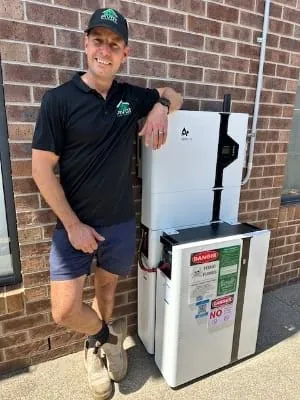
From one of our jobs
A finished battery and inverter install
Photographed on site in Melbourne’s west. REC 37223.
- Program started
- July 2025
- Discount basis
- Per usable kWh, falling yearly
- 10kWh battery installed
- From about $5,500
- Battery requirement
- Must be VPP capable
What the Cheaper Home Batteries program is
The federal Cheaper Home Batteries program started in July 2025 and it is the main reason home storage arithmetic changed. Before it, a battery was an expensive way to buy resilience and a slow way to buy savings. With it, an installed battery is priced within reach of a normal household budget rather than being a premium add-on.
It is a federal program, not a Victorian one, which means it sits outside Solar Homes and outside Victorian Energy Upgrades entirely. There is no state income cap on it and no two year property age test. What matters instead is the battery itself, its usable capacity, and whether the installation meets the program requirements.
Mechanically it behaves like STCs on a solar system. The discount is handled by the accredited installer and taken off the installed price, so you do not lodge anything and you do not wait for a payment. What you see is a lower number on the quote. That is also why quoted battery prices vary so much between suppliers, because some advertise before the discount and some after.
How the discount scales with usable kWh
The program does not pay a flat amount per battery. It scales with usable capacity, which is the sensible design choice, because a 5kWh battery and a 20kWh battery do very different amounts of work and displace very different amounts of grid electricity.
The word that matters in that sentence is usable. Batteries are advertised on nominal or total capacity, but a portion of that is reserved and never cycled in order to protect the cells and the warranty. The usable figure is the one the program cares about and the one that determines what your battery actually does for you each evening. Two products advertised at the same headline size can have meaningfully different usable capacity.
The practical effect is that a larger battery attracts a larger discount, but not a better outcome by default. Support scaling with size does not make an oversized battery a good purchase. A battery earns its keep by filling with surplus generation during the day and emptying into evening consumption at night. Capacity that never fills, or never empties, is capacity you paid for and do not use.
We will not publish a figure per kilowatt hour, because the rate has an annual step down built into it and program parameters can change. Ask for the current rate and the resulting discount to be shown as a line on your quote against the specific product being offered.
Why the value declines every year
This is the single most important thing to understand about timing. The support available per kilowatt hour is designed to reduce annually. The program is intended to accelerate a market, not to subsidise it permanently, so the incentive tapers as installed volumes grow and product prices fall.
That produces a genuine timing consideration rather than a sales tactic. If you have already decided that storage suits your household, waiting a year means the same battery attracts less support. If you have not decided, waiting a year also means product prices may have moved and you will have another year of real consumption data to size against. Those two pull in opposite directions, and which one wins depends on how confident you are in the decision.
What is not a good reason to buy is urgency manufactured by a salesperson. A battery bought this month at the wrong size for the household is worse value than a battery bought next year at the right size, regardless of what happened to the discount in between.
| Element | How it works |
|---|---|
| Federal discount | Scales with usable kWh, applied by the installer to the installed price, declines each year |
| VPP capability | The battery must be capable of joining a virtual power plant, whether or not you enrol |
| Usable capacity | The program and your evening savings both run off usable kWh, not the advertised headline size |
| Installed price, 10kWh | From about $5,500 after rebates for a quality installed system |
| Existing solar | Retrofit to an existing array is common. The inverter arrangement determines the work involved |
The program started in July 2025 and the discount rate steps down annually. Confirm the current rate and your eligibility before committing. The written quote, showing the discount as a line item against the specific product, is the accurate figure.
The VPP capability requirement
To attract the discount, a battery has to be capable of joining a virtual power plant. A virtual power plant is a fleet of home batteries coordinated by an operator, so that thousands of small systems can respond together when the grid needs support. The point of the requirement is that publicly subsidised storage should be able to contribute to grid stability rather than sitting idle behind a meter.
Capable is the operative word. The requirement is about what the battery can do, not about signing you up to something. You are not obliged to enrol in a VPP program to receive the discount. What you cannot do is buy a battery that is technically incapable of participating and expect it to qualify.
Whether you should join a VPP later is a separate decision with real trade-offs. Enrolling typically pays you for allowing the operator to discharge your battery at times of grid stress, which means some evenings your stored energy leaves rather than serving your house. For a household that values backup and self-sufficiency, that is a genuine cost. For a household chasing return, the payments can be worth it. Decide it on its own merits after the battery is in, not as a condition of buying one.
How it works with an existing solar system
Most batteries we install go onto homes that already have panels, and that retrofit is straightforward far more often than people expect. What determines the work is the inverter arrangement.
Some existing inverters can be paired with a compatible battery directly. In other cases the battery comes with its own inverter and runs alongside the existing one, which is usually the simpler retrofit and avoids replacing equipment that is working perfectly well. Replacing a healthy solar inverter purely to suit a battery brand is rarely the right call, and it is worth pushing back if a quote proposes it without explaining why.
The other half of the assessment is your data. A battery pays by storing surplus daytime generation and releasing it into evening consumption. If your array is small, or the household is out all day and uses little power at night, there may not be enough surplus to fill it or enough evening load to empty it. Twelve months of interval data from your retailer answers that question far better than any rule of thumb. The is a battery worth it in Melbourne west guide works through the arithmetic.
If you do not have panels yet, the sensible order is usually solar first, load shifting second, storage third. A quality 6.6kW system in Melbourne costs about $4,500 to $6,500 before incentives and roughly $3,000 to $5,000 after federal STCs, which is set out in the solar rebates guide.
What actually drives the payback
The discount lowers the purchase price once. What repays a battery over time is the gap between what you would pay to import electricity in the evening and what you would have received for exporting that same energy at midday.
That gap has widened, which is why storage stacks up better than it used to. Export value has fallen substantially, and the feed-in tariff guide explains what changed. Every kilowatt hour you store rather than export is worth the difference between those two numbers, every day the battery cycles.
That is also why the households that do best from storage are the ones with meaningful evening consumption. Electric hot water on a timer, a heat pump tank, reverse cycle heating in winter and an EV charger all give a battery something to do. A household with a small array and low evening use will not cycle a battery hard enough for the numbers to work, no matter what the discount was.
Homes across Altona, Williamstown, Point Cook and Hoppers Crossing sit right across that spectrum, which is why we ask for consumption data before recommending a size rather than after.
Before you sign anything
Ask for four numbers on the quote. The installed price before the discount, the discount applied, the net amount payable, and the usable capacity of the battery in kilowatt hours as distinct from its advertised size. If a supplier will not separate those, that tells you something.
Then check the warranty terms, specifically the throughput or cycle conditions rather than just the headline years, and check whether the quote includes any switchboard work. A battery installation has real electrical requirements and on older boards an upgrade is sometimes needed. No program pays for that, and the switchboard upgrade cost guide covers what it involves.
Pivot Trade Services holds REC 37223 and SAA accreditation S3962281, ABN 87 689 296 937, and installs across Melbourne west from 11/23-25 Jordan Close, Altona. Every installation carries a 12 month workmanship guarantee on top of the manufacturer warranty. To get a sized recommendation and a current figure, contact us or call 0401 500 446 or 1300 748 688.
Program values, eligibility rules and approved product lists change, and the federal discount steps down annually. Confirm the current position with the program administrator before you commit, and treat the written quote as the accurate figure. The rebate hub covers how this program sits alongside the state ones.
Figures in this guide are indicative and were accurate at the time of writing (3 August 2026). Rebate values, eligibility rules and certificate-linked discounts change regularly. Confirm current amounts with the program administrator, and treat your written quote as the accurate figure for your property.
Answers
Frequently asked questions
The federal Cheaper Home Batteries program, which began in July 2025 and reduces the up-front cost of an installed battery. It is administered federally, so there is no Victorian income cap and no two year property age requirement attached to it. The discount is applied by the accredited installer to your installed price rather than claimed by you afterwards.
It scales with the usable capacity of the battery in kilowatt hours, so a larger battery attracts a larger discount. Usable capacity is not the same as the advertised headline size, because a portion of every battery is reserved and never cycled to protect the cells. Ask for the usable figure and the resulting discount shown as a line on your quote.
The program is designed to taper. It exists to accelerate a market rather than to subsidise it indefinitely, so the support per kilowatt hour steps down annually as installed volumes rise and product prices fall. If you have already decided storage suits your household, waiting means the same battery attracts less support than it does today.
No. The battery must be capable of joining one, but enrolling is your choice and is not a condition of receiving the discount. Joining typically pays you for allowing an operator to discharge your battery during grid stress, which means some of your stored energy leaves rather than serving your house. Decide that separately, once the system is in.
Usually yes, and it is the most common installation we do. Some existing inverters pair directly with a compatible battery, and otherwise the battery brings its own inverter and runs alongside the existing one. Replacing a healthy solar inverter purely to suit a particular battery brand is rarely justified, so ask why if a quote proposes it.
From about $5,500 installed for a quality system after rebates, though the final figure depends on the product, the inverter arrangement, the switchboard and how much electrical work the installation needs. Advertised battery prices are inconsistent about whether the discount is already included, so always compare the net amount payable rather than headline numbers.
Probably not yet. A battery earns money by filling with surplus daytime generation and emptying into evening consumption. Low evening use means it never empties, so you paid for capacity that sits idle. Electrifying hot water and heating, or adding an EV, changes that picture considerably, which is why we look at twelve months of interval data before sizing.
It sits alongside them rather than competing with them, because it is federal and covers a product the state programs do not. Solar Homes and Victorian Energy Upgrades apply to other upgrades in the same house, such as hot water and heating, so a household electrifying several things can draw on multiple programs across the project, each on its own terms.
Browse every cost, rebate and comparison guide in the Pivot guides library, or claim the $60 off your first job voucher.
Want this priced for your place?
Tell us what you need and we will give you a written price, not a range that moves on the day.
- Free
- On-site quotes
- Fixed
- Written pricing
- 12 mth
- Workmanship guarantee
- 5.0★
- 63 Google reviews