
Fixed properly, sized for the room, no wobble
Ceiling Fan Installation in Melbourne
A ceiling fan does not cool a room. It cools the people in it, by moving air across skin. That distinction matters because it explains why the fan should be sized and positioned for where people actually sit and sleep, and why running one in an empty room is a waste.
- REC 37223
- Melbourne west
- Fixed quotes
The short answer
Ceiling fan installation in Melbourne typically costs $150 to $350 where an existing ceiling light point can be used, and more where new wiring or a wall control is required. AS/NZS 3000 requires a minimum 2.1 metre clearance from the floor to the blades. A ceiling fan running costs a few cents per hour, far less than air conditioning, and a DC motor fan uses roughly 65 per cent less power than a comparable AC motor fan.

From one of our jobs
Ceiling fan swapped over and balanced
Photographed on site in Melbourne’s west. REC 37223.
Used properly alongside a split system, a fan lets you set the air conditioner two or three degrees higher for the same comfort, which is where the running cost savings actually come from.
Sizing the fan to the room
Blade span is the number that matters. Too small and you get noise without air movement, because the fan has to spin fast to shift anything. Too large in a small room and the blades come too close to walls and furniture and the airflow feels turbulent.
Ceiling height matters just as much. AS/NZS 3000 requires at least 2.1 metres of clearance from the floor to the blades, and in practice you want the blades roughly 300mm below the ceiling for good airflow. On a standard 2.4 metre ceiling that means a low-profile or hugger fan. On a 2.7 metre or raked ceiling you need a drop rod, and on a raked ceiling you also need a canopy rated for the pitch.
DC or AC motor
Older fans use AC motors controlled by a wall speed controller. They are cheap, reliable and noisier, and they typically have three speeds. DC motor fans cost more up front and use around 65 per cent less power for the same airflow, run noticeably quieter, offer six or more speeds and almost always include a remote with a reverse function.
For a bedroom, where noise at low speed is the thing you notice at 2am, a DC fan is usually worth the difference. For a rarely used spare room or a garage, an AC fan is fine. We will give you a straight recommendation rather than pushing you to the expensive one by default.
Noise at low speed
DC fans hold a very low speed quietly. AC fans tend to hum at their lowest setting, which is the setting you use most in a bedroom.
Reverse mode
Running in reverse at low speed in winter pushes warm air down off the ceiling. It genuinely helps in rooms with high ceilings and ducted heating.
Control type
Remote only, wall control, or both. If the remote will get lost, ask for a wall control while the wall is open.
Light or no light
Fan and light combinations save a fitting but the light is usually compromised. In a room where lighting quality matters, separate the two.
Fixing it so it never wobbles
Nearly every wobbling fan is a fixing problem, not a balance problem. A fan is a rotating mass hanging off a ceiling and it must be fixed to structure, not to plasterboard. Where there is no joist or noggin in the right position, we install a timber mounting block or a purpose-made brace between the joists.
In a lot of houses the existing light point is not over a joist, which is exactly why the previous fan wobbled. We check what is above the ceiling before committing to a position. Where roof access is not possible, such as a unit with a concrete slab above or a first floor with a bathroom over it, we will tell you what the options are rather than fixing into plaster and hoping.
Wiring and controls
Replacing an existing fan on a like for like basis is usually straightforward. Putting a fan where there is only a light is more involved, because you need either a remote receiver at the fan or an extra conductor run back to the switch plate to control the fan and light separately.
Where a wall control is wanted and the wall is finished, the cable has to be fished down the cavity. Brick veneer and stud walls are generally fine, and solid brick or double brick internal walls are where it becomes a bigger job. We work this out at the quote stage so there are no surprises once we are on site.
Outdoor and alfresco fans
Fans under a pergola, veranda or alfresco area have to be rated for the location. An indoor fan put outside will corrode, the blades will warp with moisture and the motor will eventually seize. Look for a fan specified for damp or outdoor locations with sealed motor housing and ABS or treated blades.
Near the bay, corrosion is faster than most people expect. In Altona, Williamstown and Seaholme we recommend fans specified for coastal conditions, and we make sure the circuit supplying them is RCD protected as required for outdoor equipment.
| Room size | Suggested blade span |
|---|---|
| Up to 3m x 3m, small bedroom or study | 1000 - 1100mm |
| Up to 4m x 4m, standard bedroom | 1200 - 1300mm |
| Up to 5m x 5m, living or family room | 1300 - 1400mm |
| Large open plan or alfresco | 1400 - 1800mm, or two fans |
| Ceiling under 2.5m | Low-profile hugger, no drop rod |
| Ceiling over 2.7m or raked | Drop rod plus angled canopy |
A guide, not a rule. Furniture layout, ceiling height and where people actually sit change the answer.
Worth a call if any of these apply
- 1Your fan wobbles or has developed a click or hum
- 2The remote has stopped working or was lost with the old house
- 3You want a fan where there is currently only a light
- 4The bedroom is hot upstairs while the rest of the house is fine
- 5You have an alfresco area with no air movement in summer
- 6You run the air conditioner in one room all evening
On the job
Ceiling Fans in Melbourne's west
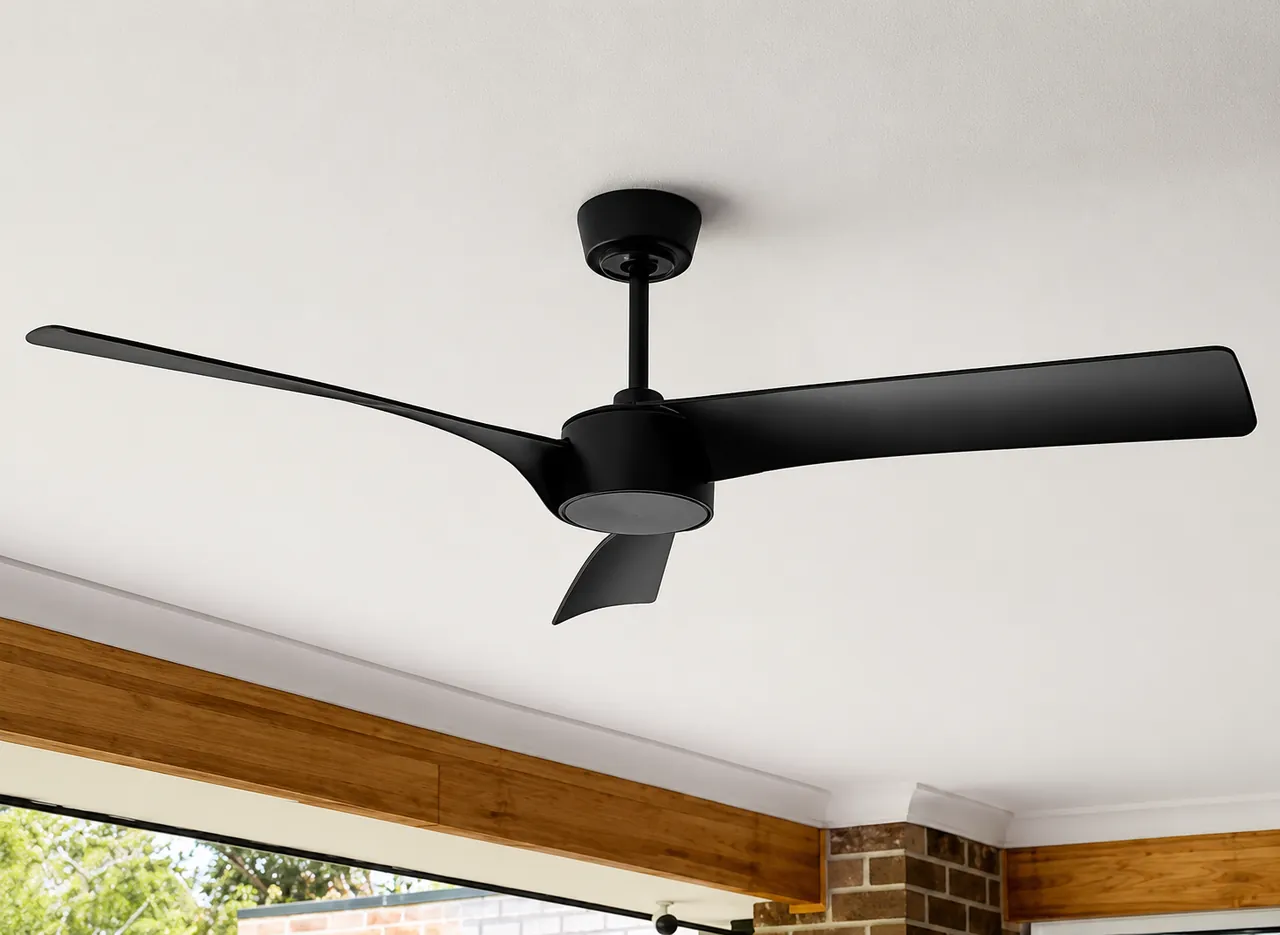
A DC fan uses a fraction of the power of an old AC unit
Licensed and accredited work by a local team. Read about Pivot Trade Services or see recent jobs across the western suburbs.
Answers
Frequently asked questions
Indirectly, yes. A fan uses a fraction of the power of an air conditioner, and the air movement makes a room feel two to three degrees cooler than it is. That lets you raise the thermostat setting by a similar amount, and every degree you raise a cooling setpoint saves meaningful energy. The fan does not replace air conditioning on a 40 degree day, but it substantially reduces how often you need it.
Usually yes, but there are two things to check. First, whether the ceiling has structure in the right place to fix to, or whether a mounting block can be installed from the roof space. Second, how the fan and light are to be controlled separately, which needs either a remote receiver or an extra conductor to the switch. We confirm both at the quote.
In summer, the blades should push air straight down, which creates the breeze you feel. In winter, reverse it and run it at the lowest speed. That pulls air up the middle and pushes the warm air that has collected at ceiling level gently down the walls without creating a draught. The difference is most noticeable in rooms with high ceilings.
Nine times out of ten the mounting is not fixed to solid structure, or the blades are not all seated the same. Bent blade arms, a loose canopy screw or dust building unevenly on the blades will also do it. A small wobble is not dangerous but it will get worse as the fixing works loose, so it is worth having looked at rather than ignored.
Over a bed is fine as long as the 2.1 metre floor to blade clearance is met, which it will be at any normal ceiling height. Bathrooms are different. The Wiring Rules define zones around baths and showers where fittings must be rated for the conditions, so a fan in a bathroom needs to be positioned and specified accordingly, and it needs RCD protection on the circuit.
A straight replacement of an existing fan takes about an hour. A new fan where there is an existing light point takes one and a half to two hours including installing a mounting block. Adding a wall control or running a new circuit takes longer, and if the ceiling has no accessible roof space above it the time depends entirely on the route we can find.
Book ceiling fans
Tell us what you need and we will give you a written price, not a range that moves on the day.
- Free
- On-site quotes
- Fixed
- Written pricing
- 100%
- Workmanship guarantee
- 5.0★
- 69 Google reviews