
Energy saving · Updated 3 August 2026
Home Battery Storage Explained: Is It Worth It in Melbourne's West? (2026)
Battery storage in Melbourne west pays by shifting cheap daytime solar into expensive evening consumption. Here are the real numbers, the payback, and the households it actually suits.
- 10 min read
- Written for Victoria
- 2026 figures
The short answer
A 10kWh home battery costs $8,000 to $12,000 before rebates in Melbourne west. The federal rebate of roughly 30 percent, about $250 per usable kWh from 1 May 2026, takes about $2,500 off a 10kWh system, leaving a net cost of $5,500 to $9,500. Payback typically runs 7 to 10 years against a real world life of 12 to 15 years. It suits households using around 18kWh a day with existing solar of 6.6kW or larger.
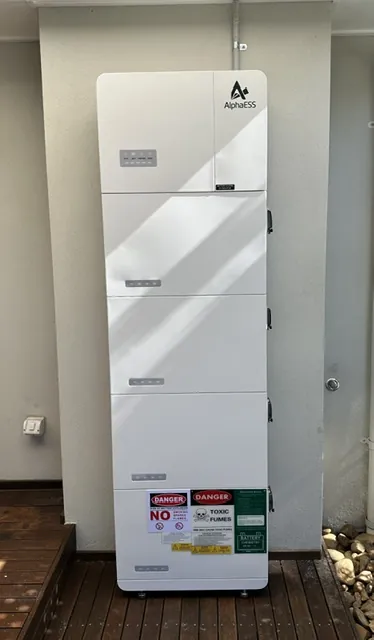
From one of our jobs
A completed home battery cabinet with isolation labelling
Photographed on site in Melbourne’s west. REC 37223.
- 10kWh before rebates
- $8,000 - $12,000
- Federal rebate
- About $2,500
- Net cost
- $5,500 - $9,500
- Payback
- 7 - 10 years
- Viability threshold
- ~18kWh a day
What a battery actually does for you
A home battery does one thing: it moves electricity through time. It stores solar generation you produce in the middle of the day and releases it in the evening when you would otherwise be buying from the grid.
The reason that is worth money in 2026 is the gap between what you get for exported solar and what you pay for imported power. Feed-in tariffs are now well under 5 cents, while peak grid rates sit at 30 to 45 cents. Every kilowatt hour you store and use yourself instead of exporting is worth the difference between those two numbers.
Victoria removed the mandatory minimum feed-in tariff on 1 July 2025, which means there is no floor under what retailers must pay for your exports. That change is the single biggest reason the battery conversation has shifted from marginal to worth doing for the right household.
What it costs, and what the rebate is worth
A 10kWh battery costs $8,000 to $12,000 before rebates, supplied and installed. The federal rebate is roughly 30 percent, calculated at about $250 per usable kilowatt hour from 1 May 2026, which works out at about $2,500 on a 10kWh system. That leaves a net cost of $5,500 to $9,500.
The rebate tapers above 14kWh, so the support does not scale linearly forever. That matters if you are considering a large system, because the effective subsidy rate on the top end of a very large battery is lower than on the first 10kWh.
Two Victorian points worth knowing. The Solar Victoria income cap is $150,000 from 1 July 2026, and the Solar Victoria interest-free battery loan closed in 2025, so financing is now a matter for you and your lender rather than a state program.
| Item | Amount |
|---|---|
| 10kWh battery before rebates | $8,000 - $12,000 |
| Federal rebate, about $250 per usable kWh | About $2,500 |
| Net cost after rebate | $5,500 - $9,500 |
| Typical payback | 7 - 10 years |
| Real world life | 12 - 15 years |
The federal rebate is roughly 30 percent and applies from 1 May 2026 at about $250 per usable kWh, tapering above 14kWh. The Solar Victoria income cap is $150,000 from 1 July 2026. The Solar Victoria interest-free battery loan closed in 2025.
Usable capacity is not advertised capacity
This is the number most comparisons get wrong. A battery advertised at 13.5kWh commonly has 12.8kWh usable, because a portion of the pack is reserved to protect cell life. The usable figure is the one that determines how much of your evening you can cover, and it is also the one the federal rebate is calculated against.
For most Melbourne west households the sensible installed range is 10 to 15kWh usable. Below 10kWh you tend to run out partway through the evening on a normal day. Above 15kWh you are buying capacity that only gets used on the handful of days a year when generation and consumption line up badly.
When comparing quotes, insist on usable kilowatt hours for every option. A comparison between an advertised figure and a usable figure is not a comparison at all.
Warranty, cycles and how long it really lasts
Battery warranties are usually written as a period and a cycle count with a retained capacity figure. Commonly that is 10 years or around 10,000 cycles, with 60 to 70 percent capacity retention at the end of the warranty period.
What that means in practice is that the battery does not stop working at year ten, it simply holds less than it did when new. Real world life is more like 12 to 15 years, with a gradual decline in usable capacity across that time.
This is worth holding alongside the payback figure. A payback of 7 to 10 years against a life of 12 to 15 years means the battery does return its cost and then some, but the margin is not enormous and it depends on the household actually cycling the battery most days. A battery that sits half full is not paying anything back.
Typical warranty
10 years or around 10,000 cycles, with 60 to 70 percent capacity retention at the end of the period.
Real world life
12 to 15 years, with a gradual decline in usable capacity rather than a sudden failure.
Payback
Typically 7 to 10 years, and only if the battery is cycled most days rather than sitting partly charged.
Retention, not failure
End of warranty means reduced capacity, not a dead unit. Plan the economics around declining usefulness, not a cliff.
Who it actually suits in Melbourne west
There is a rough threshold below which a battery does not make sense, and it is worth being blunt about it. As a guide, a battery becomes viable at around 18 kilowatt hours a day of household consumption, with existing solar of 6.6kW or larger.
The reason is arithmetic rather than opinion. To pay for itself the battery has to fill during the day and empty in the evening, most days. That needs enough surplus generation to fill it and enough evening consumption to draw it down. A household with a 5kW array and 10kWh a day of consumption will cycle a battery shallowly and infrequently, and the payback stretches out well past the warranty.
In Melbourne west that threshold is met most often by larger family homes in Point Cook, Hoppers Crossing, Altona Meadows and Sunshine North, where roof space supports a decent array and household consumption is genuinely high. It is met least often by small renovated cottages in Yarraville and Seddon with modest rear extension arrays and two occupants.
Consumption
Around 18kWh a day or more. Below that, the battery does not get emptied often enough to earn its keep.
Existing solar
6.6kW or larger. Without surplus generation there is nothing cheap to store, and charging a battery from the grid changes the economics entirely.
Evening usage pattern
A household that is home in the evening draws the battery down daily. One that is out most nights does not.
Time of use tariff
A peak rate of 30 to 45 cents against a feed-in under 5 cents is what creates the value. Check your actual rates, not a generic assumption.
What changed in Victoria, and why the maths moved
Two policy changes drive the current picture. Victoria removed the mandatory minimum feed-in tariff on 1 July 2025, which removed the floor under export payments and made stored solar more valuable relative to exported solar. Feed-in rates are now well under 5 cents.
The federal rebate, at roughly 30 percent or about $250 per usable kWh from 1 May 2026, then reduced the upfront cost by about $2,500 on a 10kWh system. Together those two changes are what moved a typical payback from beyond the warranty period into the 7 to 10 year range.
The Solar Victoria interest-free battery loan closed in 2025, so the state no longer offers a financing pathway. And the Solar Victoria income cap of $150,000 from 1 July 2026 applies to the state programs that remain, which is worth checking against your circumstances before assuming a stacked outcome.
An honest summary
For a household in Melbourne west using around 18kWh a day with a 6.6kW or larger array already on the roof, a battery is a reasonable investment in 2026. Net cost of $5,500 to $9,500 on a 10kWh system, payback of 7 to 10 years, and a real world life of 12 to 15 years is a defensible set of numbers, and there is genuine value in the backup and independence that is harder to put a figure on.
For a household below that threshold, the honest answer is that panels, load shifting and an efficient hot water system will return more per dollar than storage will. That is not a reason never to install a battery. It is a reason to do the cheaper things first and revisit the battery with a year of real consumption data in hand.
We are happy to run those numbers against your actual bills rather than a generic profile. Pivot Trade Services holds REC 37223 and SAA accreditation S3962281, and every installation carries a 100% workmanship guarantee on top of the manufacturer warranty.
What a battery does not do
Two expectations are worth correcting before anyone signs a quote. The first is backup. Not every battery installation keeps the house running through a blackout, and the ones that do usually need additional hardware and a defined backup circuit rather than powering the whole house. If outage backup is part of why you want a battery, say so at quote stage, because it changes the specification.
The second is independence. A 10 to 15kWh usable battery covers an evening, not a week of cloudy weather. Going fully off grid from a suburban rooftop array is a different exercise at a different price. What a battery does well is shift a normal day of generation into a normal evening of consumption, which is exactly what the 7 to 10 year payback is built on.
Figures in this guide are indicative and were accurate at the time of writing (3 August 2026). Rebate values, eligibility rules and certificate-linked discounts change regularly. Confirm current amounts with the program administrator, and treat your written quote as the accurate figure for your property.
Answers
Frequently asked questions
For a household using around 18 kilowatt hours a day with existing solar of 6.6kW or larger, yes. Net cost on a 10kWh system is $5,500 to $9,500 after the federal rebate, payback runs 7 to 10 years and real world life is 12 to 15 years. Below that consumption threshold the battery is not cycled often enough to pay for itself.
$8,000 to $12,000 before rebates. The federal rebate of roughly 30 percent, about $250 per usable kilowatt hour from 1 May 2026, takes about $2,500 off, leaving $5,500 to $9,500 net. The rebate tapers above 14kWh, so very large systems receive proportionally less support on the top end.
A battery advertised at 13.5kWh commonly has 12.8kWh usable, because part of the pack is reserved to protect cell life. Usable capacity is what determines how much of your evening you can cover and it is also what the federal rebate is calculated on. Always compare quotes on usable kilowatt hours.
Warranties are commonly 10 years or around 10,000 cycles, with 60 to 70 percent capacity retention at the end of that period. Real world life is more like 12 to 15 years. The battery does not fail at the end of warranty, it simply holds progressively less, so the economics decline gradually rather than stopping.
Victoria removed the mandatory minimum feed-in tariff on 1 July 2025, which took away the floor under what retailers must pay for exported solar. Rates are now well under 5 cents while peak grid rates sit at 30 to 45 cents. That gap is exactly what makes storing your own generation worth doing.
No. The Solar Victoria interest-free battery loan closed in 2025, so financing is now a matter between you and your lender. The federal rebate of roughly 30 percent still applies, and the Solar Victoria income cap of $150,000 from 1 July 2026 applies to the state programs that remain.
For most Melbourne west households the sensible range is 10 to 15kWh usable. Below 10kWh you run out partway through a normal evening. Above 15kWh you are paying for capacity that only gets used on a handful of days a year, and the federal rebate tapers above 14kWh anyway.
Browse every cost, rebate and comparison guide in the Pivot guides library, or claim the $60 off your first job voucher.
Want this priced for your place?
Tell us what you need and we will give you a written price, not a range that moves on the day.
- Free
- On-site quotes
- Fixed
- Written pricing
- 100%
- Workmanship guarantee
- 5.0★
- 69 Google reviews