
Comparisons · Updated 3 August 2026
Heat Pump vs Gas Hot Water (2026): Which Should You Install?
The running cost gap matters, but the incentive gap matters more. Three programs apply to a heat pump and none of them apply to a gas replacement. Here is the full picture, including when gas still wins.
- 9 min read
- Written for Victoria
- 2026 figures
The short answer
A heat pump is the cheaper long term choice for most Victorian homes, mainly because it attracts incentives that gas hot water does not. Supplied and installed a heat pump costs $3,000 to $4,500, and after stacking Solar Homes of up to $1,000, or up to $1,400 for a locally made product, the Victorian Energy Upgrades invoice discount and federal STCs of roughly $300 to $600, most households pay from a few hundred dollars up to about $1,500. Gas still suits homes with no compliant outdoor position.
- Installed before incentives
- $3,000 - $4,500
- Typical out of pocket
- A few hundred to $1,500
- Federal STCs
- $300 - $600
- Energy vs electric storage
- About one third
Two ways of making hot water, and where the gap comes from
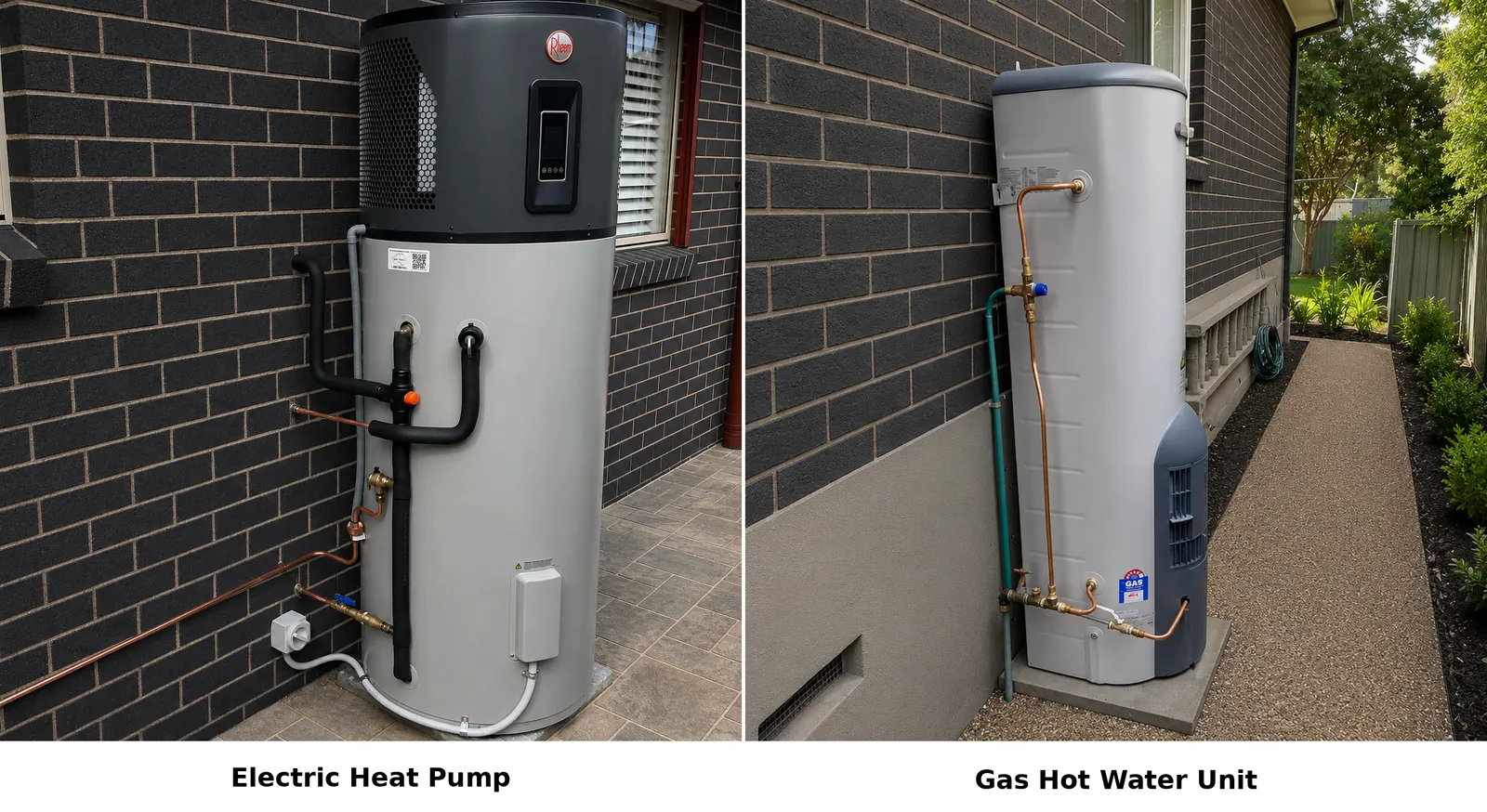
A gas system burns fuel to heat water, either on demand in an instantaneous unit or to keep a storage tank hot. It is a mature, reliable technology and there is nothing wrong with it as an appliance.
A heat pump does not make heat at all. It moves it, collecting warmth from the outside air with a refrigerant circuit and delivering it into a tank of water. That is why it uses roughly one third the electricity of conventional electric storage for the same amount of hot water. The compressor does not create the heat, it just relocates it, which is why the output exceeds the input.
Against gas the comparison is less about a single efficiency number and more about three things: what you pay to run it, what you pay to buy it after incentives, and whether you can pair it with something you already own. On the last point, a heat pump timed to run in the early afternoon can absorb solar generation that would otherwise be exported for a few cents. Gas cannot use your solar at all. With feed-in tariffs where they are, that alone changes the arithmetic for any household with panels on the roof.
One more thing worth being clear about. If you are currently on old electric storage rather than gas, the heat pump case is overwhelming and this comparison barely applies. Our page on electric water heaters covers where conventional element tanks still make sense, which is a shrinking list.
The incentive gap is the biggest single difference
This is the part that decides most quotes, and it is not close. Three separate programs can apply to a heat pump hot water installation in Victoria, and none of them apply to replacing a gas unit with another gas unit.
Solar Victoria Solar Homes contributes up to $1,000, or up to $1,400 for a locally made product, subject to eligibility including a combined household income cap of $150,000 from 1 July 2026. Victorian Energy Upgrades applies a discount directly to your installation invoice rather than being claimed afterwards, with no income test, provided the property is at least two years old and you make the minimum customer contribution of $200 including GST. Federal small scale technology certificates are worth roughly $300 to $600 and are normally assigned to the installer and deducted from your price.
Stacked, that commonly totals $3,000 or more against a supplied and installed cost of $3,000 to $4,500. Most Victorian households end up paying from a few hundred dollars up to about $1,500. A gas replacement, by contrast, is paid at full price, because these programs exist specifically to shift households off gas rather than to keep them on it.
One honest caveat. The VEU program changed on 30 September 2026, so the amount must be confirmed in writing at quote time rather than taken from a figure someone remembers from last season. Our heat pump hot water rebate guide goes through each program in detail, including who the income cap catches.
The two side by side
This is what actually differs day to day and over the life of the appliance.
| Factor | Heat pump | Gas |
|---|---|---|
| How it heats | Moves heat from the outside air into a storage tank | Burns gas on demand, or to keep a storage tank hot |
| Energy use | Roughly one third the electricity of conventional electric storage | Consumes gas, plus the daily supply charge on the connection |
| Incentives | Solar Homes, VEU invoice discount and federal STCs can stack | No equivalent incentives on a like for like gas replacement |
| Installed cost | $3,000 to $4,500 before incentives | Quoted per job, paid in full |
| Typical out of pocket | A few hundred dollars up to about $1,500 | The full installed price |
| Works with solar | Yes, run the heating cycle in the early afternoon | No, gas cannot use your generation |
| Outdoor equipment | Compressor and fan, needs clear airflow and sensible placement | Instantaneous units mount on a wall, no compressor |
| Recovery | Slower reheat, so tank sizing matters | Instantaneous units do not run out of hot water |
| Noise | Audible compressor and fan while running | Minimal, a burner and a small fan |
VEU requires the property to be at least two years old, has no income test, and carries a $200 including GST minimum customer contribution. Solar Homes has a combined household income cap of $150,000 from 1 July 2026. The VEU program changed on 30 September 2026, so amounts are confirmed in writing at quote.
Noise and placement, which is the real constraint
This is where heat pump installations go wrong, and it is almost always a siting problem rather than a product problem. A heat pump has a compressor and a fan. They make noise while the unit is running, in the same way an air conditioner outdoor unit does.
Sited sensibly, with clear airflow, a bit of distance from bedroom windows and the discharge pointed away from where people sit, it is a non issue and most households stop noticing it within a fortnight. Sited under a bedroom window, or hard against a narrow side boundary where the sound reflects off a neighbouring wall, it becomes the thing you complain about for ten years.
Terrace and townhouse sites are the hardest. On a narrow block in Yarraville or Footscray there may be one viable position, or none that satisfies both airflow and neighbour proximity. This is why we assess the position before quoting rather than assuming the new unit goes where the old one was. Gas instantaneous units have no compressor, mount flat on a wall, and simply do not raise this question, which is a genuine advantage in tight sites.
The other placement factor is the run to the tank and the electrical supply. A heat pump needs a dedicated circuit and an isolator, and on older homes that sometimes triggers a switchboard upgrade before anything else can happen. It is far better to identify that at quote stage.
Good position
Clear airflow on at least the intake and discharge faces, away from bedroom windows, discharge pointed into open space rather than at a wall.
Poor position
Under a bedroom window, in a narrow side passage where sound reflects, or boxed in so the unit recirculates its own cold discharge air.
Electrical
A dedicated circuit and isolator are required, and a Certificate of Electrical Safety is issued on completion of the electrical work.
Tight blocks
On terraces and townhouses this is the deciding factor more often than price. If there is no compliant position, gas stays the sensible answer.
Cold mornings, recovery and getting the tank size right
A gas instantaneous unit does not run out of hot water. That is its single best feature and it is why households with four teenagers and one bathroom like them. A heat pump heats a tank, so it has a finite amount available and it reheats more slowly than a gas burner does.
That difference shows up as a cold shower for the last person on a winter morning if the tank was sized on the average day rather than the busiest one. It is not a fault, it is a sizing decision made badly. As a general guide, 170 to 220 litres suits one or two people, 250 to 280 litres suits three or four, and 300 litres or more suits five or more. Size for the morning where everyone showers back to back, not the one where two people do.
Cold weather does reduce a heat pump efficiency, because there is less heat in the outside air to collect. Modern units are designed for Melbourne conditions and continue to work through winter, but the compressor runs longer to achieve the same result. The practical answer is the same as the sizing answer: a slightly larger tank, and a heating cycle timed for the early afternoon when the air is warmest, which is also when your solar is generating.
That timer setting is the single most valuable thing you can do with a heat pump after installation. Running the compressor in the warmest air of the day is when the unit is most efficient, and on a solar home it means the tank fills with generation that would otherwise export for a few cents. Set it once and it works every day for a decade.
Lifespan, servicing and what actually fails
Both technologies are mature and both will run for many years with reasonable care, so the question is less about which lasts longer and more about what breaks and what it costs to fix.
A gas instantaneous unit has a burner, a heat exchanger and controls. It is a simple machine, parts are widely available, and most tradespeople in Melbourne have worked on one. A gas storage tank eventually loses its tank, which is a replacement rather than a repair.
A heat pump has a refrigerant circuit and a compressor as well as a tank. That is more to go wrong, and refrigerant work requires an ARC licence, so it is not a general plumbing repair. On the other hand the electrical and control side is straightforward, and a properly sited unit with clear airflow leads a fairly gentle life. Both types benefit from an occasional check of the temperature and pressure relief valve, which is the most commonly ignored maintenance item on any hot water system.
What we would say honestly is that neither choice is a maintenance trap. Placement, sizing and installation quality determine how a heat pump behaves over its life far more than the brand on the front does. That is true of most of the hot water systems we fit.
When staying on gas is still the right answer
We install both, and there are households where we say keep the gas. Being straight about those cases is more useful than pretending the answer is always the same.
The first is a working unit. If your gas hot water system is functioning and only a few years old, replacing it early rarely pays back. Incentives make the heat pump cheap, not free, and scrapping a working appliance to save on running costs is usually a slower payback than people expect. Put the changeover on the list for when it fails, and get the quote ready before it does.
The second is placement. If there is genuinely no position on the property where a heat pump can sit with clear airflow and without pointing a compressor at a neighbouring bedroom, that is a real constraint, not a detail to work around. Narrow inner west blocks throw this up regularly.
The third is a household that keeps gas for other reasons. If you are staying on gas for cooking or heating anyway, the daily supply charge is being paid regardless, and one of the bigger arguments for electrifying hot water disappears. The picture changes entirely if you are also planning to move heating to reverse cycle, because then hot water is the appliance standing between you and disconnecting gas altogether.
The fourth is genuinely heavy simultaneous demand in a house with no room for a large tank. An instantaneous gas unit that never runs out has real value in that specific situation.
If none of those apply to you, the heat pump case is strong and the incentives are the reason. Happy to run the numbers against your actual household rather than a generic profile, so get in touch if you want it looked at properly. Pivot Trade Services holds REC 37223 and SAA accreditation S3962281, and every installation carries a 100% workmanship guarantee on top of the manufacturer warranty.
Figures in this guide are indicative and were accurate at the time of writing (3 August 2026). Rebate values, eligibility rules and certificate-linked discounts change regularly. Confirm current amounts with the program administrator, and treat your written quote as the accurate figure for your property.
Answers
Frequently asked questions
Over the life of the appliance, for most Victorian households, yes. The bigger difference is upfront. A heat pump is $3,000 to $4,500 installed but stacks Solar Homes, the Victorian Energy Upgrades invoice discount and federal STCs, leaving most households paying a few hundred dollars up to about $1,500. A gas replacement attracts none of those and is paid in full.
None of the main Victorian programs. Solar Homes, Victorian Energy Upgrades and federal STCs are aimed at reducing energy use and emissions, so they support heat pumps rather than like for like gas replacements. That single fact is the largest financial difference between the two options and it is why the installed prices and the amounts payable look so different.
They have a compressor and a fan, so they make noise while running, similar to an air conditioner outdoor unit. Placement decides whether that matters. With clear airflow, some distance from bedroom windows and the discharge pointed into open space, most households stop noticing within a fortnight. Under a bedroom window or in a narrow side passage it becomes a lasting complaint.
Only if the tank was sized badly. A heat pump reheats more slowly than a gas burner, so size for the busiest morning rather than the average one. As a guide, 170 to 220 litres suits one or two people, 250 to 280 litres suits three or four, and 300 litres or more suits five or more. Instantaneous gas units never run out, which is their main advantage.
Yes. Efficiency drops in colder air because there is less heat available to collect, so the compressor runs longer for the same result, but modern units are designed for these conditions and keep working through winter. Setting the heating cycle for the early afternoon helps, since that is the warmest air of the day and it lines up with solar generation.
Yes, and it is one of the better uses of a rooftop array now that feed-in tariffs are low. Set the timer to heat in the early afternoon and the tank absorbs generation that would otherwise be exported for a few cents. Gas cannot use your solar at all, which is a meaningful difference for any household with panels.
Both are mature technologies that run for many years with reasonable care. A gas instantaneous unit is a simpler machine with widely available parts. A heat pump adds a refrigerant circuit and compressor, and refrigerant work requires an ARC licence. Placement, sizing and install quality affect heat pump life far more than the brand does.
When your existing gas unit is working and fairly new, when there is genuinely no compliant outdoor position for a heat pump on a narrow block, when you are keeping gas for cooking or heating anyway so the supply charge is being paid regardless, or when you need heavy simultaneous demand and have no room for a large tank.
Browse every cost, rebate and comparison guide in the Pivot guides library, or claim the $60 off your first job voucher.
Want this priced for your place?
Tell us what you need and we will give you a written price, not a range that moves on the day.
- Free
- On-site quotes
- Fixed
- Written pricing
- 100%
- Workmanship guarantee
- 5.0★
- 69 Google reviews