
Twelve hundred prefabricated houses that do not open like brick veneer
Electrician in Norlane
Norlane is Victorian Housing Commission housing built between 1947 and 1976, with the peak years from 1951 to 1957. Around 2,464 houses in total, put up for Ford, International Harvester and phosphate works employees, laid out in uniform blocks around Labuan Square with standardised house types rather than individual designs.
- Norlane 3214
- Powercor network
- REC 37223
The short answer
Pivot Trade Services is a licensed electrician working in Norlane 3214 under REC 37223, about 55km from our Altona workshop. We cover switchboard upgrades, safety switches, rewiring, fault finding, power points, lighting, smoke alarms and solar. Norlane is on the Powercor network. The Housing Commission built 2,464 houses here between 1947 and 1976, more than 1,200 of them prefabricated units imported from Holland and France, and their wall construction changes how cable is routed.
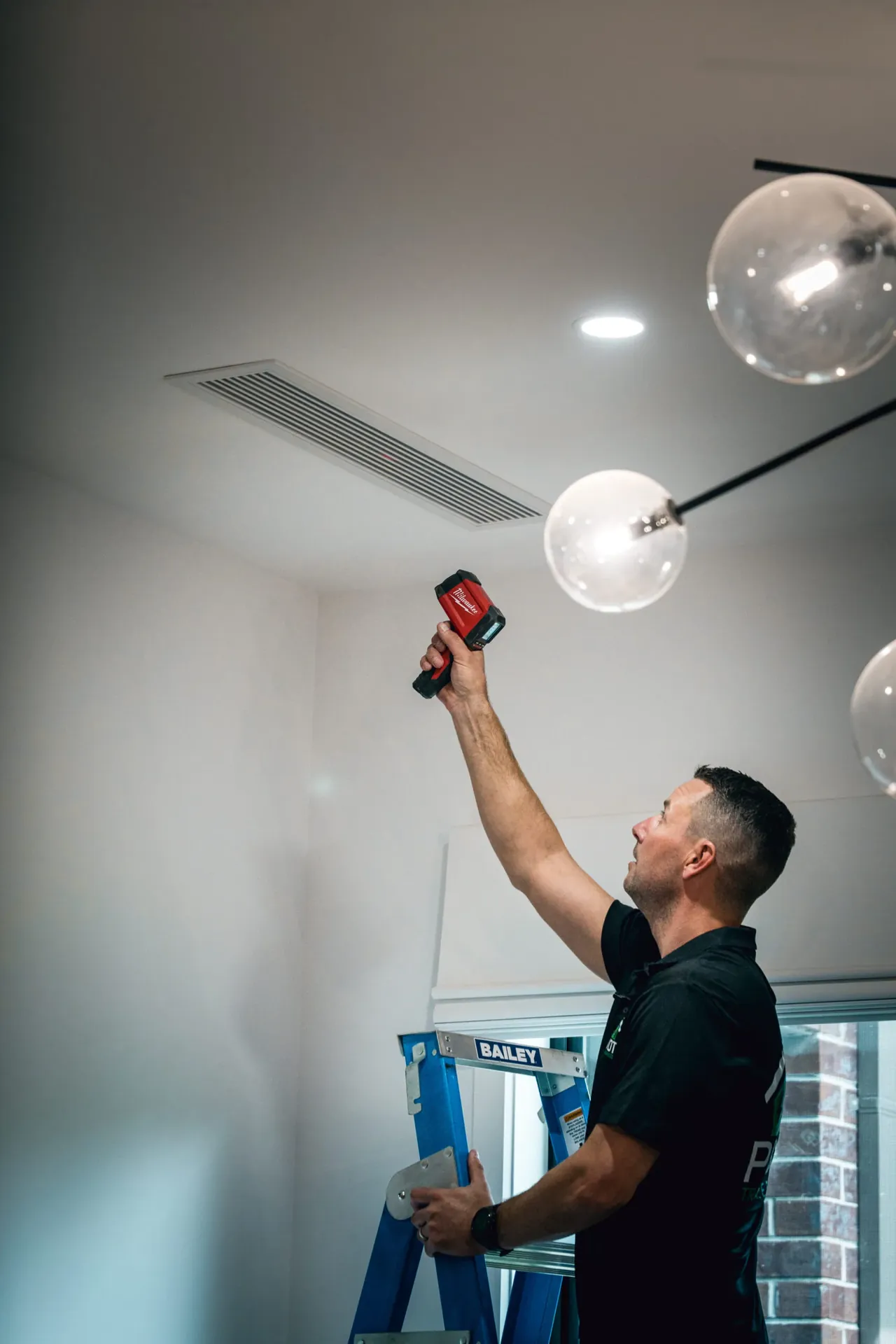
From one of our jobs
Pendant lighting and a ducted return in one visit
Photographed on site in Melbourne’s west. REC 37223.
More than 1,200 of those houses are prefabricated units imported from Holland and France. That is not a historical footnote for an electrician. Their wall construction is not what you expect from conventional Australian brick veneer, so cable routes have to be confirmed on site rather than assumed from what worked at the last address.
Imported prefabs, and why a cable route gets confirmed
The Dutch and French prefabricated houses here were shipped in as systems, and their wall build up, cavity depth and framing do not match the brick veneer an electrician usually works with. A route that would be a simple cavity drop in a conventional house can be blocked, shallower than expected, or in a panel that should not be cut.
So on a Norlane prefab we establish the construction before quoting rather than after. It changes where outlets can practically go, how a sub main gets to a rear addition, and whether a run is better taken through the roof space. Knowing that in advance is the difference between a clean job and an expensive surprise.
Confirm, do not assume
The wall build up on an imported prefab is checked on site, because the standard assumption does not apply to over 1,200 houses here.
Roof space alternatives
Where a wall cavity is not usable, the roof space is usually the practical route, and that changes the labour.
Fixing method
How an outlet, an alarm or an outdoor unit is fixed depends on the panel construction, not on a default fastener.
Installations sized for a 1950s household
These houses were built for Ford and International Harvester workers in the early 1950s, and the original installations were sized for the load of that time: a stove, a copper, a fridge and lighting. Everything since has been added to that. Even where a board has been partly upgraded, the circuit count and the consumer mains often still reflect the original design.
That is why we look at the whole installation rather than just the board door. A modern kitchen, reverse cycle heating and a car charger on an installation designed for 1953 needs the supply and the circuit arrangement assessed, not just a breaker added. An RCBO refit starts around $800 and a full replacement runs toward $3,500.
Consumer mains
Often the real limit in Commission stock, and it is checked before anything continuous gets connected.
Circuit count
A 1950s house typically has too few circuits rather than bad cable, so capacity is the fix.
Protection first
RCD coverage on every final subcircuit comes with a board replacement and is the highest value part of the work.
Asbestos, and how a board comes out
Housing of this vintage frequently has asbestos in sheeting and in the backing behind a meter box. In Norlane that is common enough to assume until proven otherwise, and it changes how a board is removed rather than whether it should be.
We identify it at the site check and quote removal as its own line. What we will not do is cut into an unknown panel to save half an hour. The prefabricated houses add another reason for care here, because their sheet materials are not always what they appear to be from the outside.
Assume then verify
In 1950s Commission stock the safe assumption is that asbestos is present until the check says otherwise.
Separate line item
Removal is priced up front, not raised as a variation with the board already off the wall.
Prefab sheeting
Imported panel materials need the same caution, because their composition is not obvious from the surface.
Planned estates, consistent roofs, straightforward solar
Because the Norlane estates were planned as a whole, the orientation is consistent street by street and the roofs are low to moderate pitch tile and steel on single storey homes. Blocks are uniform with wide frontages and clear side access, so equipment placement and cable runs are simple compared with the inner suburbs.
A 6.6kW system is typically $4,500 to $8,500 before STCs and roughly $3,000 to $6,000 after. The variable in Norlane is not the roof, it is whether the board and mains can carry the connection, and on a house that still has original protection the answer is that the board comes first.
Consistent orientation
Planned estates mean neighbouring houses face the same way, so a yield estimate on one street is genuinely repeatable.
Clear access
Uniform blocks with real side access keep scaffold, trenching and cable runs cheap here.
Board and solar together
On original Commission protection, the upgrade and the connection are quoted as one job.
Fifty five kilometres, booked in blocks
Norlane is about 55km from our workshop at 11/23-25 Jordan Close, Altona, which makes the northern Geelong suburbs the closest part of the region to us. It still means booked work rather than same day attendance, and we will tell you the week rather than the hour.
Board upgrades, safety switch retrofits, smoke alarms and solar are all planned jobs, so that scheduling costs you nothing. Powercor runs the network here and in our own area, so a meter exchange or a connection application is a process we already know. REC 37223, SAA S3962281 for solar and battery, 100% workmanship guarantee.
Grouped visits
Several Norlane and Corio jobs on one run keeps travel out of any single quote.
Realistic timing
A week, not an hour, because that is a commitment we can keep from 55km away.
Documented handover
Certificate of Electrical Safety, a labelled board schedule and manufacturer paperwork for anything supplied.
On the ground
What we see in Norlane homes
- Imported Dutch and French prefabricated houses whose wall construction does not behave like the brick veneer most cable routes assume.
- Original 1950s Commission installations with circuit counts and consumer mains sized for a household that had a stove and a copper.
- Asbestos in sheeting and meter box backing across most of the stock built before the mid 1980s.
- Uniform blocks with wide frontages and consistent street orientation, which makes solar layouts and cable runs unusually predictable.
Licensed and accredited work by a local team. Read about Pivot Trade Services or see recent jobs across the western suburbs.
Answers
Norlane questions
More than 1,200 of the houses here were imported prefabricated units from Holland and France in the 1950s, and their wall construction is not conventional Australian brick veneer. Cavity depth, framing and panel materials differ, so a cable route that works on a standard house may not work here. We confirm the construction on site before quoting, and often use the roof space instead.
Not always. Partial upgrades in Norlane commonly added breakers without adding RCD protection, and left the original circuit count and consumer mains untouched. These houses were wired for a 1950s household load. If you are adding a modern kitchen, reverse cycle heating or a car charger, the supply and circuit arrangement need assessing, not just another breaker in the board.
In housing built between 1947 and 1976 it is common enough that we assume it until the check says otherwise, particularly in sheeting and in the backing behind a meter box. It changes how a board is removed and it is quoted as its own item rather than raised mid job. On the imported prefabs we take the same care with panel materials, because composition is not obvious from the surface.
Usually easily. The estates were planned as a whole, so orientation is consistent street by street, the roofs are low to moderate pitch on single storey homes and the blocks have clear side access. A 6.6kW system is $4,500 to $8,500 before STCs and roughly $3,000 to $6,000 after. The real question is whether the existing board can carry the connection, which is why we quote both together.
Not the same day. We are about 55km away at Altona, which makes Norlane and Corio the closest part of the Geelong region for us, but we still book work in blocks and give you the week rather than the hour. Board upgrades, safety switches, smoke alarms and solar are planned jobs, so that suits them. For an urgent fault, call a Geelong based electrician.
A board that brings RCD protection to every final subcircuit. Original Commission protection interrupts an overload in the cable and does nothing to protect a person from a shock, and in Norlane that original protection is still widespread. An RCBO refit starts around $800 with a full replacement toward $3,500, and it is the work that everything else depends on.
Other work we do in Norlane
- Solar installation in NorlaneThe houses shipped in from Holland and France
- Home battery in NorlaneKnow the wall before you hang anything on it
- EV charger in NorlaneThe walls here are not what most electricians expect
- Split system in NorlaneThe wall you are drilling is not what you think it is
- Heat pump hot water in NorlanePrefabricated walls, original boards, off peak tanks
Get a Norlane quote
Tell us the address and what you need. We quote Norlane 3214 and the surrounding western suburbs in writing, with no obligation.
- Free
- On-site quotes
- Fixed
- Written pricing
- 100%
- Workmanship guarantee
- 5.0★
- 69 Google reviews