
From ceramic fuses to a board that protects people
Switchboard Upgrades in Melbourne
The switchboard is the one part of your electrical installation whose job is to fail safely. Everything else runs current. The board is there to cut it off before a fault becomes a fire or an electrocution. A board full of ceramic rewireable fuses does part of that job. It does not protect a person.
- REC 37223
- Melbourne west
- Fixed quotes
The short answer
A switchboard upgrade in Melbourne typically costs $800 to $3,500 or more, depending on whether the board is simply refitted with RCBOs or the consumer mains, meter panel and enclosure all need replacing. Under current AS/NZS 3000 Wiring Rules, new Victorian installations require RCD protection on all final subcircuits. Switchboard work is prescribed electrical work, so a licensed Registered Electrical Contractor must complete it and issue a Certificate of Electrical Safety.
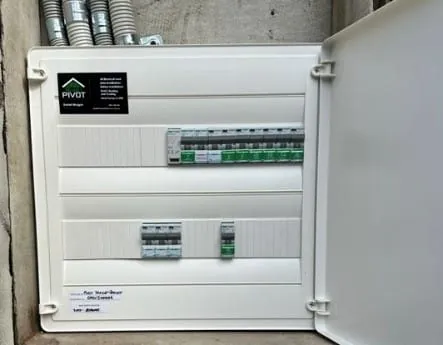
From one of our jobs
Every circuit labelled before we hand it back
Photographed on site in Melbourne’s west. REC 37223.
Plenty of houses across Yarraville, Newport, Sunshine and Braybrook still run on boards installed in the 1960s and 70s. They were adequate for a fridge, a stove and a few lights. They are not adequate for a modern kitchen, ducted heating, a home office and an EV in the driveway.
How to tell your board is due
You do not need to be an electrician to spot most of these. If more than two apply to your board, it is worth having it looked at rather than waiting for something to go wrong.
Ceramic fuses with fuse wire
If you have ever rewired a fuse with a length of wire in the dark, your board pre-dates modern protection entirely.
No safety switches
Circuit breakers protect the wiring from overload. Only an RCD protects a person from a shock. Many boards have breakers and no RCDs at all.
No spare space
A board that is full cannot take an air conditioner, an EV charger, solar or a new kitchen circuit without being reworked.
Repeated tripping
A board that trips whenever the kettle and the toaster run together is telling you the circuits are overloaded or the protection is worn out.
Heat, buzzing or scorch marks
Discoloured plastic, a burning smell or a warm main switch means loose or degraded connections. This one is not a wait and see item.
Asbestos backing board
Common in boards up to the mid 1980s. It is safe while undisturbed, but it changes how the upgrade has to be done and who is allowed to do it.
What a compliant board looks like in 2026
Current AS/NZS 3000 Wiring Rules require RCD protection on all final subcircuits in new installations, which means lights, power points, oven, air conditioning and everything else, not just the power points as was the case under older rules. When we upgrade an existing board we bring it to that standard wherever the existing wiring allows.
Most of our upgrades use RCBOs, which combine the safety switch and the circuit breaker in one device per circuit. They cost a little more than shared RCDs but they are worth it, because a fault on the dishwasher only kills the kitchen circuit instead of taking out half the house and the fridge with it.
Main switch rated for the supply
Sized to the consumer mains and the service fuse, not just whatever was there before.
One RCBO per circuit
Faults stay contained to a single circuit, which also makes fault finding far quicker later.
Clear circuit labelling
Printed and accurate, so the next person who opens the board is not guessing.
Spare ways left free
We leave room for the next addition. Solar, a charger or a split system should not trigger another board job.
Surge protection where it suits
A surge diverter can be fitted at the board at the same time, which is much cheaper than doing it as a separate call out.
What the day looks like
A straight board changeover on a single-phase house runs three to five hours. Your power is off for most of that, so plan for the fridge and freezer to be closed and for anyone working from home to have another option. We give you a window at booking rather than a vague morning or afternoon.
The old board comes out, the enclosure and backing are replaced, every circuit is re-terminated and identified, then the whole installation is tested. That testing is the part people do not see and the part that matters. Insulation resistance, earth continuity, polarity and RCD trip times all get measured and recorded, and the Certificate of Electrical Safety goes to you and to Energy Safe Victoria.
When another job forces the upgrade
A lot of switchboard upgrades are not planned. They surface when you order solar, book an EV charger, add a second air conditioner or convert to induction cooking, and the installer finds the board cannot take the new circuit or lacks the protection the new work requires.
This is worth knowing before you sign for the other job, because a quote that does not mention the board is not a complete quote. If you are planning to electrify your home over the next few years, doing the board once, properly, with spare capacity, is cheaper than three partial reworks.
What drives the cost
The spread between $800 and $3,500 comes down to how much of the installation has to change, not to how many hours we stand there.
Number of circuits
Each circuit needs its own device and its own termination. A six-circuit house and a sixteen-circuit house are different jobs.
Condition of the existing wiring
If circuit cables are brittle, too short to re-terminate or lack an earth, they have to be extended or replaced before they can go back in.
Consumer mains size
If the cable from the point of supply to the board is undersized for the load, replacing the board alone does not fix the bottleneck.
Meter panel condition
Old timber or asbestos panels usually need replacing at the same time, and the meter may need to be moved by the metering provider.
Single or three phase
Three-phase boards use more devices, larger enclosures and more labour to balance the load across phases.
| Scope of work | Typical installed cost |
|---|---|
| Add RCD protection to an existing sound board | $120 - $300 per device |
| Refit existing enclosure with RCBOs on every circuit | $800 - $1,500 |
| Full board replacement, single phase, up to 12 circuits | $1,500 - $2,500 |
| Full board replacement plus new meter panel or enclosure | $2,200 - $3,500 |
| Three-phase board replacement | $2,500 - $4,500+ |
| Consumer mains upgrade, priced separately | Quoted after site check |
Indicative only. Asbestos backing, meter relocation and consumer mains work are quoted separately after we open the board.
Book a board check if any of these are true
- 1You still have ceramic fuses or fuse wire
- 2There is no safety switch, or only one covering the whole house
- 3The board is full and an installer has told you there is no room
- 4Breakers trip regularly with normal household use
- 5You can smell burning plastic or hear buzzing at the board
- 6You are planning solar, a battery, an EV charger or induction cooking
- 7The house has not had electrical work done since the 1980s
On the job
Switchboard Upgrades in Melbourne's west
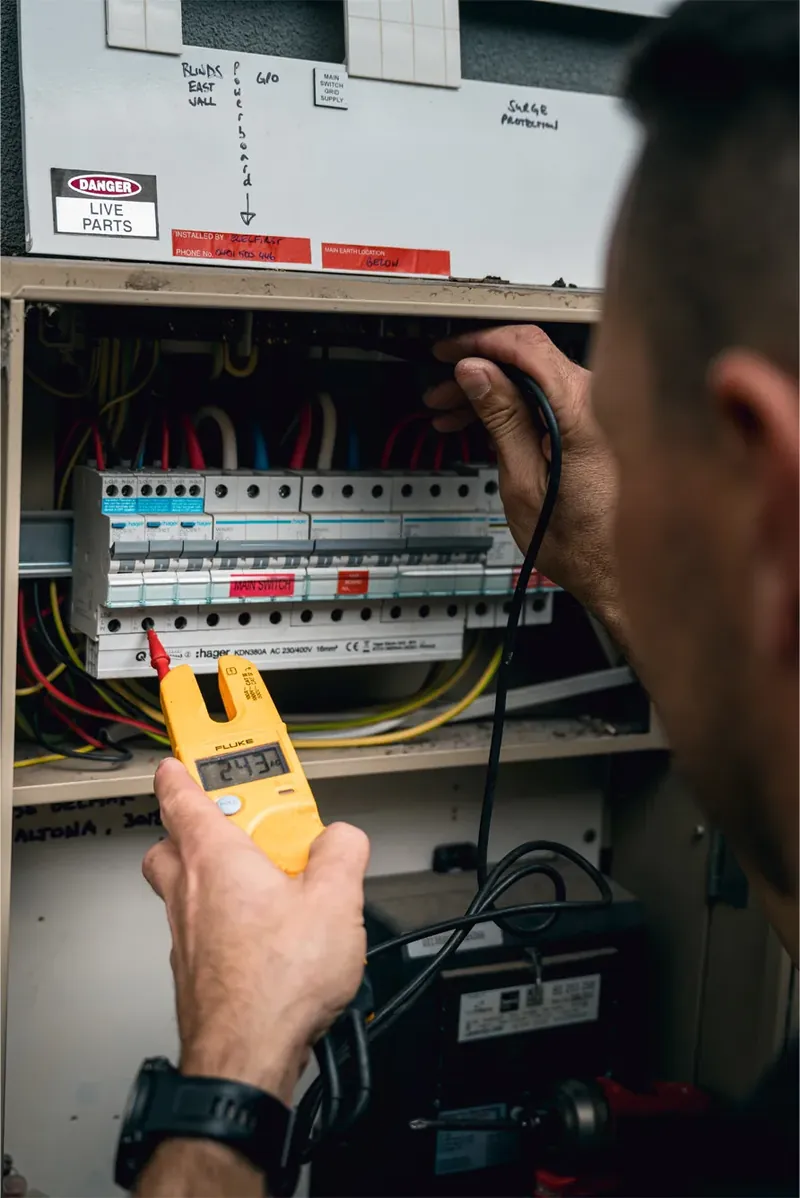
Live testing after a switchboard upgrade in Melbourne's west 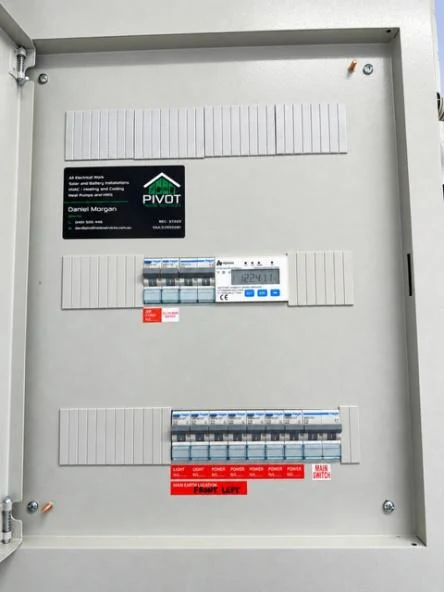
Every circuit labelled and the compliance plate fitted
Licensed and accredited work by a local team. Read about Pivot Trade Services or see recent jobs across the western suburbs.
Answers
Frequently asked questions
A circuit breaker protects the cable. It trips when the current exceeds what the wiring can carry, which prevents overheating and fire. A safety switch, or RCD, protects people. It compares the current flowing out with the current coming back and cuts supply within about 30 milliseconds if the difference suggests electricity is flowing through a person or to earth. You need both, and many older boards only have the first.
There is no rule forcing you to upgrade a working board simply because it is old. The obligation bites when new work is done. Any new or altered circuit has to comply with current AS/NZS 3000 requirements, which in practice means RCD protection, and a board that cannot accommodate that has to be changed. Rental properties also have periodic safety check requirements that often surface board defects.
No. The board has to be de-energised to be worked on safely, and anyone who offers to do it live should not be in your house. We plan the outage so it is as short as practical, usually three to five hours, and we can stage larger jobs to keep the fridge circuit running for part of the day if that matters to you.
Sometimes. If the tripping is caused by worn out protection devices or by too many loads on one old circuit, a board upgrade with properly split circuits will fix it. If there is a genuine fault in the wiring or an appliance, new devices will keep tripping, and correctly so. That is why we test the installation as part of the upgrade rather than just swapping hardware.
Asbestos backing panels were common until the mid 1980s. Undisturbed, they are not a hazard. Drilling or cutting them is. Where we find one, the panel is removed under the correct controls and disposed of properly, and that is quoted as a separate line. We will never drill into a suspect panel and hope for the best.
No, and neither can any other electrician. Metering is the responsibility of your electricity retailer and their metering provider. What we do is prepare the board and panel, then submit the paperwork so the meter can be exchanged or relocated. We coordinate that for you so you are not stuck between the retailer and the distributor.
A well built board with quality devices should run for 25 to 30 years without needing replacement, though RCDs are wearing devices and should be tested. Press the test button on each one every three months. If one does not trip, or trips slowly, it needs replacing regardless of how new the board is.
Book switchboard upgrades
Tell us what you need and we will give you a written price, not a range that moves on the day.
- Free
- On-site quotes
- Fixed
- Written pricing
- 100%
- Workmanship guarantee
- 5.0★
- 69 Google reviews