
Tethered, tidy, and correctly commissioned
Tesla Wall Connector Installation in Melbourne
The Tesla Wall Connector is one of the tidiest home chargers on the market and it is the unit customers ask us for by name more than any other. The current Gen 3 version is a slim wall mounted charger with the cable permanently attached, wifi connectivity for commissioning and firmware updates, and the ability to share available supply across several units on the same circuit.
- REC 37223
- Melbourne west
- Fixed quotes
The short answer
The Tesla Wall Connector is a tethered AC home charger that suits both Tesla and non-Tesla electric vehicles through its Type 2 connector. It can be configured for single or three phase supply, and the charging speed delivered depends on the property supply and the vehicle onboard charger. Installation in Melbourne typically costs $1,200 to $2,200 single phase and $2,500 to $3,000 or more three phase, on a dedicated RCD protected circuit certified by a licensed Registered Electrical Contractor.
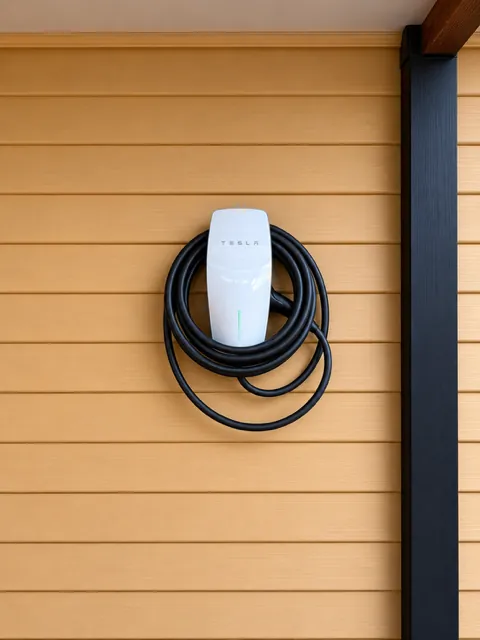
From one of our jobs
A Tesla Wall Connector on a dedicated 32A circuit
Photographed on site in Melbourne’s west. REC 37223.
We install them across Melbourne's western suburbs. As with any EV charger installation, what decides the price and the final specification is not the charger itself. It is the supply at the property, the switchboard, and how far the cable has to travel to reach where the car parks.
What the Gen 3 unit does
In general terms, the Wall Connector is an AC charger that sits between your switchboard and your car and manages the current and the safety functions of the charging session. It is not a fast DC charger. Nothing you mount on a house wall is.
The configuration is done at commissioning rather than by buying a different model. The same unit is set up for the supply at the property and the circuit it is connected to, which is why we confirm the specification after looking at the board rather than before. The charger, the circuit and the car each impose a ceiling and the lowest one wins. A vehicle whose onboard charger caps at a lower AC rate will charge at that rate no matter what the wall unit could deliver.
Tethered cable
The lead is attached to the unit and stows on it. Quicker day to day than fetching a cable from the boot, and one less thing to leave at home.
Wifi connected
Used for commissioning, configuration and firmware updates over the life of the unit rather than for daily operation.
Configurable output
Set up at installation to suit the supply and the circuit rather than being fixed at purchase.
Power sharing capable
Several units can be linked to share a single supply, which is the standard approach for two car households and small developments.
Single phase or three phase output
Most homes in Melbourne's west are single phase, and on single phase the practical ceiling for any home AC charger is 32A. That is roughly 7.4kW, which adds around 40 to 50 kilometres of range per hour. Plug in after dinner with a nearly empty battery and it is full by morning, which is all the great majority of drivers need.
Where a property already has three phase supply, the Wall Connector can be configured to use it and the available output rises accordingly. That is worth taking if the supply is there and the vehicle can use it. What is rarely worth it is converting a single phase property purely to charge faster overnight, because that means distributor work, new consumer mains, a metering change and a rebuilt switchboard. We set that argument out in full in do I need 3 phase power for an EV charger.
Does it suit a non-Tesla EV
Yes. The Wall Connector uses a Type 2 connector on the AC side, which is the standard fitted to every new electric vehicle sold in Australia. A Kia, a BYD, a Polestar or a Volkswagen will plug into it and charge normally.
There are two practical differences worth knowing. Some convenience features in the Tesla app ecosystem are designed around Tesla vehicles, so scheduling and monitoring for another brand may be done through the car or your retailer app rather than through the charger. And the tethered cable is a fixed length, so where the charge port sits on your vehicle matters more than it would with a socketed unit. A Tesla takes its port at the rear left. Plenty of other cars take it at the front right. If you are still choosing hardware, our guide to the best home EV chargers in Australia compares tethered and socketed properly.
Power sharing across multiple units
Power sharing is the feature that makes the Wall Connector a strong choice for a household with two electric vehicles, or for a small block of townhouses on a shared supply. Several units are linked and share the current available on the circuit feeding them. When one car is charging it can use the full allocation. When two are plugged in, the units divide what is available rather than both drawing full current and tripping the protective device. It happens automatically, with nobody plugging and unplugging on a roster.
It often removes the need to upgrade the supply at all, because two separate 32A circuits demand far more from a switchboard and consumer mains than two shared units on one properly sized circuit. Plan it at the first installation, because running the circuit once, sized for the second unit, is much cheaper than doing the job twice.
Wifi commissioning and firmware
The unit is commissioned over wifi at the end of the installation. That is where the supply configuration, the current limit and the network connection are set, and it is part of the job rather than something left for you afterwards.
Check the wifi coverage at the charger position before the day. Garages, particularly detached ones and anything behind a brick wall or a metal roller door, are frequently the weakest signal in the house. If the router is at the other end of the property, an access point near the garage is worth sorting out beforehand, otherwise commissioning is slower and firmware updates will not arrive reliably over the life of the unit.
If the car sits at home during the day and you have solar, it is worth a conversation at quote about how you want to prioritise charging against generation and against your tariff. The sensible configuration for a car that leaves at seven each morning is different from one that sits on the driveway.
Mounting and cable routing
The physical install is where the difference between a tidy job and an average one shows up, and it is about decisions made before anything is drilled. Mounting height matters for the tethered lead. Too high and the cable drags on the car. Too low and it sits on a wet garage floor.
Position matters for how you park. Reverse in or drive in, on the left or the right, with a second car in the way or not. Check the cable reaches with the car parked the way it is parked on a bad day, not a good one.
Cable routing is the largest cost variable. A run through an accessible roof space or along a garage wall close to the board is quick. Double brick, a rendered facade or a detached structure needing a submain and trenching is a different piece of work. This close to the bay in Altona, Seaholme and Williamstown, we also avoid mounting hardware that will not survive salt air.
Height set for the tethered lead
So the cable stows cleanly, does not drag on paintwork and does not sit in water on the floor.
Positioned for how you park
Charge port side, reverse or forward, second vehicle in the way. Tethered cable length is fixed.
Shortest sensible cable route
The distance from the switchboard is the largest single driver of the installed price.
The electrical work involved
A Wall Connector is permanently connected equipment, so this is prescribed electrical work. It needs its own dedicated final subcircuit back to the switchboard with a breaker sized to the charger and RCD protection of the correct type for EV supply equipment under AS/NZS 3000. It cannot share a circuit with power points or lighting.
That means the board needs a spare way, main switch capacity and appropriate protection before the charger circuit exists at all. Where it does not, a switchboard upgrade comes first, and that runs $800 to $3,500 or more depending on scope. Our switchboard upgrade cost guide explains what puts a job at each end of that range, and the EV charger installation cost guide sets out the charger side.
Your distributor may also need to be notified of the new load. That is our job to handle, not yours. On completion we test the installation, confirm the charger delivers the current it has been configured for, and issue a Certificate of Electrical Safety through our REC.
Pivot Trade Services holds REC 37223 and ABN 87 689 296 937, and works across the west from Altona, including EV charger installation in Point Cook and the suburbs listed on our service areas page. Every installation carries a 100% workmanship guarantee on top of the manufacturer warranty. For a fixed quote, contact us or call 0401 500 446.
| Scenario | Typical installed cost |
|---|---|
| Single phase, switchboard within a few metres of the charger position | $1,200 - $1,700 |
| Single phase, long cable run or board at the other end of the house | $1,700 - $2,200 |
| Three phase, where the property already has three phase supply | $2,500 - $3,000+ |
| Switchboard upgrade, where the existing board cannot take the circuit | +$800 - $2,500 |
| Load management device and metering | $200 - $600 |
| Underground conduit to a detached garage, per metre | $60 - $120 |
Installation cost only. The charger itself is priced separately and supplied either by you or by us. Figures are indicative and every quote we give is fixed after we have looked at the switchboard and the cable route. The final configuration depends on the supply available at the property.
Free download
The Melbourne Home EV Charger Buyer's Guide
What a charger actually costs, how to tell whether you need three phase, and the six questions that separate a real quote from a cheap one. Four pages, no email required.
PDF · 4 pages · 2026 edition
On the job
Tesla Wall Connector Installation in Melbourne's west
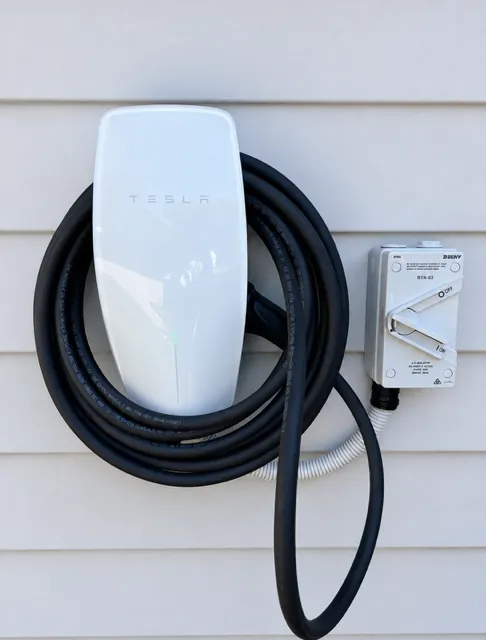
A Tesla Wall Connector on its own dedicated circuit 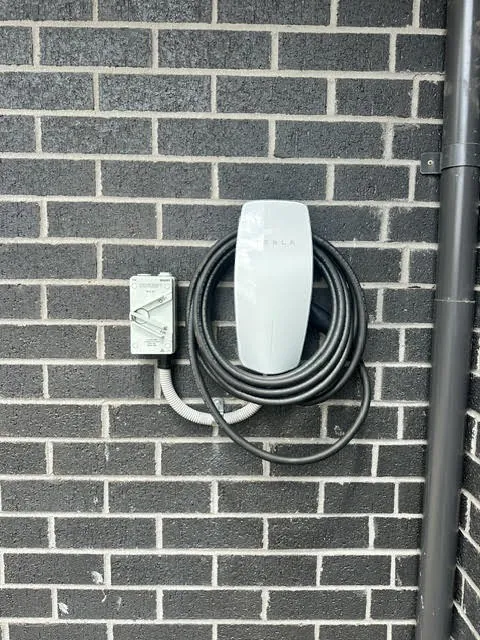
A tethered charger, wired back to its own circuit
Licensed and accredited work by a local team. Read about Pivot Trade Services or see recent jobs across the western suburbs.
Answers
Frequently asked questions
Yes. It uses a Type 2 connector on the AC side, which is the standard on every new electric vehicle sold in Australia, so other brands plug in and charge normally. The main practical considerations are that some app based scheduling features are built around Tesla vehicles, and that the tethered cable is a fixed length, so where your charge port sits matters.
That depends on three ceilings and the lowest one applies: the supply at the property, the circuit and protection we install, and what your vehicle accepts on AC. On single phase the practical maximum for any home charger is 32A, which adds roughly 40 to 50 kilometres of range per hour. We confirm the achievable figure after looking at your switchboard.
No. If your property is single phase, a 7kW class installation still refills a normal day of driving several times over during an overnight charge. Three phase is worth configuring where the supply already exists and the vehicle can use it. Converting a single phase property purely for charging speed involves distributor work, new mains, metering and a rebuilt board.
Yes, and that is what power sharing is for. Linked units divide the available current between them instead of both drawing full load, so two cars can be plugged in overnight without tripping anything. It often avoids a supply upgrade entirely. Plan it at the first installation, because running the circuit once sized for two units is much cheaper than doing it twice.
Wifi is used for commissioning, configuration and firmware updates rather than for the charging session itself. Check the signal at the charger position before installation day, because garages are commonly the weakest coverage in a house. Keeping the unit connected afterwards means it continues to receive firmware updates over its life, which costs nothing to leave in place.
Set by how you actually park and by the fixed length of the tethered lead. We look at which side the charge port sits, whether you reverse in, and whether a second car ever blocks the space. Height is set so the cable stows cleanly without dragging on paintwork or sitting in water. Outdoor positions near the bay need weather rated fixings.
A dedicated final subcircuit from the switchboard, a breaker sized to the charger, RCD protection of the correct type for EV supply equipment under AS/NZS 3000, a labelled means of isolation, mounting, commissioning and full testing. It cannot share a circuit with anything else. It is prescribed work, so a licensed REC issues a Certificate of Electrical Safety on completion.
Either works. Plenty of customers buy the unit directly and have us install it, and we are happy to work that way. If we supply it, the hardware appears as its own line on the quote so you can see exactly what you are paying for. Our workmanship guarantee applies regardless of who supplied the hardware.
Book tesla wall connector installation
Tell us what you need and we will give you a written price, not a range that moves on the day.
- Free
- On-site quotes
- Fixed
- Written pricing
- 100%
- Workmanship guarantee
- 5.0★
- 69 Google reviews