
Make it safe first, work out the rest after
Emergency Electrician, Melbourne West
Most calls that come in as emergencies are not, and most people are relieved to hear it. The ones that genuinely are share a common feature: there is a live conductor, a heat source or a shock risk that will not wait until Monday.
- REC 37223
- Melbourne west
- Fixed quotes
The short answer
An emergency electrician call-out in Melbourne typically costs $150 to $250 after hours before any repair work, with hourly rates of $120 to $200 outside business hours. Genuine electrical emergencies include burning smells, smoke or sparks from a switchboard or outlet, exposed live conductors, a fallen power line, and shocks from taps or appliances. If the whole street has lost power, the fault belongs to the distribution network, and the faults number is printed on your electricity bill.
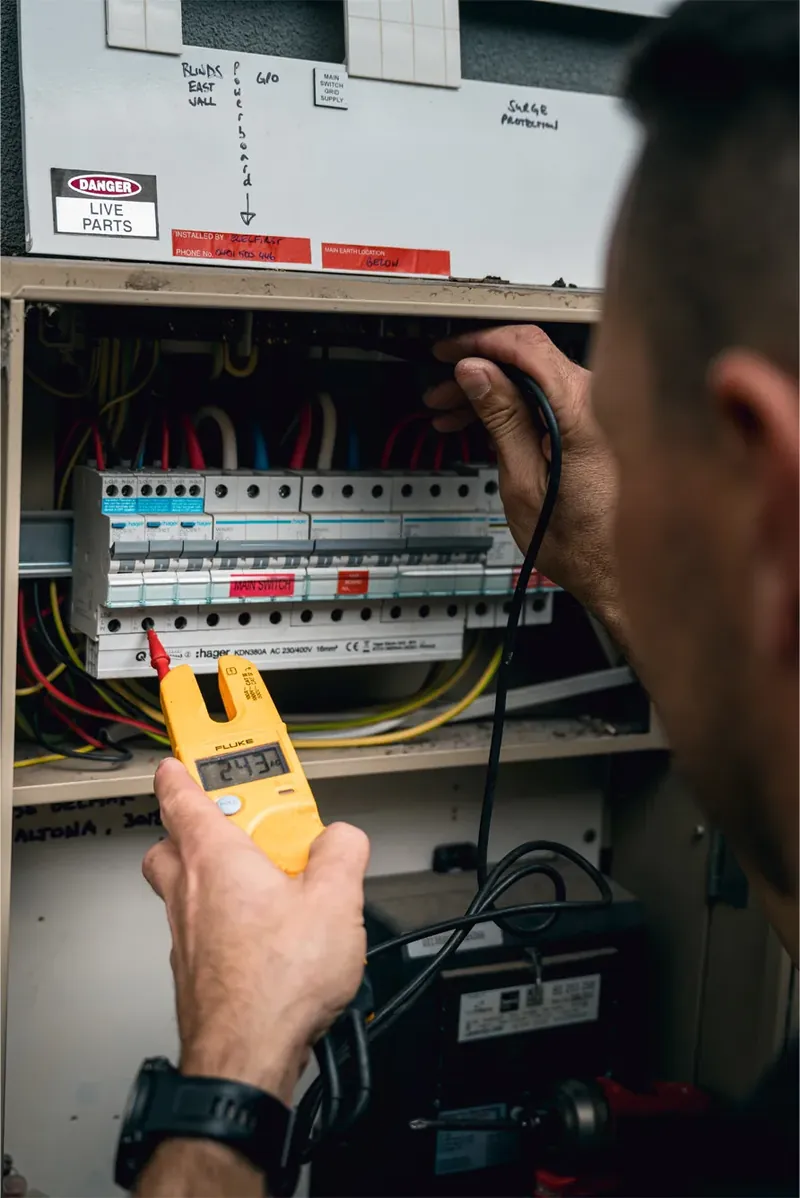
From one of our jobs
Live testing after a switchboard upgrade in Melbourne's west
Photographed on site in Melbourne’s west. REC 37223.
This page is written so you can work out which one you have at eleven at night, do the right thing in the next two minutes, and know what it will cost if you need us out.
What to do before anyone arrives
The first decision is whether to isolate. If you can safely reach the switchboard, turn off the affected circuit, or the main switch if you are not sure which circuit it is. Do not touch anything that is smoking, arcing or wet, and do not stand in water to reach a switch.
If someone has received a shock, treat it seriously even if they seem fine. Electrical shock can cause a heart rhythm problem hours later, so the advice is to seek medical attention. Do not touch the person while they are still in contact with the source. Isolate the supply first, or use something dry and non-conductive to separate them.
Fallen or damaged power line
Stay at least eight metres clear and keep others back. Call 000, then the distributor. Never assume a line on the ground is dead.
Smoke or burning smell from the board
Turn off the main switch if you can reach it safely, leave the area and call us. A burning smell at a switchboard is a fire in its early stage.
Water over electrical equipment
A burst pipe or flooding over outlets or a board means isolating the supply before anyone goes near it.
Shock from a tap or appliance
Stop using it, isolate the circuit and call. This usually indicates a fault energising metalwork or a problem with the earthing.
Sparks or arcing at an outlet
Isolate the circuit at the board. A single flash on plugging in is normal, ongoing arcing is not.
Your problem or the network is
This one question decides who you should be calling, and it saves a lot of people an unnecessary call-out fee. If the power is off at neighbouring houses or the whole street is dark, the fault is on the distribution network and it is the distributor's job to fix, at no cost to you. Melbourne's west is served mainly by Powercor, with Jemena covering parts of the north-west. The faults and emergencies number for your distributor is printed on your electricity bill.
If your house is the only one without power and the main switch has tripped or the supply is dead at your board, the problem is on your side of the point of supply and it is ours to fix. A partial loss, such as one side of the house being dead or lights working at half brightness, often indicates a lost neutral or a failed service fuse, which needs someone out regardless of who ultimately owns the fault. We can identify which side of the boundary the fault sits on and hand it to the distributor if it is theirs.
What actually counts as an emergency
We would rather you called and were told to wait than sat up all night worrying about something that could not hurt you. The split below is roughly how we triage calls.
Call immediately
Burning smells, smoke, visible arcing, exposed live conductors, shocks from taps or appliances, water over electrical equipment, damage after a storm or a car into a pole.
Same day, but not midnight
Total power loss to the house when the street has supply, a dead cooking or hot water circuit, a safety switch that will not reset at all, a board that is hot to touch but not smoking.
Next business day is fine
One dead power point, a light that will not work, a fan that has stopped, a breaker that trips only when a specific appliance is used and holds otherwise.
Isolate and it can wait
A cracked faceplate, a damaged outdoor light, a garden light filled with water. Turn the circuit off and book normally.
Make safe first, repair second
The first job on any emergency call is to make the installation safe. That might mean isolating and locking off a circuit, disconnecting a faulty hardwired appliance, or replacing a failed protective device so the rest of the house has power while the faulty part stays off.
A full repair sometimes has to wait for daylight, for parts, or for the distributor. That is normal and we say so on site rather than pushing an expensive overnight fix that could be done properly and cheaper the next morning. What we will not do is leave a house energised in a state we would not accept in our own.
What it costs after hours
After-hours work costs more, and anyone who tells you otherwise is loading it somewhere else. Here is what to expect so there are no surprises at the door.
Stopping it happening again
Most emergencies we attend were preventable and had been signalling for weeks. Breakers that trip occasionally, a warm faceplate, a light that flickers when the heater starts, a board with no RCDs. None of these are dramatic, and all of them are cheap to fix in business hours.
After an emergency call-out we will tell you plainly whether the fault was isolated bad luck or a symptom of an installation that is past its service life. If it is the second, you will get the test results and a quote, not a scare campaign.
| When you call | Typical cost before repairs |
|---|---|
| Business hours call-out | $60 - $120 |
| Business hours hourly rate | $90 - $160 |
| After hours, evenings and weekends | $150 - $250 call-out |
| After hours hourly rate | $120 - $200 |
| Public holidays and overnight | Quoted at the time of call |
| Make safe only, repair booked for the next day | Call-out plus first hour |
We give you an expected figure on the phone before we leave the workshop. Parts and repairs are additional and quoted on site.
Call us now if you have
- 1Smoke, sparks or a burning smell from the switchboard
- 2A power line down or damaged on your property
- 3Received a shock from a tap, appliance or metal fitting
- 4Water leaking onto electrical equipment or into the board
- 5Exposed conductors after storm damage or an impact
- 6A main switch that trips again immediately after resetting
- 7Lost power to your house while the street still has supply
Licensed and accredited work by a local team. Read about Pivot Trade Services or see recent jobs across the western suburbs.
Answers
Frequently asked questions
Look outside. If the street lights and your neighbours are also dark, it is a network outage and the distributor is responsible, at no charge to you. If everyone else has power and you do not, check your main switch and safety switches. If they have tripped and will not reset, or the board is dead entirely, the fault is on your side and you need an electrician.
Expect $150 to $250 as a call-out fee outside business hours, with hourly rates of $120 to $200 after that. Public holidays and the middle of the night are higher. We give you an expected figure on the phone before we come, and if the job turns out to be a network fault rather than yours, we will tell you before you commit.
Resetting a tripped breaker or safety switch once is reasonable. If it trips straight back in, stop. Repeated resetting of a device that is detecting a genuine fault is how a small fault becomes a fire. If there is any smell of burning, any heat at the board or any visible damage, do not reset it at all. Leave it off and call.
You pay for the call-out and the time on site, which covers isolating the fault and leaving the property safe. When we come back in normal hours to complete the repair, you are charged for the repair, not for a second call-out. We would rather do a proper job in daylight than an expensive improvised one at 1am.
Do not touch them while they are still in contact with the source. Turn off the supply at the switchboard, or use something dry and non-conductive to break the contact. Call 000 if they are unresponsive, burned or in pain. Even a mild shock warrants a medical check, because heart rhythm problems can develop later. Then isolate the circuit and have the fault found before anyone uses it again.
We are based in Altona and cover Altona North, Altona Meadows, Seaholme, Williamstown, Newport, Spotswood, Yarraville, Footscray, Maidstone, Braybrook, Sunshine, Laverton, Point Cook, Hoppers Crossing and Werribee. Being local matters at 2am. A van from Altona reaches most of these suburbs in twenty minutes, which is not true of a call centre dispatching from the other side of Melbourne.
It is a nuisance rather than an emergency, but do not disconnect it and go back to bed. Check for steam, cooking fumes or dust first, and press the hush button. If the alarm keeps sounding with no cause, it may have reached the end of its life or have an internal fault, which is a repair worth booking promptly. Never leave a house with a disabled alarm overnight.
Book electrical emergencies
Tell us what you need and we will give you a written price, not a range that moves on the day.
- Free
- On-site quotes
- Fixed
- Written pricing
- 100%
- Workmanship guarantee
- 5.0★
- 69 Google reviews