
The paperwork chain, handled for you
Mains Upgrades and Supply Connections
Connection work is where electrical jobs meet bureaucracy. The wiring is usually the simple part. The complication is that three or four separate organisations each own a piece of the process, and if one of them is approached in the wrong order the job stalls for weeks.
- REC 37223
- Melbourne west
- Fixed quotes
The short answer
An electrical connection is the work that links a property to the distribution network, including new supply connections, consumer mains upgrades, single to three phase conversions, meter panel work and temporary builders supply. In Victoria a licensed Registered Electrical Contractor performs the installation work and submits the request to the distributor, while metering is arranged through the electricity retailer. Consumer mains are sized using the maximum demand method in Appendix C of AS/NZS 3000.
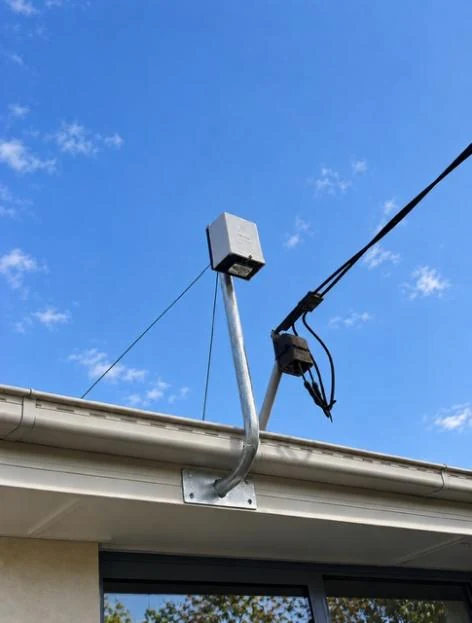
From one of our jobs
A new consumer mains and point of attachment
Photographed on site in Melbourne’s west. REC 37223.
We handle new connections, supply upgrades, phase conversions, meter panel work, temporary builders supply and disconnections across Melbourne's west, including the coordination with the distributor and your retailer.
The work this actually covers
Connection is a broad term. These are the jobs that fall under it, and they range from an afternoon to several weeks depending on who else has to be involved.
New supply to a new build
Consumer mains from the point of supply to the switchboard, meter panel, main earthing and the connection request to the distributor.
Consumer mains upgrade
Replacing undersized or degraded mains between the point of supply and the board, commonly needed when a house electrifies.
Single to three phase conversion
Where the load or the equipment requires it, subject to what is available in the street.
Overhead to underground
Converting an overhead service to underground, usually as part of a renovation or a facade change.
Meter panel work and relocation
Preparing or relocating the panel so the metering provider can install or move the meter.
Temporary builders supply
A compliant temporary pole or board so trades have power and RCD protection during construction.
Abolishment and disconnection
Safely disconnecting supply for demolition or major works, coordinated with the distributor.
Who does what, and in what order
This is the part that trips people up. In Victoria, four parties are usually involved and each has a defined role. Your electrician does the installation work on your side of the point of supply and lodges the electronic connection request with the distributor. The distributor, in most of Melbourne's west that is Powercor, owns the network up to the point of supply and approves and energises the connection.
Metering is separate again. Since the national metering reforms, meters belong to your electricity retailer and are installed by a metering provider they engage, not by the distributor and not by your electrician. So if you want a new meter, an upgraded meter or a meter moved, the request goes through your retailer, and the retailer instructs their metering provider. We prepare the panel, do the wiring, submit the paperwork and chase the pieces so you are not caught between three call centres. The Certificate of Electrical Safety for the installation work comes from us as the licensed REC.
Is single to three phase worth it
Three phase is not automatically better. It costs more to install, needs a larger board and, if the street does not have three phase available at your frontage, the cost can move from a few thousand dollars to a great deal more.
The honest test is whether you have a load that needs it. Ducted air conditioning above a certain size, a workshop with three-phase machinery, a large solar array with a three-phase inverter, a commercial kitchen, or a genuine need to charge two EVs at 22kW are real reasons. Wanting faster overnight car charging on its own usually is not, because a single-phase 7kW charger already fills most batteries overnight. We will price both and tell you which one we would choose in your position.
Check availability first
Three phase must be available at the street frontage. If it is not, the distributor has to extend it, which changes the economics completely.
Balance matters
A three-phase installation only delivers its benefit if the load is distributed sensibly across the phases at the board.
Solar interacts with it
Three-phase homes with single-phase inverters can behave unexpectedly with export limits, so the inverter choice should follow the supply decision.
It changes the board
A three-phase board is physically larger and more expensive, so the cost is not just the mains and the connection.
Sizing the supply for an electrified home
This is the calculation more homes need and fewer get. When you add induction cooking, heat pump hot water, reverse cycle heating and an EV charger to a house built around a gas stove and a gas heater, the electrical load roughly doubles. The consumer mains and the service fuse were sized for the old house.
Maximum demand is calculated using the method set out in Appendix C of AS/NZS 3000, which applies diversity factors to each type of load rather than simply adding up nameplate ratings. Running that calculation before you commit to an electrification plan tells you whether the existing mains will carry it, whether load management on the EV charger solves the problem more cheaply than new mains, or whether the supply genuinely needs upgrading. Doing it after the fact is how people end up paying for a switchboard twice.
Backup generators and standby supply
Connecting a generator to a house is connection work with its own standard. AS/NZS 3010 covers the installation of generating sets, and the critical requirement is that the generator can never be connected to the network at the same time as the supply. That is achieved with a changeover switch that mechanically prevents both being live together.
Running a generator into a power point with a double-ended lead is the practice this exists to prevent. It back-feeds the street through your service, which can energise conductors that a network worker believes are dead. We install a proper inlet and changeover arrangement so that a generator can be connected safely, and we label it so that anyone else working on the installation knows it is there.
How long it takes
Our part of the work is usually a day or less. The waiting is on the other parties. A straightforward meter exchange arranged through a retailer commonly takes one to three weeks. A new connection to a new build depends on the distributor's assessment and scheduling. Anything requiring network augmentation, such as extending three phase down a street, is measured in months rather than weeks.
We tell you the realistic timeline at quote stage, submit the paperwork the same week where we can, and give you the reference numbers so you can follow it up directly if you want to. Nothing about this process rewards guessing, so we would rather set the expectation accurately at the start.
You probably need connection work if
- 1You are building new and need supply to the site
- 2Your consumer mains are the original for a house from the 1960s or 70s
- 3You are converting from gas to all-electric appliances
- 4You need a meter moved for a renovation or a new facade
- 5You want three phase for machinery, HVAC or a large solar system
- 6A builder needs temporary power on site
- 7A property is being demolished and supply must be abolished
Licensed and accredited work by a local team. Read about Pivot Trade Services or see recent jobs across the western suburbs.
Answers
Frequently asked questions
No electrician can. Meters belong to your electricity retailer, who engages a metering provider to install or exchange them. What we do is the wiring, the meter panel and the connection request, then coordinate with your retailer so the meter work is scheduled. Customers often waste weeks calling the distributor for a meter, which is not their responsibility either.
The clues are lights dimming when large appliances start, a main switch that trips under heavy load, and mains cable that is visibly older and thinner than the modern equivalent. The definitive answer comes from a maximum demand calculation using Appendix C of AS/NZS 3000, comparing the calculated demand for your actual and planned loads against the rating of the existing cable and service fuse.
It is the boundary between the distributor's network and your installation. For an overhead service it is usually the point of attachment on the house. For an underground service it is generally at the property boundary or the pillar. Everything on the network side is the distributor's to maintain. Everything on your side, including the consumer mains and the switchboard, is yours.
You need a compliant temporary supply. Builders supply provides RCD-protected outlets in a weatherproof enclosure, correctly earthed and protected, which running leads from a neighbour or an old board does not. It is also a condition of most site insurance and is checked. We install and later remove temporary supplies as part of new build connection work.
Only through a proper changeover arrangement installed to AS/NZS 3010. The changeover switch physically prevents your generator and the network supply being connected at the same time. Without it, the generator back-feeds the street through your service and can energise lines that network crews believe are isolated. This is the single most dangerous thing homeowners do with generators.
Our installation work is generally one day. The connection and metering side depends on the distributor and your retailer, and commonly runs one to three weeks for a straightforward job. New estates, network augmentation or three-phase extension can take considerably longer. We submit the request as early as possible and give you the reference so you can track it yourself.
For a standard residential connection the distributor generally has a defined charge, and where network work is required beyond the standard offer, the property owner contributes. Your electrician's costs cover the installation work on your side. We set out both parts separately in our quote so you know which portion is ours and which is the distributor's, rather than being surprised by a second bill.
Book mains upgrades
Tell us what you need and we will give you a written price, not a range that moves on the day.
- Free
- On-site quotes
- Fixed
- Written pricing
- 100%
- Workmanship guarantee
- 5.0★
- 69 Google reviews