
Systems sized for what you use, not what fits
Solar Panel Installation Across Melbourne’s West
Solar in Victoria is a different proposition to what it was five years ago. The panels are cheaper, the rebates are smaller, and the money no longer comes from exporting. Since Victoria removed the mandatory minimum feed-in tariff on 1 July 2025, export rates have sat well under 5 cents per kWh while peak import runs 30 to 45 cents.
- REC 37223
- Fixed written quotes
- 100% workmanship guarantee
The short answer
A quality 6.6kW solar system in Melbourne costs $4,500 to $8,500 before incentives and roughly $3,000 to $6,000 after federal STCs, which are worth about $2,000 to $3,000 in 2026 and end in 2030. Eligible Victorian households can add up to $1,400 through Solar Homes, subject to a $150,000 combined household income cap from 1 July 2026. Systems must be installed by an accredited installer, comply with AS/NZS 5033 and AS/NZS 4777.2, and be approved by Powercor or Jemena.
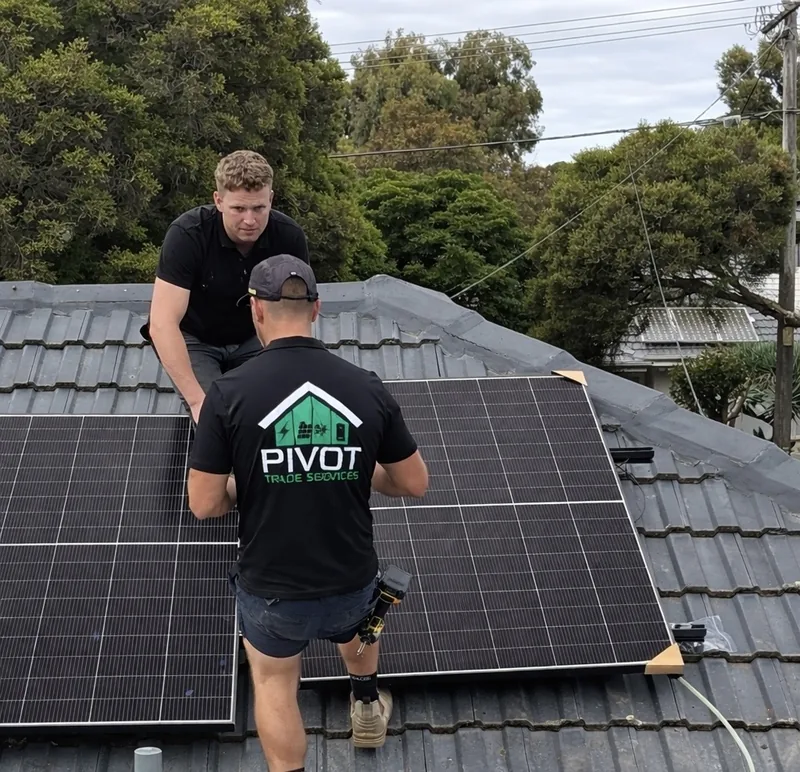
From one of our jobs
Panels going on over a tiled roof in Melbourne's west
Photographed on site in Melbourne’s west. REC 37223.
That gap decides everything about how a system should be designed. We have been accredited solar installers for seven years and we size systems around what the household actually consumes during daylight, then look at what can be shifted into daylight. It is a less impressive number on the quote and a better one on the bill.
Why self-consumption now beats export
Every kilowatt hour you use while the sun is up saves you the full import rate. Every kilowatt hour you export earns a fraction of it. At current rates that is roughly a six to nine times difference for exactly the same energy, and it is the single most important fact in solar economics in 2026.
The practical consequence is that system design stops being about maximising annual generation and starts being about matching a generation curve to a consumption curve. A household that is empty from 8am to 6pm has a different optimal system to one with someone home, a pool pump, or a heat pump on a timer.
It also changes panel orientation advice. North remains best for total yield, but a split east and west array flattens the curve and lifts morning and afternoon output, which is often worth more than peak midday generation you would only export.
Shift the hot water
A heat pump hot water system on a daytime timer is the cheapest storage most homes will ever buy, and it turns 4 cent export into 40 cent avoided import.
Run heating and cooling in daylight
Pre-cooling or pre-heating the house while solar is generating costs almost nothing and reduces evening demand.
Time-shift appliances
Dishwasher, washing machine and pool pump on daytime timers rather than overnight off-peak, which no longer competes.
Then consider a battery
Once the easy shifting is done, whatever is left in the evening peak is the load a battery has to justify itself against.
What it costs and what the rebates do
A quality 6.6kW system in Melbourne is $4,500 to $8,500 before incentives, and roughly $3,000 to $6,000 after federal STCs. STCs are worth about $2,000 to $3,000 on that system size in 2026. They are not a rebate you claim later, they are assigned to the installer and discounted from the price upfront.
The STC scheme ends in 2030 and the value drops each year until then. That is the actual argument for not waiting, and it is worth more than any promotion. If you have been considering solar for three years, the delay has already cost you real money.
On top of that, the Solar Victoria Solar Homes rebate is worth up to $1,400 for eligible households, with a combined household income cap of $150,000 from 1 July 2026. Not everyone qualifies. We check before quoting rather than after, so the number you see is the number you pay.
Export limits and distributor approval
You do not get to decide how much you export. Your distributor does. In Melbourne’s west that is Powercor or Jemena depending on your address, and each has its own connection rules, application process and approval timeframes.
Approval has to be obtained before the system is energised, and the distributor can impose an export limit on your inverter as a condition. That limit is set by network capacity in your street, not by anything the installer chooses. Any installer promising you unlimited export is promising something they do not control.
An export limit is less painful than it sounds under current tariffs. If exports are worth under 5 cents anyway, being capped costs you very little, provided the system was designed around self-consumption in the first place. It hurts most on systems that were oversized to export.
Equipment and standards
We fit Fronius inverters as our default. They are not the cheapest option and we are comfortable saying so. Inverters are the component that fails first in most systems, they carry the monitoring, and they are the part you interact with for the next decade, so it is a poor place to save $600.
Grid-connected inverters must comply with AS/NZS 4777.2, which governs how they behave on the network, including how they respond to voltage and frequency excursions. Array installation follows AS/NZS 5033, covering DC cabling, isolation, labelling and mounting. All associated electrical work follows AS/NZS 3000 and is certified with a Certificate of Electrical Safety.
To claim STCs or the Solar Victoria rebate, the system must be installed by an accredited installer. That is what SAA S3962281 covers. Panels and inverters also need to be on the approved product lists, which is one reason we do not fit whatever is cheapest that month.
Roofs in the western suburbs
Roof condition matters more than most quotes admit. A tiled roof from the 1950s in Altona or Yarraville may need tiles replaced during install. Old Colorbond can be fine structurally while the fixings are not. If a roof is due for replacement within five years, it is nearly always cheaper to do that first than to pay for a removal and reinstall later.
Shading is the other honest conversation. A single afternoon shadow from a neighbouring two storey extension or a mature gum can take a surprising bite out of a string. We assess it on site and design around it, using string layout or optimisers where they genuinely help rather than as a default upsell.
Salt exposure in Altona, Seaholme and Williamstown means mounting hardware and isolator enclosures need to be specified for coastal conditions. Standard hardware corrodes noticeably faster within a couple of kilometres of the bay.
After the install
You should finish with monitoring you can actually read, documentation covering the array layout and inverter settings, your Certificate of Electrical Safety, and warranty paperwork for panels and inverter. We also walk you through what normal output looks like in each season, because a system that is quietly underperforming is easy to miss.
Our workmanship guarantee applies and covers the installation itself: mounting, penetrations, cabling, isolators and commissioning. Panel and inverter warranties are much longer and come from the manufacturer. If something goes wrong, we handle the diagnosis and tell you which warranty it falls under.
| Item | Amount | Notes |
|---|---|---|
| 6.6kW system before incentives | $4,500 - $8,500 | Quality panels and a Fronius inverter |
| Federal STC value | $2,000 - $3,000 | Discounted at point of sale, tapers annually to 2030 |
| 6.6kW system after STCs | $3,000 - $6,000 | What most households actually pay |
| Solar Homes rebate | Up to $1,400 | Income cap of $150,000 combined from 1 July 2026 |
| Typical export rate | Under 5c per kWh | No mandatory minimum since 1 July 2025 |
| Typical peak import rate | 30c - 45c per kWh | Why self-consumption drives the return |
Ranges reflect equipment choice, roof type, storey height and switchboard condition. Rebate eligibility is confirmed before quoting.
How the job runs
- 01
Usage and roof assessment
We start with 12 months of interval data if you have it, then assess roof pitch, orientation, shading, tile or sheet condition and access. This is what decides system size, not a floor plan.
- 02
Design and rebate check
We lay out the array, select the inverter, and confirm STC value and Solar Homes eligibility against the income cap before issuing the quote, so the price you approve is final.
- 03
Distributor application
We lodge the connection application with Powercor or Jemena and confirm any export limit they impose before install day. Nothing gets energised without that approval.
- 04
Installation
Usually one day for a standard single storey system. Mounting, DC and AC cabling, isolators, inverter mounting and any switchboard work, all to AS/NZS 5033 and AS/NZS 3000.
- 05
Commissioning and handover
Inverter commissioned to AS/NZS 4777.2, monitoring configured on your phone, Certificate of Electrical Safety issued, and paperwork lodged so your retailer can switch you to a solar tariff.
Recent work
Solar Panel Installation we have done around Melbourne's west
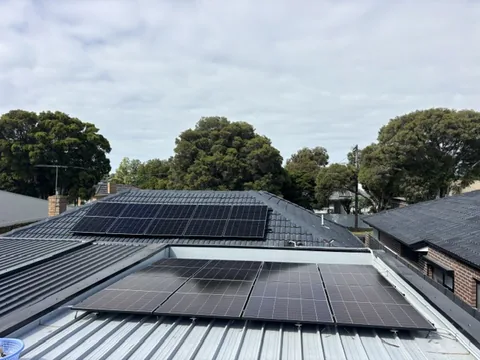
A finished array split across two roof faces 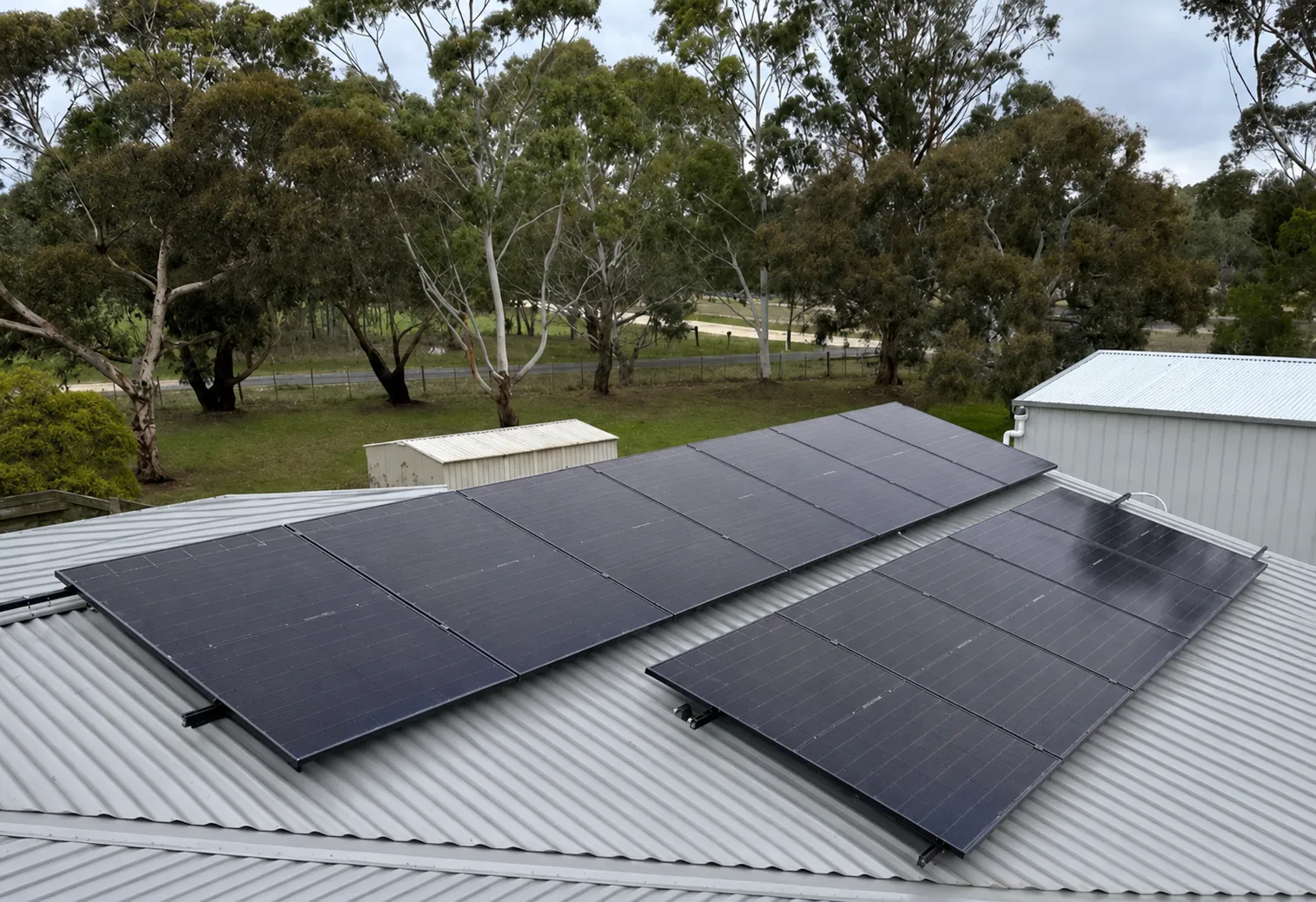
Panels laid out across a colorbond roof 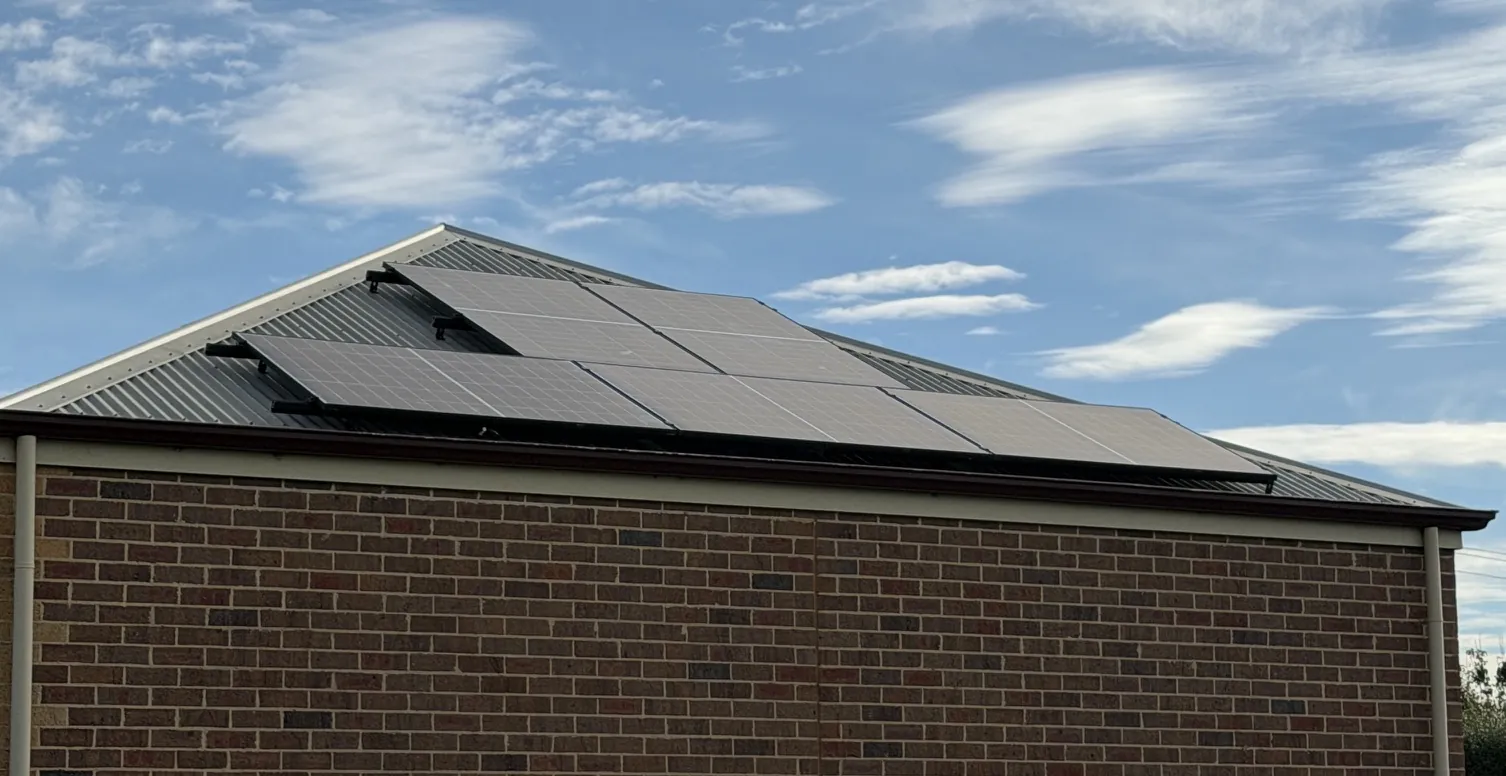
A finished array on a brick home in Melbourne’s west 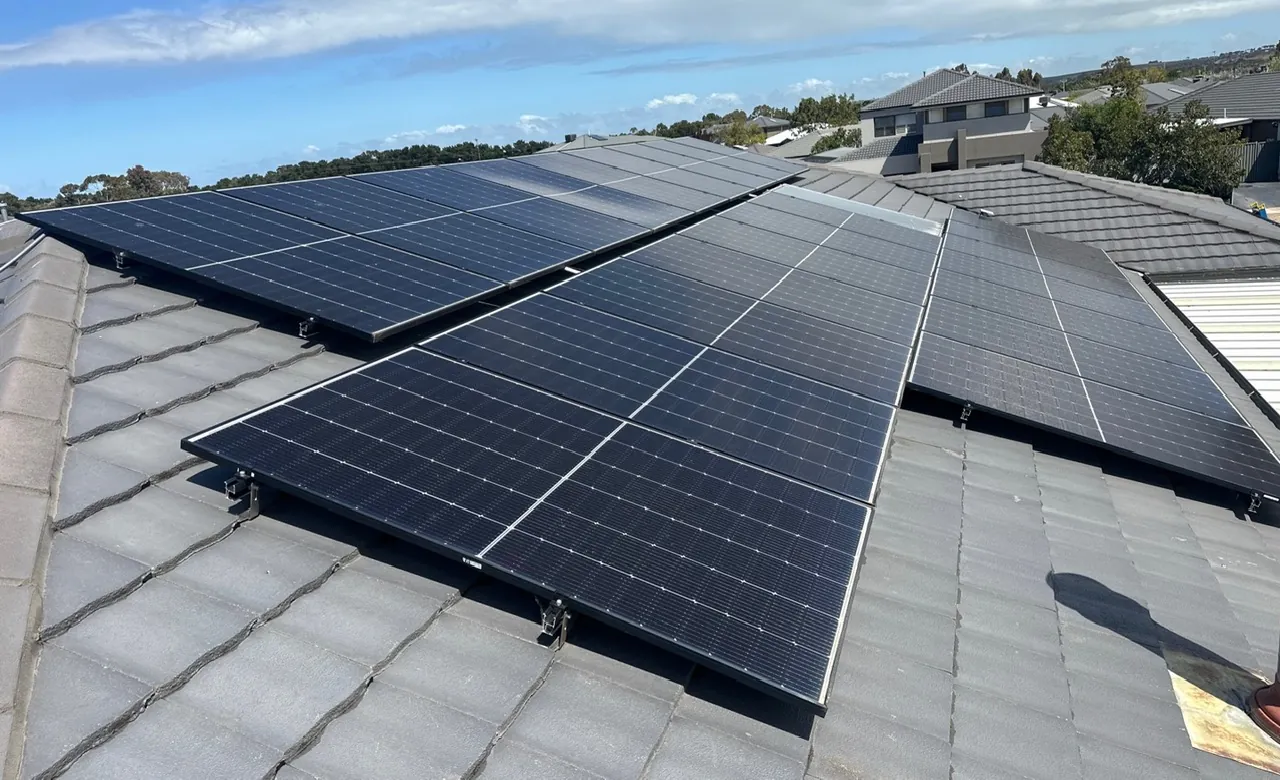
Panels fixed to a tiled roof, laid out for the best run of sun 
Inverter and isolators mounted out of the weather 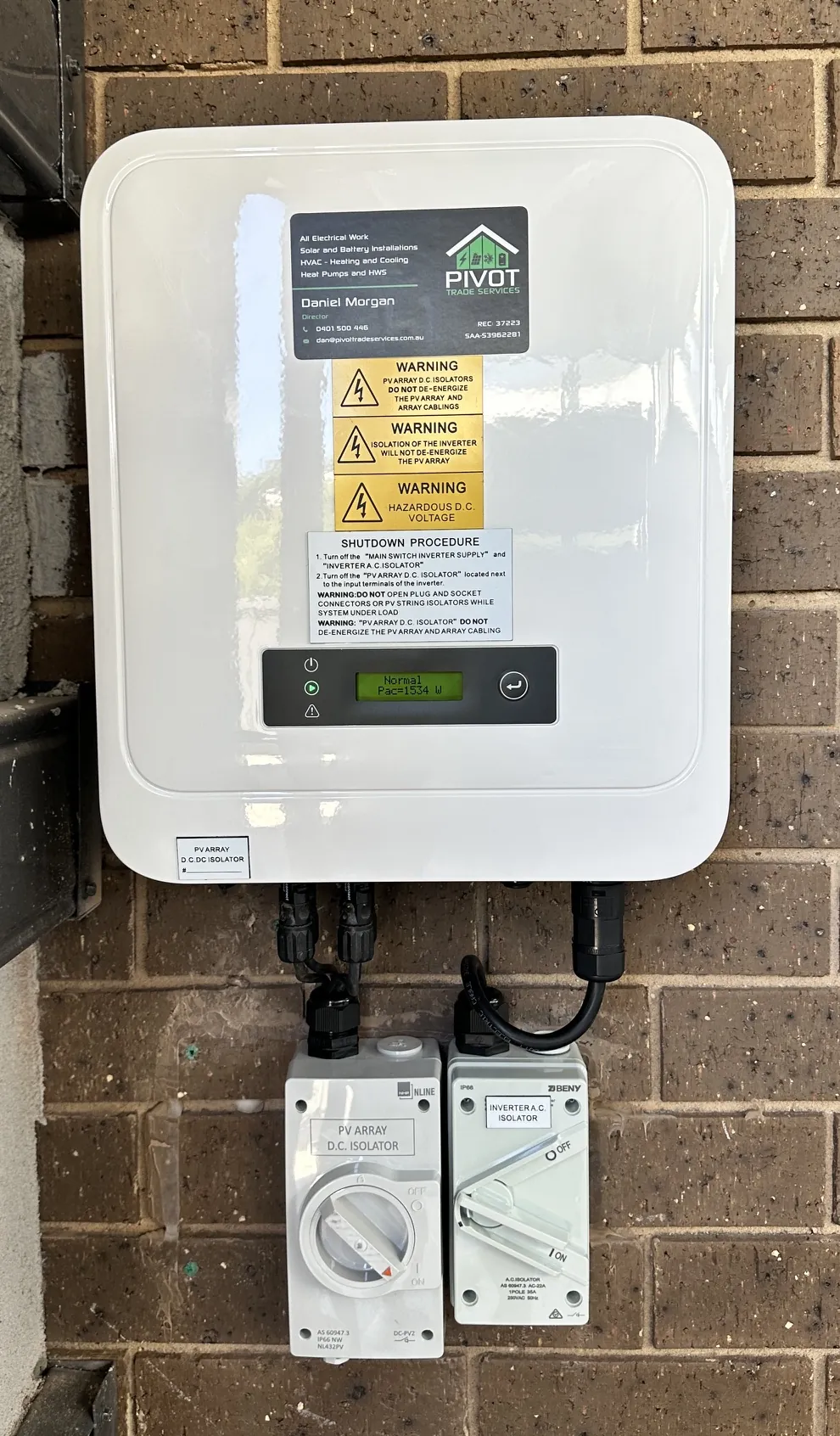
Inverter and isolators mounted on the brickwork, out of the weather
Photographs from our own jobs. No two switchboards, roofs or run lengths are the same, which is why we quote in writing after seeing yours.
Licensed and accredited work by a local team. Read about Pivot Trade Services or see recent jobs across the western suburbs.
Answers
Frequently asked questions
It depends on daytime consumption, not house size. 6.6kW remains the common sweet spot because it pairs with a 5kW inverter and attracts strong STC value. Households that are empty all day may do better with a smaller system plus load shifting. Households with a heat pump, pool or someone home often justify going larger.
It varies by distributor and by how loaded your local network is. Powercor and Jemena each run their own process, and some streets in established areas take longer because network capacity is already committed. We lodge the application early and give you a realistic date rather than booking an install we cannot energise.
Rarely, under 2026 tariffs. When exports are worth under 5 cents and imports cost 30 to 45 cents, most of the value is in what you use rather than what you send out. An export limit hurts systems that were deliberately oversized to sell power. It barely touches a system designed around self-consumption.
Panel prices have already fallen a long way and the remaining movement is small. The incentive is moving the other way. STCs taper every year until the scheme ends in 2030, so waiting means paying more of the total yourself while also forgoing a year of bill savings. On current numbers, waiting costs money.
Yes, and west can be the better choice for some households. West-facing panels produce later in the day, which lines up with people arriving home and turning things on. Total annual yield is lower than north, but the energy is generated at a time you are more likely to use it, which is what actually pays.
Very little. Melbourne rain handles most cleaning, though panels under trees or near industrial areas benefit from an occasional wash. What matters more is watching output. If your monitoring shows a string producing noticeably less than its pair, something has changed and it is worth investigating rather than waiting for the next bill.
Sometimes, and it depends on inverter headroom, string configuration and your existing distributor approval. Adding capacity usually requires a new application, and if the original inverter is already at capacity it means replacing it. It is generally cheaper to size correctly at the start than to extend in two years.
Yes. Once the system is approved and installed, your meter needs to be reconfigured for bidirectional metering and your retailer needs to move you onto a solar tariff. We lodge the paperwork that triggers this, but you should also check your first bill after install to confirm the change actually happened.
Get a fixed quote on solar panel installation
Tell us what you need and we will give you a written price, not a range that moves on the day.
- Free
- On-site quotes
- Fixed
- Written pricing
- 100%
- Workmanship guarantee
- 5.0★
- 69 Google reviews