
Half heritage cottage, half converted industrial
Electrician in Spotswood
Spotswood is small and unusual. A tight pocket of period cottages around Hudsons Road, a strong industrial heritage anchored by the Pumping Station and Scienceworks, and a growing number of warehouses and workshops converted into homes and studios. Two completely different electrical worlds inside a few streets.
- Spotswood 3015
- Jemena network
- REC 37223
The short answer
Pivot Trade Services is a licensed electrician working in Spotswood 3015 under REC 37223, nine kilometres from our Altona workshop. We cover cottage rewiring, switchboards, converted warehouse and studio work, three-phase circuits, solar, EV chargers and air conditioning. Spotswood is on the Jemena network, and its converted industrial buildings often retain legacy three-phase supply that can be reused for fast EV charging without a supply upgrade.
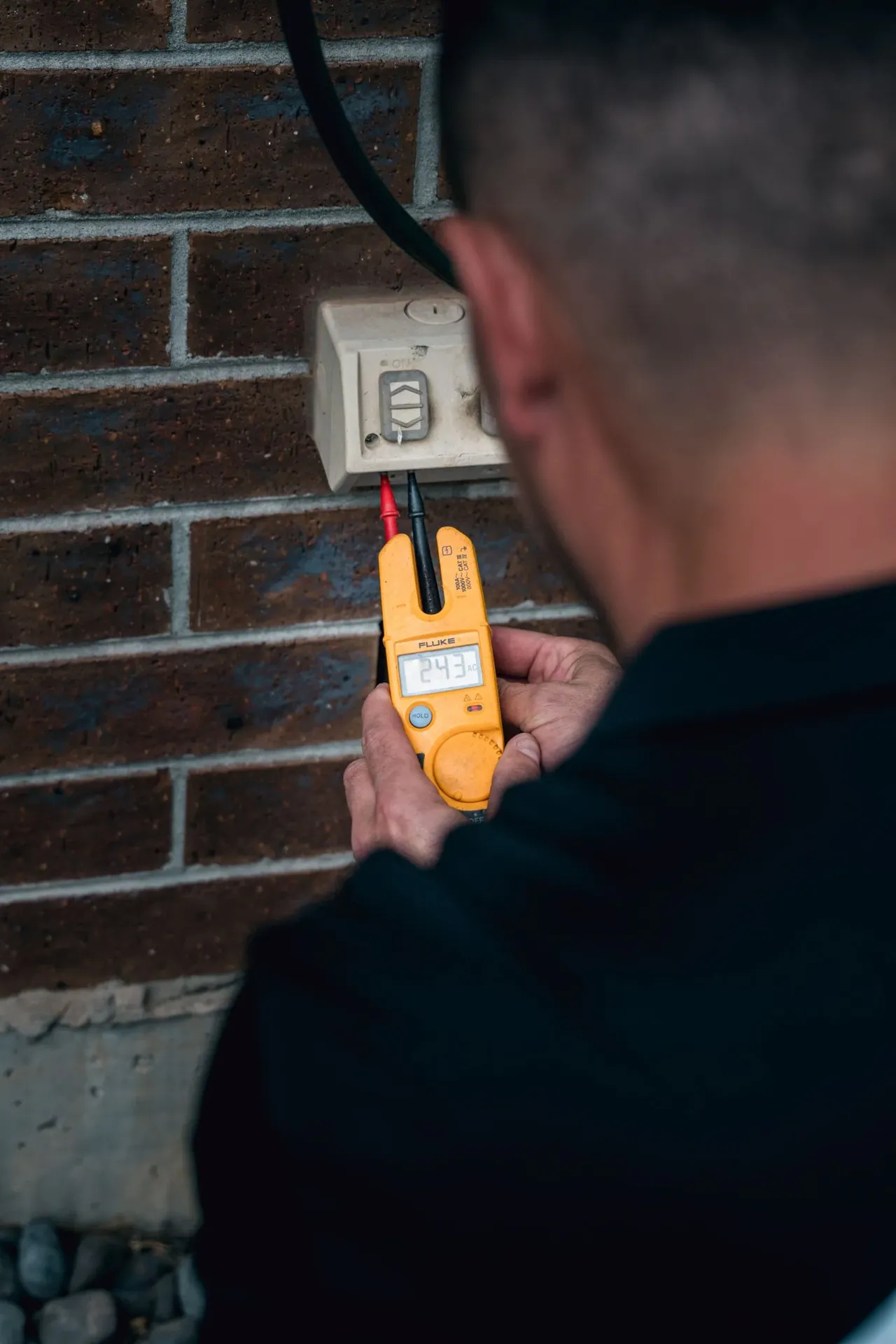
From one of our jobs
Testing an outdoor power point after installation
Photographed on site in Melbourne’s west. REC 37223.
The cottages have the wiring problems you would expect of their age. The converted buildings often have the opposite problem, or rather the opposite advantage: supply capacity that a house would have to pay thousands to add, sitting unused because nobody has tested what is actually there.
Legacy three phase, and how to find out if you have it
A building that used to run machinery was very likely fed with three-phase supply, and when it was converted, that supply frequently stayed. We have opened boards in Spotswood conversions and found three active conductors sitting there behind a domestic-looking main switch.
If that applies to your building, a three-phase EV charger at $2,500 to $3,000 or more becomes straightforward, a larger solar inverter with balanced phases is possible, and heavy workshop or studio loads stop being a problem. The first step is a proper check of what is at the meter and what condition the existing distribution is in, because legacy supply is only useful if the cable and protection behind it are sound.
Check the meter first
Three active conductors and the main switch arrangement tell us what supply you have before anything is ordered.
Condition, not just capacity
Old industrial distribution can be adequate in size and long past it in condition. Both get tested.
Balanced loads
On three phase, circuits are distributed across the phases rather than piled onto one, which is a real part of the labour.
Cottage wiring built for a much smaller house
The Spotswood cottages were wired for a fraction of a modern load. A few lighting points, a couple of power circuits, and a stove. Now the same installation runs an induction cooktop, a dishwasher, a home office, a reverse cycle head and a car in the driveway.
The cable is often sound. The number of circuits is the constraint, and so is the board. A refit with RCBOs on every circuit starts around $800 and a full replacement with a new panel runs toward $3,500. Where original rubber-insulated cable survives on the untouched circuits, we test insulation resistance before energising anything new on it rather than assuming age alone is the problem.
Weather on two fronts
Spotswood takes real weather. It is bay-adjacent, so salt reaches it, and it sits under the West Gate approach where wind and grime are constant. Outdoor equipment here shows wear faster than a sheltered inland suburb.
That is a specification issue rather than a design one. Sealed enclosures with the right IP rating, protected cable entries, corrosion-resistant fixings on anything at height, and outdoor units positioned out of the worst exposure where the block allows. On the flat warehouse and studio roofs common here, mounting and waterproofing detail matters more than on a pitched tile roof, because standing water finds any weakness.
Adding load, in a cottage or in a shell
The two building types here need opposite advice. In a cottage, adding an EV charger, an induction cooktop or a reverse cycle head usually means the board runs out of room and protection at the same time, so the board comes first and the new circuit second. A single-phase 7kW charger is $1,200 to $2,200 installed, and on a compact block with no side clearance the cable route is what moves it within that range.
In a converted building the supply is often more than adequate and the difficulty is physical. There are no cavities to run cable in, no accessible ceiling space, and frequently a concrete slab where you would like a vertical run. Surface conduit and trunking are the normal answer, installed neatly and properly supported rather than improvised, and in most of these fitouts it suits the building anyway.
Cottage boards
An RCBO refit starts around $800 and a full replacement with a new panel runs toward $3,500, depending on circuit count.
Conversions
Cable routes are surface-run and planned in advance, because there is nowhere to hide them after the fact.
Two very different roofs for solar
A Spotswood cottage offers small original roof planes, often steep and often partly shaded by a neighbouring building. A converted warehouse offers a large flat roof with nothing on it. The same suburb, and two completely different solar designs.
On the cottages we work with the planes that exist and size the system to daytime consumption. A 6.6kW system is $4,500 to $8,500 before STCs and roughly $3,000 to $6,000 after, and a small cottage roof will often support less. On a flat warehouse roof, tilt frames set the array to a useful angle and the available area is rarely the limit, so the design question becomes consumption, export approval and whether a battery at $8,000 to $12,000 before rebates makes sense alongside it.
On the ground
What we see in Spotswood buildings
- Three-phase supply still connected in converted industrial buildings, behind a board that looks entirely domestic.
- Original cottage circuits that are physically sound but far too few for how the house is used now.
- Outdoor fittings weathering faster than expected from the combination of salt air and constant wind near the bridge approach.
- Large flat roofs on studio and warehouse conversions where tilt-frame solar makes far more sense than a standard flush layout.
Licensed and accredited work by a local team. Read about Pivot Trade Services or see recent jobs across the western suburbs.
Answers
Spotswood questions
Quite possibly. Buildings that once ran machinery were commonly fed with three phase, and conversions often keep it even when the new fitout looks entirely domestic. We check the number of active conductors at the meter and the state of the existing distribution. If it is there and sound, fast EV charging and larger inverters become options without paying for a supply upgrade.
Yes, though rarely concealed. Converted industrial buildings usually have no cavities and no accessible ceiling space, so cable runs in surface conduit or trunking. In a lot of these fitouts that suits the look anyway. What matters is that the route is planned and the conduit is installed neatly and correctly supported, rather than improvised on the day.
It gets more exposure than most people assume. Salt from the bay plus constant wind and grime from the bridge approach means outdoor equipment ages faster here than in a sheltered inland street. We specify sealed enclosures, protected entries and corrosion-resistant fixings on anything mounted outside or at height, which costs little at installation and avoids early replacement.
Not necessarily dangerous, but almost certainly overloaded. Spotswood cottages were wired with very few power circuits, and modern kitchen appliances all landed on the same one. The fix is splitting the load across additional circuits at the board, which needs the board to have room and correct protection. We test rather than assume, because a genuine wiring fault produces similar symptoms.
Tilt frames, generally, to set the panels at a useful angle rather than lying flat where they collect dirt and shed water poorly. Flat roofs also need careful attention to mounting and waterproofing, because standing water finds any penetration that was not detailed properly. Area is rarely the constraint on these roofs, so the design is driven by consumption and by what Jemena approves for export.
Nine kilometres from 11/23-25 Jordan Close, Altona 3018. Spotswood is booked work with a time window rather than a two-minute drive. Everything electrical is certified under REC 37223 with a Certificate of Electrical Safety, solar and battery work sits under SAA accreditation S3962281, and all of it carries a 100% workmanship guarantee.
Other work we do in Spotswood
- Solar installation in SpotswoodHalf cottage, half warehouse
- Home battery in SpotswoodCottages and converted industrial
- EV charger in SpotswoodHalf heritage cottage, half converted warehouse
- Split system in SpotswoodCottage rooms and warehouse volumes in the same street
- Heat pump hot water in SpotswoodHalf heritage cottage, half converted warehouse
Get a Spotswood quote
Tell us the address and what you need. We quote Spotswood 3015 and the surrounding western suburbs in writing, with no obligation.
- Free
- On-site quotes
- Fixed
- Written pricing
- 100%
- Workmanship guarantee
- 5.0★
- 69 Google reviews