
The suburb where the board, the wiring and the hot water all age out together
Electrician in Newport
Newport is our most common full-upgrade suburb, and there is a reason for it that is nothing to do with marketing. The period weatherboard and brick homes around Newport Lakes and the old Railway Workshops were largely built and serviced in the same window, which means they are now arriving at the end of several component lives at once.
- Newport 3015
- Jemena network
- REC 37223
The short answer
Pivot Trade Services is a licensed electrician working in Newport 3015 under REC 37223 and SAA accreditation S3962281, eight kilometres from our Altona base. We cover switchboard upgrades, safety switches, rewiring, solar, batteries, heat pump hot water, EV chargers and air conditioning. Newport is on the Jemena network, and a high proportion of its period homes reach the point where the original board, wiring and hot water service all fail within a few years of each other.
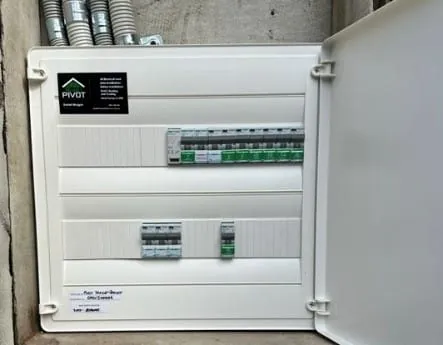
From one of our jobs
Every circuit labelled before we hand it back
Photographed on site in Melbourne’s west. REC 37223.
The board is original or nearly so. The hot water service is at the age where it goes without warning. The wiring is sound in the renovated parts and questionable in the parts nobody has touched. Handled separately, that is four call-outs and four disruptions. Handled as one planned package, it is cheaper and the parts get designed to work together.
Why everything ages out at once here
A switchboard has a service life. So does a hot water service, a ducted heater, and the rubber or early PVC insulation on a set of original circuits. In a suburb where a large share of the housing went up and was serviced in similar decades, those lives run out in similar years.
What that looks like in practice is a household that has a hot water failure in autumn, a tripping circuit in winter, and a quote for solar in spring where the installer says the board cannot take the inverter. Each is treated as a surprise. None of them is. Once you look at the age profile of a Newport house, the sequence is predictable, which means it can be planned instead of reacted to.
Doing it as one package instead of four callouts
The order that saves money is board first, then solar, then hot water and heating, then a battery, then EV charging. The board is first because everything else connects to it, and building it once with spare ways is far cheaper than reworking it three times.
A board replacement runs $800 to $3,500 depending on circuit count and meter panel condition. Heat pump hot water is $3,000 to $4,500 before incentives and uses roughly a third of the electricity of a conventional electric storage unit. A 6.6kW solar system is $4,500 to $8,500 before STCs and roughly $3,000 to $6,000 after. A 10kWh battery is $8,000 to $12,000 before rebates and around $5,500 to $9,500 after. Done together, the circuits are planned once and the disruption happens once.
One board build
Circuits for the inverter, heat pump, charger and future battery are allowed for at the time rather than squeezed in later.
One set of paperwork
Certificates, connection approvals and rebate documentation handled together rather than four times over.
One contractor
Electrical under REC 37223 and solar and battery under SAA S3962281, so nobody is pricing around somebody else’s work.
Street trees are a solar design factor here
Newport has mature street trees, and they are one of the genuine reasons a solar system underperforms its brochure figure. A branch shading part of a string in late afternoon takes off more output than the shaded panel area alone would suggest, depending on how the array is wired.
So we model the shading rather than assuming a north-facing roof is a clear roof. Where trees are unavoidable, the answers are panel-level electronics, string layouts that keep shaded panels together, or simply a smaller array on the clear part of the roof. Original tiled hips and gables in Newport generally give good northern exposure once the trees are properly assessed, which is exactly why the assessment matters.
Coastal, quietly
Newport does not feel like a beach suburb from most of its streets, but it is close enough to the bay that outdoor and rooftop equipment takes salt. It shows on condenser fins, outdoor isolators, enclosure hinges and solar mounting hardware.
The item worth being fussy about is the mounting system on a solar array, because it stays on the roof for twenty-five years and replacing it means taking the panels off. We use hardware rated for the exposure rather than the cheapest compliant option, and we seal outdoor enclosure entries properly rather than relying on the gland that came in the box.
Safety switches, and what they actually do
A large share of the older Newport stock still has circuit breakers without RCD protection, or a single RCD covering the whole house. A breaker protects the cable from overload and fire. An RCD protects a person, by comparing current out with current back and cutting supply in about thirty milliseconds if the difference suggests electricity is going somewhere it should not.
Adding RCD protection to a sound board is $120 to $300 per device. Where we replace a board, we fit RCBOs so each circuit has both functions in one device. That means a fault on the dishwasher trips the kitchen circuit rather than the whole house, and the fridge and the lights stay on while you work out what happened.
On the ground
What we see in Newport homes
- Original boards, original hot water services and original heating reaching the end of their lives within a few years of each other.
- One RCD covering an entire house, so any single fault takes out every circuit at once.
- Mature street trees causing measurable afternoon shading losses on otherwise well-oriented northern roof planes.
- Salt corrosion on condensers and outdoor isolators despite the suburb not feeling coastal from the street.
- Renovated rear sections with modern wiring joined onto untouched original circuits at the front of the house.
Licensed and accredited work by a local team. Read about Pivot Trade Services or see recent jobs across the western suburbs.
Answers
Newport questions
Because everything else connects to it. A solar inverter, a heat pump, a charger and a ducted system each need a compliant circuit with correct protection, and a full or outdated board cannot provide that. Building the board once with spare ways left free costs less than reworking it each time another installer arrives and finds no room. It also means the later jobs are quoted accurately rather than with a board surprise attached.
A like-for-like replacement is fastest and cheapest on the day. A heat pump changeover is $3,000 to $4,500 before incentives and uses roughly a third of the electricity of a conventional electric storage unit, which is why it is usually the better long-term answer, particularly with solar on the roof running it through the middle of the day. It needs a suitable circuit and a sensible outdoor position, both of which we check on site.
Rarely stop, often reduce. Shading on part of an array costs more output than the shaded area suggests, depending on how the strings are arranged. The answers are panel-level electronics, grouping shaded panels on their own string, or designing a smaller array that sits on the genuinely clear part of the roof. We model it rather than estimating from an aerial photo, because Newport trees are a real variable here.
It is better than none and worse than it should be. With a single RCD, any fault anywhere takes out every circuit, including the fridge and the lights, which makes finding the cause harder and living with it worse. RCBOs give each circuit its own combined breaker and safety switch, so faults stay contained. On a board replacement that is standard for us rather than an upgrade option.
Usually across a small number of planned visits rather than one day, because a board replacement, a solar install and a hot water changeover each need their own time and their own outage. What we do is plan them as one project so the board is built for what is coming, the paperwork is handled together, and you are not paying three companies to work around each other.
Eight kilometres from 11/23-25 Jordan Close, Altona 3018, so it is a regular run for us rather than an unfamiliar postcode. Newport is on the Jemena network, which we deal with constantly for solar approvals and meter exchanges. All work is certified under REC 37223 with a Certificate of Electrical Safety and a 100% workmanship guarantee.
Other work we do in Newport
- Solar installation in NewportTrees first, then panels
- Home battery in NewportPart of a planned upgrade, not a bolt-on
- EV charger in NewportThe suburb where the charger is usually part of a bigger upgrade
- Split system in NewportPeriod homes with room to do it properly
- Heat pump hot water in NewportThe suburb where three things fail in the same decade
Get a Newport quote
Tell us the address and what you need. We quote Newport 3015 and the surrounding western suburbs in writing, with no obligation.
- Free
- On-site quotes
- Fixed
- Written pricing
- 100%
- Workmanship guarantee
- 5.0★
- 69 Google reviews