
Post-war homes on one side, new units on the other
Electrician in Sunshine
Sunshine is changing faster than almost anywhere we work. Original post-war blocks around Hampshire Road and out toward the station interchange are being subdivided into two and three-unit developments, and new apartments are going up alongside them. On the same street you will find a 1955 house with its original board and a six-month-old townhouse with RCBOs on everything.
- Sunshine 3020
- Jemena network
- REC 37223
The short answer
Pivot Trade Services is a licensed electrician working in Sunshine 3020 under REC 37223, fourteen kilometres from our Altona base. We cover switchboards, new supplies and meter panels for unit developments, rewiring, solar, EV chargers and air conditioning. Sunshine is on the Jemena network, and its ongoing subdivision of original post-war blocks into two and three-unit developments means new supply arrangements and separate boards are routine work here.
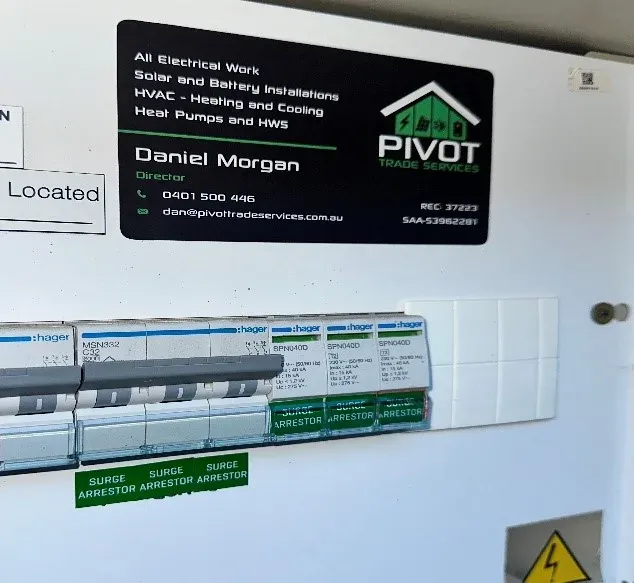
From one of our jobs
Whole-of-home surge protection at the board
Photographed on site in Melbourne’s west. REC 37223.
We work on both sides of that change. Bringing original homes up to a standard that protects the people in them, and wiring the townhouses that are replacing them, including the supply and metering arrangements that a subdivision creates.
What a subdivision actually needs electrically
Splitting one block into two or three dwellings is not just a building exercise. Each new dwelling needs its own supply, its own metering position and its own switchboard, and the point of supply has to be arranged so that every unit can be isolated and metered independently.
That means coordination with the distributor and the metering provider, correctly positioned and accessible meter panels, sub-mains sized for each dwelling and its run, and boards built with spare capacity so the first owner adding a charger does not trigger another job. Getting this wrong is expensive to correct after the slab is down, which is why we would rather be involved before the frame goes up than after.
Metering position
Accessible, compliant and agreed with the metering provider before it is built in, not after.
Sub-mains per dwelling
Sized to the load and the distance from the point of supply, which is not the same for the front and rear units.
Individual boards
Each dwelling gets its own board with RCBOs and its own labelling, plus spare ways for later additions.
Staging
Temporary builder supply, rough-in, fit-off and connection each have their own timing and their own paperwork.
The original post-war stock
The homes that have not yet been redeveloped are where the safety work is. Original boards without RCDs are still very common in Sunshine, and plenty of them have ceramic rewireable fuses. Those boards protect the cable and offer nothing to the person holding the faulty appliance.
Bringing one up to standard is $800 to $3,500 depending on circuit count and whether the meter panel goes with it, and adding RCD protection to a board that is otherwise sound is $120 to $300 per device. If the plan is to sell or rent the property, this is also the work that a periodic safety check or a buyer inspection will surface, so doing it deliberately is cheaper than doing it under pressure.
Townhouse roofs and honest solar sizing
New Sunshine townhouses have modern Colorbond roofs that are excellent to work on and small in area once you account for the shared boundaries and the shape of the dwelling. A three-unit development shares the roof area that one post-war house used to have.
So the sizing conversation has to be realistic. A 6.6kW system is $4,500 to $8,500 before STCs and roughly $3,000 to $6,000 after, and a compact townhouse roof will frequently support less than that once you allow for setbacks and the inverter position. On a small array, matching generation to daytime consumption matters far more than chasing a headline system size, and a battery is usually a better next step than two more panels.
Adding load to a house that predates it
The original Sunshine homes were wired for a household with far fewer appliances. Add a split system, an induction cooktop, a home office and a car and the board runs out of both space and protection at the same time.
The order that works is board first, then the rest connects to something adequate. A single-phase 7kW EV charger is $1,200 to $2,200 installed, a split system is $2,500 to $7,500 depending on capacity and pipe run, and heat pump hot water is $3,000 to $4,500 before incentives. On a post-war block with side access and a detached garage, the cable run to the garage is the variable in the charger price, and we measure it before quoting.
Fourteen kilometres, and how we run Sunshine work
Sunshine is fourteen kilometres from our Altona workshop. We are not the closest electrician to you and we will not claim to be. Sunshine work is booked with a time window and we bring what the job needs, because a return trip for a part is a real cost on a run this length.
What we do bring is one contractor across the electrical, solar and heating work, licensed under REC 37223 and SAA S3962281, with a 100% workmanship guarantee. On a subdivision or a full house upgrade, that single point of responsibility saves more time than proximity would.
On the ground
What we see in Sunshine homes
- Original post-war boards with rewireable fuses and no RCD protection, often in houses that are otherwise well maintained.
- Subdivision sites where the metering position was decided by the builder before anyone asked the metering provider.
- New townhouses with excellent boards and very little individual roof area for solar.
- Detached garages on the older blocks that were wired informally and need a proper sub-main.
- Rental properties where a periodic safety check has just surfaced defects that have existed for decades.
Licensed and accredited work by a local team. Read about Pivot Trade Services or see recent jobs across the western suburbs.
Answers
Sunshine questions
Each new dwelling needs its own supply, its own metering position and its own switchboard, plus a sub-main sized for its load and its distance from the point of supply. The metering arrangement has to be agreed with the distributor and the metering provider before it is built in. We would rather be involved before the frame goes up, because relocating a meter panel afterwards is expensive.
The check has surfaced what was already there, which in Sunshine is usually missing RCD protection or an original board that cannot provide it. Adding RCDs to a sound board is $120 to $300 per device. A full replacement is $800 to $3,500 depending on circuit count and meter panel. We provide the certification the check requires and the Certificate of Electrical Safety for the work itself.
Less than on the house it replaced, usually. A three-unit development shares the roof area a single post-war home once had, and setbacks, boundaries and the dwelling shape reduce it further. We design to the usable planes rather than a target system size, and on a small roof we would generally point you toward matching daytime consumption first and considering a battery before adding more panels.
Yes. That covers the sub-mains, the metering panel arrangement, individual boards for each dwelling, and the applications to the distributor and metering provider. Jemena is the distributor for Sunshine 3020. The paperwork is usually the longest part of the timeline, so it gets started early rather than at fit-off when the builder wants power on.
No. There is no rule forcing you to upgrade a working board simply because it is old. The obligation arrives when new work is done, because any new or altered circuit has to comply with current requirements, which in practice means RCD protection. Rental properties also have periodic safety check obligations. The safety argument is separate from the legal one, and it is the stronger of the two.
For planned work, because one contractor covers the electrical, solar and heating side under REC 37223 and SAA S3962281, which matters on a subdivision or a full house upgrade where several trades otherwise price around each other. For an urgent fault, we do run 24/7 callouts, and we will give you a realistic arrival time from Altona rather than an optimistic one.
Other work we do in Sunshine
- Solar installation in SunshineA suburb halfway through rebuilding itself
- Home battery in SunshineCheck the meter before the battery
- EV charger in SunshineA suburb rebuilding itself, two circuits at a time
- Split system in SunshinePost war rooms on one block, townhouse walls on the next
- Heat pump hot water in SunshineA suburb rebuilding itself two units at a time
Get a Sunshine quote
Tell us the address and what you need. We quote Sunshine 3020 and the surrounding western suburbs in writing, with no obligation.
- Free
- On-site quotes
- Fixed
- Written pricing
- 100%
- Workmanship guarantee
- 5.0★
- 69 Google reviews