
Period homes, heritage constraints, and what is actually behind the wall
Electrician in Williamstown
Williamstown work is heritage work. The homes around Nelson Place, The Strand and the streets behind the Botanic Gardens are Victorian and Edwardian, with post-war infill filling the gaps. They have been renovated, extended, rewired in part and left alone in part, usually by several different people over a century.
- Williamstown 3016
- Jemena network
- REC 37223
The short answer
Pivot Trade Services is a licensed electrician working in Williamstown 3016 under REC 37223, seven kilometres from our Altona workshop. We cover switchboard upgrades, rewiring, fault finding, lighting, solar, batteries, EV chargers and air conditioning. Williamstown is on the Jemena network and its heritage Victorian and Edwardian housing around Nelson Place regularly hides rubber-insulated wiring and unbonded metalwork, so a proper test comes before any new load is added.
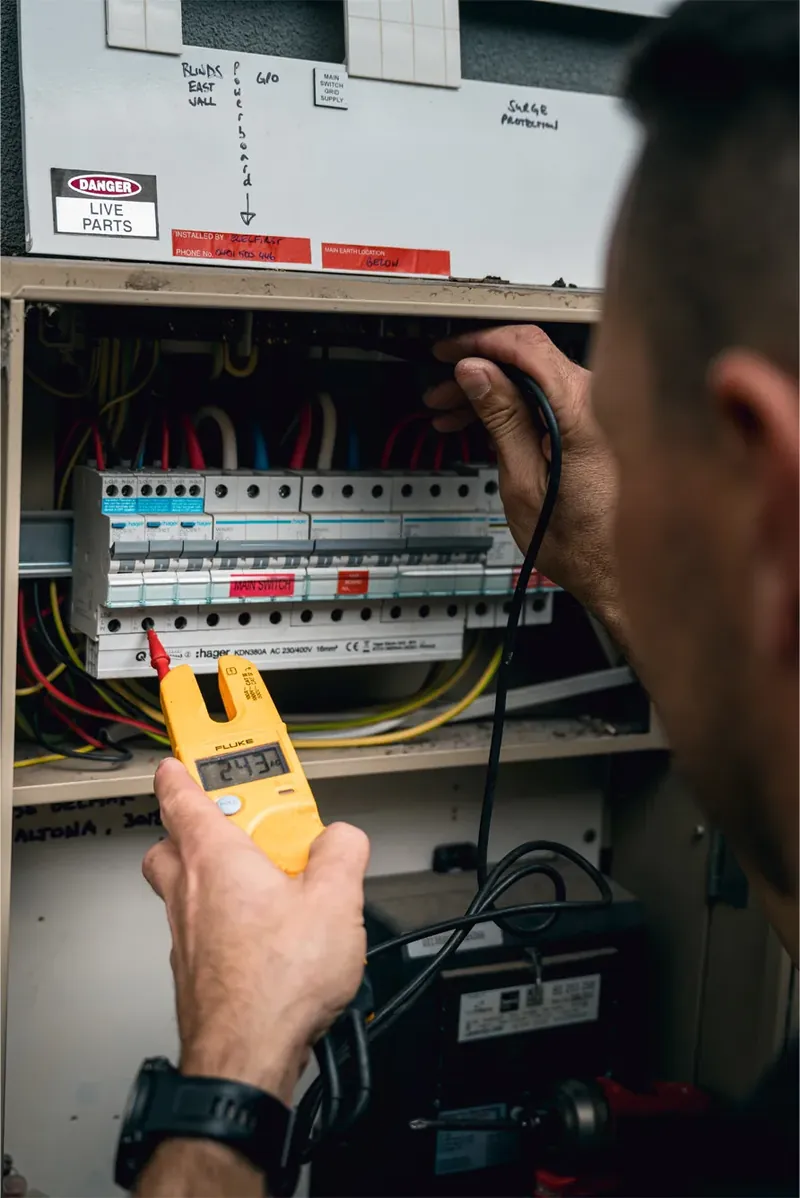
From one of our jobs
Live testing after a switchboard upgrade in Melbourne's west
Photographed on site in Melbourne’s west. REC 37223.
That means the first job on almost any Williamstown quote is finding out what is actually there. We have opened plenty of Williamstown boards expecting a straightforward addition and found rubber-insulated cable, an earth that goes nowhere, or three generations of wiring sharing one terminal. Adding load to that without looking first is how a small job becomes an insurance claim.
What a century of alterations leaves behind
Rubber-insulated wiring was used well into the 1950s and it does not age gracefully. The insulation goes hard, then brittle, then it cracks off the conductor when it is disturbed. In a Williamstown period home it often survives in the parts nobody has touched: the original lighting circuits, the runs under the floor, the cable feeding the front rooms.
The other recurring find is a board that has been added to rather than replaced. Each renovation bolted on what it needed. The result is mixed protection, unlabelled circuits and, frequently, metalwork that is not properly bonded because the earthing arrangement dates from a time when it was not required. None of this is unusual for the housing stock. It is simply what has to be established before anyone talks about a charger or an induction cooktop.
Insulation resistance testing
The measurement that tells you whether old cable is still safe to energise, rather than whether it looks alright from the board.
Earthing and bonding
Period homes often have metal pipework and fittings that were never bonded, which matters more now that there is more metal in a kitchen and bathroom.
Staged rewiring
A full rewire is disruptive in a heritage home. We can stage it circuit by circuit so plaster and cornices are opened once, not five times.
Solar on slate, chimneys and dormers
Williamstown roofs are the hardest we design around. Slate and heritage tile, steep pitches, chimneys, dormers and hips that break the roof into short unusable runs. A design that would drop straight onto an Altona Meadows roof simply will not fit here.
It is still worth doing on plenty of homes, particularly where a rear extension has added a modern roof plane out of sight of the street. A 6.6kW system is $4,500 to $8,500 before STCs and roughly $3,000 to $6,000 after, but in Williamstown the honest answer is sometimes that the roof supports less than that. We would rather design a smaller system that performs than sell you panels facing the wrong way to make a headline number.
Heritage overlays and where equipment is allowed to go
A large part of Williamstown sits under heritage controls, and they affect visible hardware. Panels on a street-facing roof plane, an inverter on a front wall, an outdoor condenser where it can be seen from the street, and in some cases the meter panel itself can all be subject to what the overlay permits.
We plan around this rather than discovering it afterwards. Rear roof planes, side returns, screened condenser positions and inverters inside a garage or under a rear eave are the usual answers. It occasionally changes the economics of a system, and it is far better to know that at the quote stage than after an application comes back.
Panel placement
Rear and side planes first, which sometimes reduces system size but keeps the application straightforward.
Condenser siting
Air conditioning outdoor units screened or placed away from the street frontage, with the pipe run planned to suit.
Cable routes in period fabric
Running cable without cutting into original plaster, cornices or leadlight is a large part of the labour in these houses.
EV charging without a driveway
Narrow heritage frontages and rear laneway access mean a lot of Williamstown homes have no off-street parking at all, or have it at the back of the block reached from a lane. That changes an EV charger from a wall-mounting exercise into a routing problem.
Where there is a rear garage or carport, the run from the board at the front of the house is long and often has to go around rather than through the building. That is the difference between a $1,200 charger install and a $2,200 one, and it is worth a proper conversation before you order the unit. Where there is genuinely no private parking, we will tell you that a home charger is not the right spend rather than fitting one you cannot reach.
A bayside suburb on the Jemena network
Williamstown is on Jemena, not Powercor, which matters for solar connection approvals, meter exchanges and supply upgrades. We lodge that paperwork as part of the job. It is also genuinely coastal, with Point Gellibrand and Williamstown Beach putting salt air across a large part of the suburb.
The combination of heritage fabric and salt exposure is why we specify outdoor hardware carefully here. Corroding fixings on a slate roof are a much bigger problem than on a Colorbond one, because access is harder and the roof itself is easily damaged. Anything we fix to a heritage roof is chosen to outlast the exposure.
On the ground
What we see in Williamstown homes
- Rubber-insulated wiring surviving on original lighting circuits in otherwise renovated period homes.
- Switchboards that have been extended by four different tradespeople, with labelling that stopped matching reality decades ago.
- Metal pipework and fixtures that were never bonded, because the original installation pre-dated the requirement.
- Roof planes broken into short runs by chimneys and dormers, which caps solar capacity well below what the roof area suggests.
- Rear laneway garages that make the EV charger cable run longer than the entire rest of the job.
Licensed and accredited work by a local team. Read about Pivot Trade Services or see recent jobs across the western suburbs.
Answers
Williamstown questions
You usually cannot tell from the switchboard, because the visible tails are often the newest part. It shows up when a fitting is removed and the insulation crumbles, or in an insulation resistance test that comes back low. If your home is pre-1960 and has not been fully rewired, assume some original cable survives and have it tested before adding any significant load.
Rarely stop, often shape. The usual outcome is that panels go on rear or side roof planes rather than the street-facing one, and the inverter goes somewhere out of view. That can reduce the size of the system the roof will carry. We design to the constraint from the start rather than submitting something that has to be revised, and we tell you honestly if the result is too small to be worth the spend.
Largely, yes, though not entirely. Roof space, subfloor and existing cable paths do most of the work, and access holes can be planned into cupboards, skirtings and less visible walls. Original plaster, cornices and leadlight are worth protecting, so we plan the route before we start rather than chasing cable and patching afterwards. Staging the work circuit by circuit also limits how much is open at once.
Jemena. That is different to Altona and Altona Meadows on the Powercor side, and it affects solar connection approvals, export limits, meter exchanges and supply upgrades. We handle those applications as part of the job. It has no bearing on your retailer, which you can change independently of who owns the poles and wires.
The board has to come first. A ducted system needs its own circuit with the correct protection, and a full or non-compliant board cannot provide it. Depending on the existing enclosure, that is either an RCBO refit from around $800 or a full replacement toward $3,500. In a period home we also check the consumer mains, because a small original supply cable can be the real bottleneck rather than the board.
Seven kilometres from our workshop at 11/23-25 Jordan Close, Altona. It is a suburb we work in most weeks, so we know the housing stock and the constraints rather than treating it as an unfamiliar postcode. Planned work is booked with a time window, and we attend live faults across the area on a 24/7 basis.
Other work we do in Williamstown
- Solar installation in WilliamstownHeritage roofs, realistic arrays
- Home battery in WilliamstownPeriod homes, modern storage
- EV charger in WilliamstownHeritage frontages, rear lanes and the parking question
- Split system in WilliamstownHigh ceilings, solid walls and a heritage overlay
- Heat pump hot water in WilliamstownHeritage homes, modern appliance, careful planning
Get a Williamstown quote
Tell us the address and what you need. We quote Williamstown 3016 and the surrounding western suburbs in writing, with no obligation.
- Free
- On-site quotes
- Fixed
- Written pricing
- 100%
- Workmanship guarantee
- 5.0★
- 69 Google reviews