
Dedicated circuits, honest advice on charging speed
EV Charger Installation in Melbourne
Charging from a normal power point works, but it is slow and it was never designed to run at full load for eight hours a night. A wall-mounted charger on its own circuit fixes both problems. It charges four to five times faster and it does it on cable and protection sized for the job.
- REC 37223
- Melbourne west
- Fixed quotes
The short answer
A home EV charger installation in Melbourne typically costs $1,200 to $2,200 for a single-phase 7kW wall unit, and $2,500 to $3,000 or more for a three-phase unit. A 7.4kW charger adds roughly 40 to 50km of range per hour, compared with about 10km per hour from a standard power point. EV charging equipment is prescribed electrical work, so a licensed Registered Electrical Contractor must install it on a dedicated final subcircuit under AS/NZS 3000 and issue a Certificate of Electrical Safety.
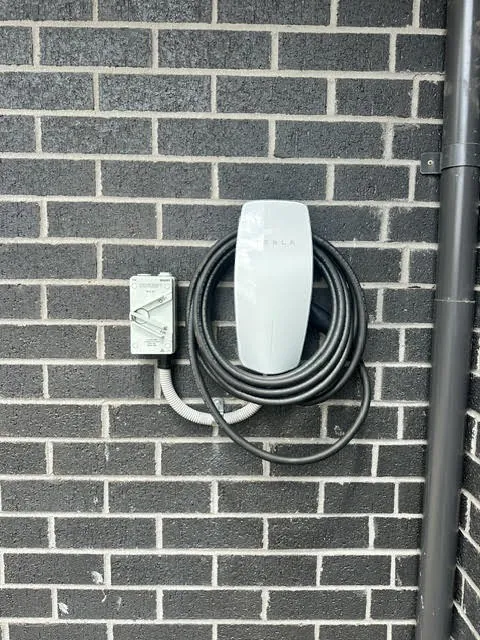
From one of our jobs
A tethered charger, wired back to its own circuit
Photographed on site in Melbourne’s west. REC 37223.
We install EV chargers across Altona, Williamstown, Point Cook, Werribee, Footscray and the rest of Melbourne's west. Every job starts with a look at your switchboard and the cable route, because those two things decide the price far more than the brand of charger you pick.
What an EV charger installation actually involves
Section 7.9 of AS/NZS 3000 covers electric vehicle charging installations. In practice that means the charger gets its own final subcircuit back to the switchboard, protected by a breaker sized to the charger and an RCD of the correct type for DC leakage. It cannot share a circuit with your power points or your lights.
Most single-storey homes with the switchboard on the garage wall are a half day job. Where the board is at the front of the house and the car parks at the back, the cable run becomes the main piece of work.
Site check first
We look at the board, the available spare ways, the main switch rating and where the cable can run without cutting up finished walls.
Dedicated circuit
New cable from the board to the charger position, sized for a continuous load rather than an occasional one.
Protection and isolation
Correct breaker, RCD protection suited to EV equipment, and a clearly labelled way to isolate the charger.
Mounting and commissioning
Charger fixed at a sensible height, app set up, charging current configured, then a full test to confirm it delivers the current it claims.
Certificate of Electrical Safety
Issued at the end, which is your proof the work was done by a licensed REC and tested.
Single phase or three phase
Most Melbourne homes are single phase. On single phase the practical ceiling for a home charger is 32A, which is about 7.4kW, and that adds roughly 40 to 50km of range per hour. Plug in at 6pm with a near empty battery and you will be full by morning, which is all most drivers need.
Three phase supply lets you go to 11kW or 22kW. That is worth doing if you drive very long distances, run two EVs off one charger, or already have three phase for a workshop or ducted system. If you do not have three phase, converting the supply purely to charge faster overnight rarely pays for itself. We will tell you when that is the case.
What moves the price
The charger itself is often the smaller half of the bill. The variables below are what we are actually pricing when we quote.
Distance from the switchboard
Every extra metre of cable and conduit costs money, and long runs sometimes need a larger cable size to keep voltage drop within limits.
Wall and ceiling access
A run through an accessible roof space is cheap. Double brick, a rendered facade or a finished basement garage is not.
Switchboard condition
If there is no spare way, no main switch capacity or no RCD protection, the board needs work before the charger can go in.
Detached garages
A separate structure may need a submain and trenching, which is priced by the metre and by the surface we have to cross.
Load management
Where the supply cannot comfortably carry a full 32A charger plus the house, a load management device lets the charger back off automatically instead of tripping the main.
Charging from your solar
If you already have solar, a smart charger with a current transformer on the main supply can track your export and put only surplus solar into the car. On a clear Melbourne day that turns midday generation you were exporting for a few cents into kilometres you would otherwise buy from the grid.
It is not free driving. Excess solar charging is slow and stop start, and it only works when someone is home during the day or you drive a car that can sit on the drive on weekends. Many customers set the charger to solar only on weekends and to a cheap overnight tariff on weeknights, which is a better use of both.
Choosing a charger
We are not tied to one brand. What matters is that the unit is sold for the Australian market, is supported here, and has a warranty someone will honour in three years.
Tethered or socketed
A tethered unit has the cable attached and is quicker to use day to day. A socketed unit keeps the cable in the boot and is tidier on a front wall.
Smart or dumb
Smart chargers give you scheduling, tariff timing and solar tracking. If you only want to plug in and walk away, a simple unit costs less and breaks less.
Weather rating
Outdoor units need a suitable IP rating and, in the west, somewhere that is not taking the full afternoon sun and salt air all year.
Future proofing
If a second EV is likely, running the cable once at a larger size now is much cheaper than doing the whole job twice.
| What you are installing | Typical installed cost |
|---|---|
| Single-phase 7kW charger, board within a few metres | $1,200 - $1,700 |
| Single-phase 7kW charger, long cable run or upstairs board | $1,700 - $2,200 |
| Three-phase 11kW or 22kW charger | $2,500 - $3,000+ |
| Switchboard upgrade where the existing board cannot take it | $800 - $3,500 |
| Load management device and metering | $200 - $600 |
| Underground conduit to a detached garage, per metre | $60 - $120 |
Prices are indicative. Every quote we give is fixed and comes after we have looked at the switchboard and the cable route.
Free download
The Melbourne Home EV Charger Buyer's Guide
What a charger actually costs, how to tell whether you need three phase, and the six questions that separate a real quote from a cheap one. Four pages, no email required.
PDF · 4 pages · 2026 edition
On the job
EV Charger Installation in Melbourne's west
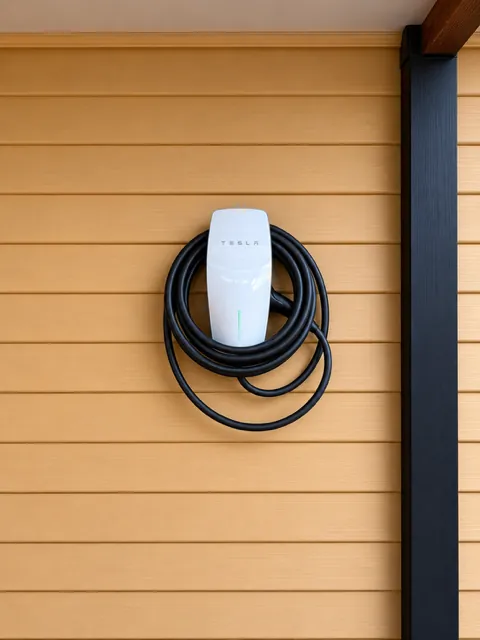
A Tesla Wall Connector on a dedicated 32A circuit 
Charger sited for the shortest, tidiest cable run 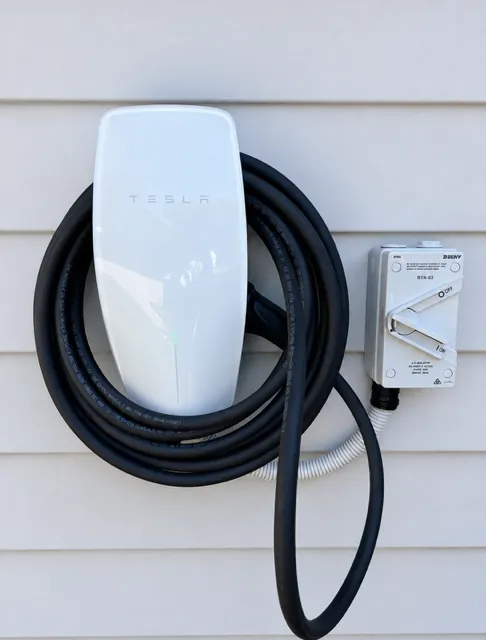
A Tesla Wall Connector on its own dedicated circuit 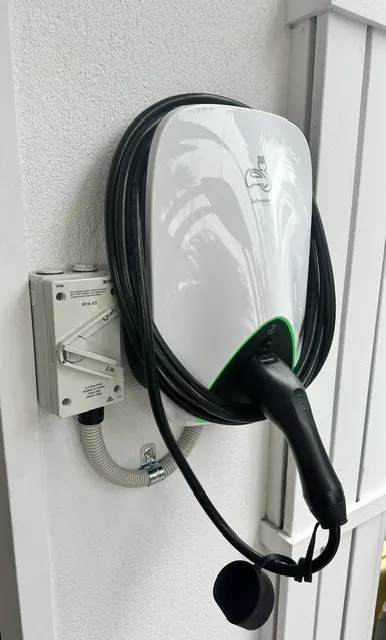
Charger sited for the shortest, tidiest cable run
Licensed and accredited work by a local team. Read about Pivot Trade Services or see recent jobs across the western suburbs.
Answers
Frequently asked questions
You can, and for a plug-in hybrid or a low kilometre commute it may be enough. A standard 10A outlet gives you around 10km of range per hour, so a flat battery on a mid-size EV takes most of a weekend. The bigger issue is that older power points and shared circuits were not designed to sit at full load overnight, so we always check the outlet and its circuit before recommending you rely on it.
Not always. If your board has a spare way, a main switch with headroom and RCD protection on the circuits, the charger can often go straight in. Boards with ceramic rewireable fuses, no RCDs or no spare space need work first. We check this at the site visit and put any board work in the quote as a separate line so you can see exactly what you are paying for.
A straightforward single-phase install in a garage next to the switchboard takes three to four hours. Long cable runs, three-phase units, board upgrades or trenching to a detached garage can push it to a full day or occasionally two visits. Your power will be off for part of the day while we work in the board, usually for less than an hour.
For almost everyone, yes. Home charging is billed at your retail electricity rate, and if you can shift it to an overnight or off-peak window the gap widens further. Public DC fast charging is priced for convenience and speed. Most drivers use home charging for the daily 90 per cent and public chargers only for trips out of Melbourne.
Every new EV sold in Australia uses a Type 2 connector on the AC side, so a Type 2 charger will suit whatever you replace the car with. Cars differ in how much AC charging they will accept, though. Some models cap at 7kW even on a three-phase charger, which is worth knowing before you pay for the larger unit.
Yes. Because EV charging equipment is prescribed electrical work, we issue a Certificate of Electrical Safety through our REC. Keep it with your house records. Insurers and future buyers ask for it, and if you ever claim on the charger warranty the manufacturer will want proof it was installed by a licensed electrician.
EV Charger Installation by suburb
- EV Charger Installation in Altona3018
- EV Charger Installation in Altona North3025
- EV Charger Installation in Altona Meadows3028
- EV Charger Installation in Seaholme3018
- EV Charger Installation in Williamstown3016
- EV Charger Installation in Point Cook3030
- EV Charger Installation in Werribee3030
- EV Charger Installation in Hoppers Crossing3029
- EV Charger Installation in Laverton3028
Book ev charger installation
Tell us what you need and we will give you a written price, not a range that moves on the day.
- Free
- On-site quotes
- Fixed
- Written pricing
- 100%
- Workmanship guarantee
- 5.0★
- 69 Google reviews