
Cost guides · Updated 3 August 2026
Switchboard Upgrade Cost in Melbourne (2026 Guide)
A switchboard upgrade in Melbourne runs from $800 for a basic single phase board up to $3,500 or more for a large, three phase or asbestos board. Most are completed within a day.
- 8 min read
- Written for Victoria
- 2026 figures
The short answer
A switchboard upgrade in Melbourne costs $800 to $1,200 for a basic single phase replacement of an old fuse box with around eight circuits, $1,200 to $1,800 for a mid-range board of 12 to 16 circuits with RCDs and a tidy board rewire, and $2,000 to $3,500 or more for large or complex work involving 20 plus circuits, three phase, relocation or an asbestos board. Most upgrades are completed within a day.
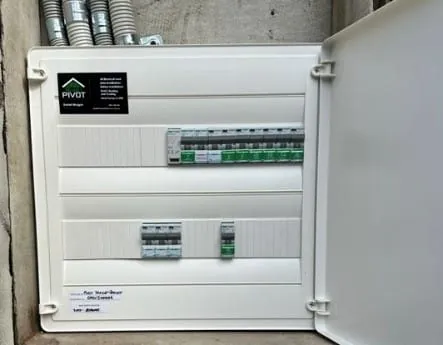
From one of our jobs
Every circuit labelled before we hand it back
Photographed on site in Melbourne’s west. REC 37223.
- Basic single phase
- $800 - $1,200
- Mid-range 12-16 circuits
- $1,200 - $1,800
- Large or complex
- $2,000 - $3,500+
- Typical duration
- Within a day
What a switchboard upgrade involves
The switchboard is where the incoming supply is divided into the circuits that feed the house, and where the protective devices that shut those circuits down live. Upgrading it means replacing the enclosure and the protective devices, re-terminating every circuit, testing the installation and issuing a Certificate of Electrical Safety.
It is not a cosmetic job. On older Melbourne homes an upgrade usually replaces rewireable ceramic fuses with modern circuit breakers, adds residual current devices so that a fault to earth trips the circuit rather than the person touching it, and creates spare capacity so the next appliance does not require another visit. The three things you are buying are safety, capacity and headroom.
The three price tiers
Switchboard quotes vary more than most electrical work because the scope varies more. These are the three tiers we see, and most Melbourne homes fall clearly into one of them.
| Scope | Detail | Price |
|---|---|---|
| Basic | Old fuse box to modern board, single phase, about 8 circuits | $800 - $1,200 |
| Mid-range | 12 to 16 circuits with RCDs and a tidy board rewire | $1,200 - $1,800 |
| Large or complex | 20+ circuits, three phase, relocation or asbestos board | $2,000 - $3,500+ |
Most upgrades are completed within a day. There is generally no rebate available for a standalone switchboard upgrade, though the work is often required to enable an appliance that does carry an incentive.
What actually drives the price
Two houses on the same street can produce quotes $1,500 apart. These are the reasons, and all of them are visible to an electrician who looks at the board before quoting.
Single phase or three phase
Three phase boards involve more incoming conductors, larger equipment and considerably more termination work. It is the single biggest jump between tiers.
Number of circuits
Eight circuits and twenty circuits are different jobs. Every circuit has to be identified, tested, re-terminated and labelled, and that time adds up linearly.
Condition of existing wiring
Brittle rubber insulation, undersized conductors or unidentifiable circuits turn a straightforward swap into investigative work. This is the most common reason a quote grows on the day when the board was never inspected first.
Asbestos board removal
Older boards can be mounted on asbestos backing, which requires proper handling and disposal. It is a real cost and it is not optional.
Relocation
Moving a board from an internal hallway to an external meter position, or from a bad position to a compliant one, means new sub-mains and making good. It sits at the top of the range for good reason.
Solar and EV readiness
Sizing the board for an inverter, a battery or a charger you plan to add costs a little more now and saves considerably more later.
How long it takes and what happens to the power
Most switchboard upgrades are completed within a day. The power is off for the working portion of that, which for a basic board is typically a few hours and for a large or three phase board can be most of the working day.
We plan around that. If a household needs a fridge or a home office kept alive, that gets discussed before the day rather than improvised on it. What we will not do is leave a house without power overnight, and if a job genuinely cannot be finished in one day we say so at quote and arrange a safe interim arrangement.
Is there a rebate for a switchboard upgrade?
Generally no. A standalone switchboard upgrade does not attract a rebate in Victoria, because incentive programs are aimed at appliances and technologies that reduce energy use or emissions, not at the infrastructure behind them.
What does happen frequently is that the board work is required to enable something that does carry an incentive. A heat pump hot water system, a solar inverter, a battery or an EV charger all need a board that can safely accommodate them. In that situation the appliance attracts its rebate and the board work sits alongside it as its own line. It is worth understanding that distinction so a quote that separates the two reads as honest rather than as an upsell.
When you actually need one
Some signs are obvious and some are not. Rewireable ceramic fuses are the clearest: if you have ever replaced fuse wire, the board is due. So is a board with no residual current devices, which is still common in Melbourne homes built or last wired before RCD requirements tightened.
The less obvious ones are worth knowing. A board with no spare ways cannot take another circuit, which means the next appliance triggers the upgrade anyway. Repeated nuisance tripping often reflects an overloaded or poorly arranged board rather than a faulty appliance. Scorching, a burning smell, or warmth at the board are reasons to call someone the same day rather than to plan an upgrade for next month.
And if you are planning solar, a battery, an EV charger, a heat pump or an induction cooktop, get the board assessed before you commit to any of them. Doing the board once, sized for the whole plan, is the cheapest version of that sequence. Opening the same enclosure three times is the expensive one.
What safety switches actually do
A circuit breaker protects the wiring. It trips when the current on a circuit exceeds what the cable can safely carry, which prevents overheating and fire. That is a genuinely important job and it is not the same job as protecting a person.
A residual current device, commonly called a safety switch or RCD, protects people. It compares the current flowing out on the active with the current returning on the neutral, and if some of it is going somewhere else, such as through a person to earth, it disconnects the circuit in a fraction of a second. That is what makes the difference between a shock and something far worse.
A lot of older Melbourne boards have breakers but no RCDs, or have RCDs on some circuits and not others. That partial arrangement is common in homes from the 1980s and 1990s. Adding a new circuit to a board like that is the natural moment to bring the rest of it up to a modern standard, because the board is open and the labour is already being spent.
What happens on the day
The job starts with isolating the supply and identifying every circuit. On an older board with no labelling, or with labelling that was accurate three renovations ago, that identification step is real work and it is where the time goes on a house with twenty circuits.
The old enclosure comes off, the new one goes on, and every circuit is re-terminated into the new protective devices. Then comes testing: insulation resistance, earth continuity, polarity, and RCD trip times. Finally the board is labelled properly, so the next person who opens it, including you at 11pm looking for the right breaker, can tell what is what.
A Certificate of Electrical Safety is issued at the end for prescribed work. That document matters at sale time and it matters for insurance, and it should never be an optional extra.
What we typically find in older Melbourne west homes
Across the western suburbs the pattern is fairly consistent by housing era, and it is a useful way to predict roughly where a quote will land before anyone visits.
Post-war homes that have never been renovated frequently still carry rewireable ceramic fuse boards. Those go straight into the basic or mid-range tier depending on circuit count, and they almost always need replacing rather than modifying.
Homes from the 1980s and 1990s usually have circuit breakers but often lack RCD protection on every final subcircuit. That is mid-range work, and the scope depends on whether the enclosure has room to add protection or has run out of space.
Estate homes from the 2000s onward generally have modern, compliant boards. There the question is not safety but spare capacity, and the answer depends on how much has already been added since the house was built.
Post-war, unrenovated
Rewireable ceramic fuses. Replacement rather than modification, typically the basic or mid-range tier.
1980s and 1990s
Breakers present, RCD protection often incomplete. Mid-range work, scope set by whether the enclosure has room.
2000s estate homes
Modern and compliant. The question is spare ways and main switch rating, not safety.
Heritage and renovated
Boards extended repeatedly over decades. Identification of existing circuits is often the largest part of the labour.
Figures in this guide are indicative and were accurate at the time of writing (3 August 2026). Rebate values, eligibility rules and certificate-linked discounts change regularly. Confirm current amounts with the program administrator, and treat your written quote as the accurate figure for your property.
Answers
Frequently asked questions
Between $800 and $1,200 for a basic single phase replacement of an old fuse box with around eight circuits, $1,200 to $1,800 for a mid-range board of 12 to 16 circuits with RCDs and a tidy board rewire, and $2,000 to $3,500 or more for large or complex work with 20 plus circuits, three phase, a relocation or an asbestos board.
Most upgrades are completed within a day, with the power off for the working portion of it. A basic board is typically a few hours. A large or three phase board can take most of the working day. We plan around anything that has to stay running and we do not leave a house without power overnight.
Generally no. Incentive programs target appliances and technologies rather than the infrastructure behind them. What does happen often is that board work is required to enable something that does carry a rebate, such as a heat pump, a solar inverter or an EV charger. In that case the appliance attracts the incentive and the board sits as its own line.
Rewireable ceramic fuses are the clearest sign. So is the absence of residual current devices, a board with no spare ways, or repeated nuisance tripping. Scorching, warmth or a burning smell at the board are reasons to call someone the same day rather than to plan work for later.
More incoming conductors, larger and more expensive protective equipment, and considerably more termination and testing work. It is the single biggest jump between the price tiers, and it is why a three phase board sits in the $2,000 to $3,500 plus range even when the circuit count is not extreme.
Some older boards are mounted on asbestos backing, which requires proper handling and licensed disposal. It is a genuine additional cost and it is not something that can be skipped or worked around. An electrician who has looked at your board before quoting will have identified it and priced it.
Yes, if you have any idea what is coming. Sizing for a future inverter, battery, EV charger or heat pump costs a little more now and saves considerably more later, because the alternative is paying an electrician to open the same enclosure and re-terminate the same circuits every time you add something.
Browse every cost, rebate and comparison guide in the Pivot guides library, or claim the $60 off your first job voucher.
Want this priced for your place?
Tell us what you need and we will give you a written price, not a range that moves on the day.
- Free
- On-site quotes
- Fixed
- Written pricing
- 100%
- Workmanship guarantee
- 5.0★
- 69 Google reviews