
More outlets, fewer double adaptors
Power Point Installation in Melbourne
Most houses in Melbourne's west were wired when a family owned a fridge, a television and a toaster. Now every room has three chargers, a router, a lamp and a laptop, and the gap gets filled by double adaptors and a powerboard behind the couch.
- REC 37223
- Melbourne west
- Fixed quotes
The short answer
Installing a new power point in Melbourne typically costs $150 to $300 where it can be connected to an existing circuit, and more where a new circuit back to the switchboard is required. Socket outlets must be RCD protected under AS/NZS 3000, and the Wiring Rules set minimum separation between outlets and sinks, basins and cooktops. Adding a power point is prescribed electrical work requiring a Certificate of Electrical Safety from a licensed contractor.
From one of our jobs
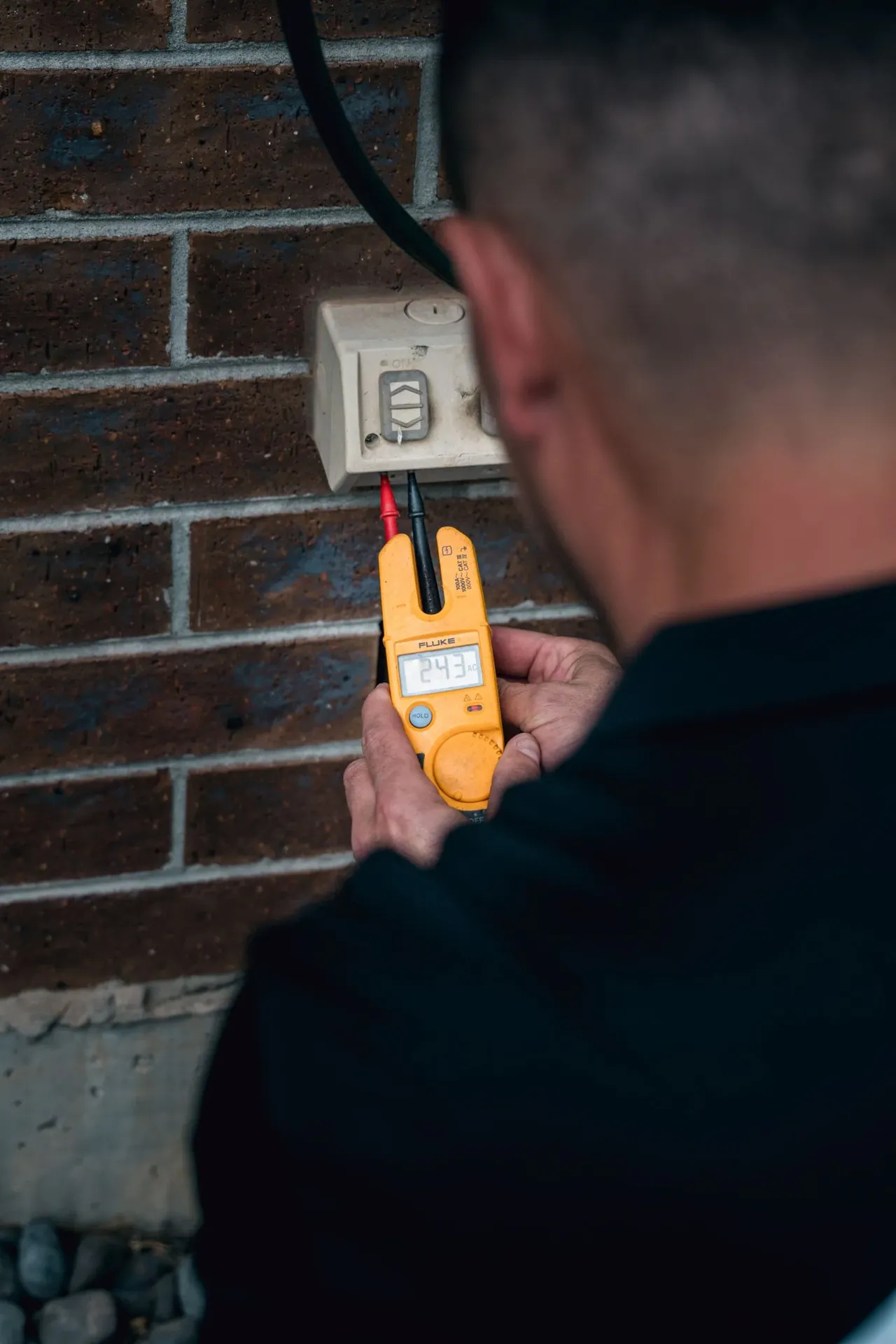
Testing an outdoor power point after installation
Photographed on site in Melbourne’s west. REC 37223.
Adding outlets is a small job that removes a real hazard. The part worth thinking about is not how many you add, but which circuit they go on.
Spurring off an existing circuit or running a new one
The cheapest way to add a power point is to extend from a nearby outlet on the same circuit. That is fine for a lamp, a phone charger or a television. It is not fine for a second fridge, a bar heater, a dryer or a workshop.
The question we ask is what is going to be plugged in and what else is already on that circuit. A typical power circuit is protected at 16 or 20 amps and shared across a whole area of the house. Adding a high draw appliance to a circuit that already runs the kitchen bench is how you end up with a breaker that trips every time the toaster and the kettle overlap. When the load justifies it, a dedicated circuit from the board is the correct answer and it is not much more expensive at the time.
Extension from an existing point
Quickest and cheapest. Suits general use outlets in bedrooms, living areas and hallways.
New dedicated circuit
Required for high or continuous loads such as second fridges, freezers, dryers, workshop tools and heaters.
Kitchen and laundry
Bench outlets are heavily used and often justify splitting across two circuits rather than one.
Garage and shed
A detached structure needs its own submain with its own protection, not an extension lead through the yard.
Where a power point can and cannot go
There is more regulation around outlet position than people expect. The Wiring Rules set minimum separation between socket outlets and sinks, basins and cooktops, generally 400mm horizontally from the edge of a sink or basin, and outlets cannot be positioned where a lead would drape across a cooking surface. That is why we sometimes have to move a proposed kitchen outlet 200mm along the wall.
Bathrooms and laundries have defined zones around baths, showers and troughs where outlets are prohibited or restricted. Outdoors, outlets need weatherproof enclosures rated for exposure. None of this is us being difficult. It is the difference between an installation that passes and one that does not.
Height
There is no fixed legal height for a general outlet, but around 300mm above floor level is standard, and above bench height in kitchens. Accessible housing has its own requirements.
Near water
Minimum distances from sinks, basins, baths and troughs apply, and some positions are excluded entirely.
Outdoors
Weatherproof, IP rated and RCD protected. A standard indoor outlet in a covered pergola is still not compliant.
Behind fixed furniture
An outlet you cannot reach to unplug is a bad outlet. We plan around wardrobes, bedheads and appliances.
Choosing the outlet itself
The mechanism inside a socket is where quality shows up. Cheap outlets lose grip on the pins over a few years, which causes heating at the connection. In a rental or a house you plan to keep, spending a few dollars more per outlet on a known brand is worth it.
USB outlets are now standard in bedrooms and kitchens, but they date faster than the socket does. USB-C with power delivery is the current sensible choice, and there is little point installing USB-A only outlets in 2026. Some outlets include a small night light or an integrated switch for a specific appliance, which is useful for things like a dishwasher hidden behind a cupboard.
RCD protection and older houses
Socket outlets require RCD protection under AS/NZS 3000. If your house has no safety switches, adding a new outlet means the circuit it lands on has to be brought up to that standard, which usually means fitting an RCD or RCBO at the switchboard.
This surprises people, but it is the single most valuable thing that comes out of a small job like this. A safety switch on a power circuit is what stops a faulty appliance, a cut extension lead or a child with a screwdriver becoming an electrocution. If the board has no room or is too old to take the device, we will tell you what the board needs before quoting the outlet.
How we do the work
For a standard cavity wall, the cable is fished down from the ceiling space and the outlet cut in with a hole saw, which leaves no patching to do. Solid brick, rendered or tiled walls are the ones that take longer, and in those cases surface conduit or a skirting duct is sometimes the sensible answer.
We test every circuit we touch and issue a Certificate of Electrical Safety for the work. If you are having several outlets done at once, tell us the whole list up front. Doing five in one visit is far cheaper per outlet than five separate call outs, and the same access we make for one is usually most of the work for the rest.
| Outlet work | Typical installed cost |
|---|---|
| Replace an existing single or double outlet | $90 - $150 |
| New double outlet from an existing circuit | $150 - $300 |
| Additional outlets in the same visit | $90 - $180 each |
| USB-C combination outlet | $180 - $320 |
| Weatherproof outdoor outlet | $220 - $400 |
| New dedicated circuit from the switchboard | $350 - $700 |
Indicative. Solid brick, tiled walls and inaccessible ceiling spaces add time and are quoted after we see the wall.
On the job
Power Points in Melbourne's west

Testing an outdoor power point after wiring it in
Licensed and accredited work by a local team. Read about Pivot Trade Services or see recent jobs across the western suburbs.
Answers
Frequently asked questions
No. In Victoria, installing or altering fixed wiring is prescribed electrical work and can only be done by a licensed electrician, who must issue a Certificate of Electrical Safety. Beyond the legal position, unlicensed work voids home insurance and creates a problem at sale time when the buyer's inspector finds it. Plugging in a powerboard is legal. Wiring a new outlet is not.
The Wiring Rules do not set a fixed number of outlets per circuit for domestic installations. What matters is the actual load and the cable and protection size. In practice we consider what is plugged in and what is likely to be added, and split circuits so that a fault or overload does not take out an entire floor of the house.
In bedrooms and kitchens, yes. They free up sockets and remove the pile of plug packs. Choose USB-C with power delivery so the outlet can actually charge a laptop or a modern phone at speed. Bear in mind the electronics inside a USB outlet have a shorter life than a plain socket, so we would not put them in every room in the house.
A small blue flash as an appliance connects is normal. A warm faceplate is not. Warmth means resistance, usually from a loose terminal or a worn socket that has lost grip on the plug pins. It is an early-stage fault that ends in scorched plastic or worse. Stop using the outlet and have it looked at rather than waiting for it to fail.
Yes. An attached garage is generally simple. A detached shed needs a submain from the switchboard, correctly sized and protected, and usually its own small distribution board with an RCD. Running an extension lead across the yard as a permanent arrangement is both unsafe and, if it is a fixed installation, not compliant.
Usually just the one for the outlet itself, cut with a hole saw so the faceplate covers it. Where the wall is a cavity with a ceiling space above, the cable is fished down without any further damage. Solid brick or tiled walls sometimes need a chase or surface conduit, and we always agree the route with you before starting.
Book power points
Tell us what you need and we will give you a written price, not a range that moves on the day.
- Free
- On-site quotes
- Fixed
- Written pricing
- 100%
- Workmanship guarantee
- 5.0★
- 69 Google reviews