
Cost guides · Updated 3 August 2026
How Much Does an Electrician Cost in Melbourne? (2026)
Melbourne electricians charge $90 to $160 an hour, with $120 the common average and a $60 to $120 call-out on top. Here is what the usual jobs actually cost and what moves the price.
- 8 min read
- Written for Victoria
- 2026 figures
The short answer
Electricians in Melbourne charge $90 to $160 an hour in 2026, with $120 an hour a fair average for licensed residential work, plus a call-out fee of $60 to $120 that usually covers the first period on site. Small jobs are more often quoted as a fixed price: a new power point runs $150 to $300, a safety switch $120 to $300, and a switchboard upgrade $800 to $3,500 or more depending on scope.
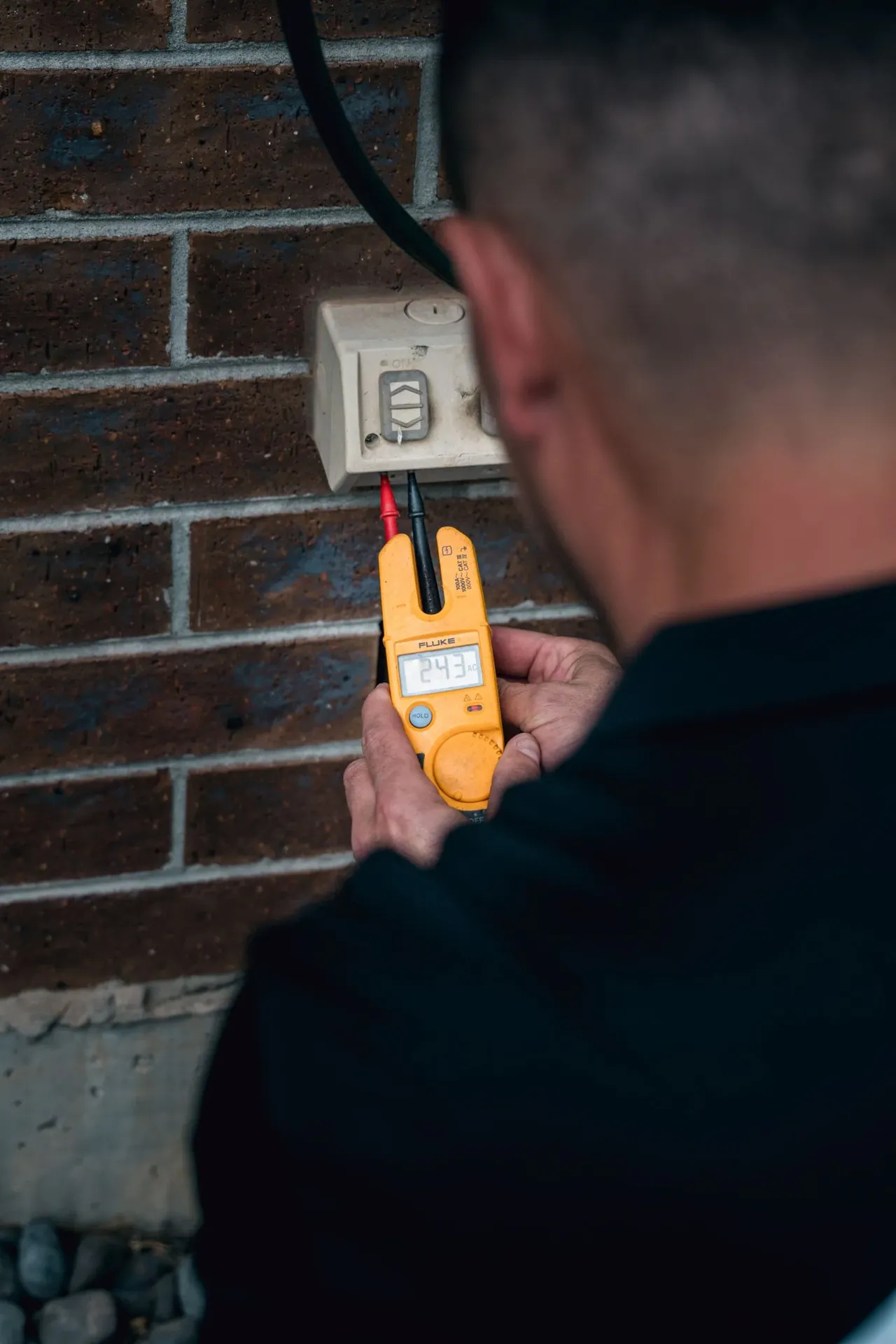
From one of our jobs
Testing an outdoor power point after installation
Photographed on site in Melbourne’s west. REC 37223.
- Hourly rate
- $90 - $160
- Common average
- $120 / hour
- Call-out fee
- $60 - $120
- New power point
- $150 - $300
- Switchboard upgrade
- $800 - $3,500+
The two ways electricians price work
Almost every electrical job in Melbourne is priced one of two ways, and knowing which one you are being offered tells you a lot about the quote in front of you.
Hourly plus materials suits diagnostic work, faults and anything where nobody can see the full extent of the problem until they start. A dead circuit, an intermittent trip, a light that works some of the time. The electrician cannot honestly quote a fixed price to find something that has not been found yet, and a fixed price on that kind of work usually means the number has been padded to cover the worst case.
Fixed price suits defined work. Install four power points, replace a switchboard, fit a ceiling fan, run a circuit for an air conditioner. The scope is visible, the materials are known, and the risk sits with the contractor rather than with you. For most planned residential work this is the fairer arrangement, and it is how we quote the majority of jobs.
Hourly plus materials
Right for fault finding, repairs and anything where the extent of the work is genuinely unknown until the cover comes off.
Fixed price
Right for defined installations. You know the number before anyone starts and any surprise sits with the contractor, not you.
Call-out plus first period
Common for small or urgent jobs. Confirm what the call-out actually includes before you agree to it.
After hours rates
Evenings, weekends and public holidays are charged at a higher rate by almost everyone. Worth asking about before you book a Saturday.
Hourly rates and call-out fees in 2026
The going rate for a licensed electrician in Melbourne sits between $90 and $160 an hour. The average is around $120 an hour for standard residential work during business hours, and that is the number we would use if you asked us for one figure to plan against.
The spread is not random. The bottom of the range tends to be a sole operator with low overheads working close to home. The top tends to be a larger business with a fully equipped van, insurance, apprentices and the capacity to turn up when they said they would. Neither is automatically better value. What matters is whether the person doing the work is licensed, whether the price is understood before they start, and whether they issue a Certificate of Electrical Safety at the end.
On top of the hourly rate, most electricians charge a call-out fee of $60 to $120. That fee covers travel and the cost of getting a van and a qualified person to your door. On many jobs it includes the first block of time on site, commonly the first half hour, so it is worth asking exactly what it buys rather than assuming it is a pure surcharge. A call-out fee that includes half an hour of labour is a different proposition to one that does not.
What the common jobs actually cost
These are the ranges we see across Melbourne for standard residential work, supplied and installed, during business hours. They assume reasonable access and an existing switchboard with capacity. Where a job sits inside its range depends almost entirely on the drivers in the next section.
| Job | Typical price |
|---|---|
| New power point | $150 - $300 |
| Downlight or light fitting (each) | $80 - $200 |
| Safety switch (RCD) | $120 - $300 |
| Ceiling fan installation | $150 - $350 |
| Hardwired smoke alarm | $120 - $250 |
| Switchboard upgrade | $800 - $3,500+ |
| Home EV charger installation | $1,200 - $2,200 |
Prices are indicative for standard residential work during business hours, with reasonable access and existing switchboard capacity. Complex access, premium fittings, three phase supply and after hours attendance all move these figures.
The five things that move the price
Two quotes for what sounds like the same job can differ by hundreds of dollars, and it is usually not because one electrician is greedy. It is because the job is not actually the same. These are the factors that make the difference.
Complexity of the job
One extra power point on an existing circuit is a short job. A new circuit run back to the board, through insulation and around structural timbers, is a different piece of work with the same name.
Access
A single storey house with a walkable roof space and a subfloor you can crawl is the cheap case. A double storey with a low pitch roof, no manhole near the work, or a slab floor pushes labour up because the cable has to go the long way.
Fitting quality
A budget downlight and a good one both take the same time to install, but the difference in product cost is real. Cheap fittings also fail sooner, which turns a saving into a second call-out.
Single phase or three phase
Three phase work involves more circuits, larger equipment and more time. It comes up most often on switchboard upgrades, larger air conditioning and 22kW EV charging.
After hours attendance
Evenings, weekends and public holidays carry a premium. If the work is not urgent, booking it in business hours is the simplest saving available on this list.
How to read a quote properly
The cheapest quote and the best value quote are frequently not the same document. What separates them is usually what has been left out rather than what has been marked up.
Look for the scope written down in plain terms, not a one line description. Look for whether materials are itemised or lumped into a total. Look for whether a switchboard upgrade, an RCD or a new circuit has been priced or quietly assumed to be unnecessary. On older Melbourne homes, particularly in the west where fuse boards and 1980s boards without RCDs are still common, that assumption is the single most common reason a quote grows on the day.
Also check that the licence details are on the document. In Victoria, electrical work has to be carried out by a licensed electrician, and a Registered Electrical Contractor must issue a Certificate of Electrical Safety for prescribed work. Pivot Trade Services holds REC 37223, ABN 87 689 296 937, and every job we complete comes with the certificate and a 100% workmanship guarantee on top of whatever the manufacturer warranty is on the product.
Where paying a bit more genuinely pays off
There are places where the cheap option costs more over time, and they are fairly predictable. Switchboard work is one. A board done properly, with room for the next appliance and RCD protection on the final subcircuits, saves you from paying twice when the air conditioner, the induction cooktop or the EV charger goes in eighteen months later.
Fittings are another. Downlights, fans and smoke alarms are cheap to buy and expensive to replace, because the replacement cost is almost entirely labour. Paying $40 more per fitting on a house with sixteen downlights is $640. Replacing sixteen failed fittings and paying an electrician to do it is considerably more than that.
The last one is planning. If you know a charger, a battery or a heat pump is on the horizon, saying so at quote stage lets the electrician design the board once instead of modifying it three times. Opening the same enclosure and terminating the same circuits repeatedly is pure duplicated labour, and it is the most common avoidable cost we see in Melbourne homes.
What an hourly rate does not include
An hourly rate covers the electrician time on site. It does not usually cover materials, and on some jobs the material cost is a bigger share of the invoice than people expect. Cable, protective devices, mounting hardware, fittings and consumables all get charged in addition, and on a job like a switchboard upgrade the equipment is a substantial line in its own right.
Travel is the other one. Most electricians build travel into a call-out fee rather than charging it hourly, which is one reason a business based near you often prices better than one dispatched from the other side of Melbourne. It is also why bundling several small jobs into one visit is such a reliable saving.
The last thing worth asking about is compliance work. Testing, certification and the paperwork that goes with prescribed electrical work take time and they are part of doing the job properly. A quote that appears cheaper because it has quietly left the certificate out is not cheaper, it is incomplete.
Emergency and after hours attendance
Live electrical faults do not schedule themselves for a Tuesday morning. A burning smell at the board, a circuit that keeps tripping and cannot be reset, exposed conductors after storm damage or a switchboard that is warm to the touch are all reasons to get someone out immediately rather than waiting.
After hours attendance costs more than business hours attendance, everywhere and from everyone, because it means calling a qualified person out at a time they would otherwise not be working. That premium is legitimate. What is not legitimate is a large fee for an urgent attendance that then turns into an unrelated sales conversation.
The practical advice is simple. If it is a safety issue, call. If it is not, book it in business hours and bundle it with anything else on the list. That single decision usually saves more than shopping between contractors on hourly rate.
Figures in this guide are indicative and were accurate at the time of writing (3 August 2026). Rebate values, eligibility rules and certificate-linked discounts change regularly. Confirm current amounts with the program administrator, and treat your written quote as the accurate figure for your property.
Answers
Frequently asked questions
Between $90 and $160 an hour, with about $120 an hour a fair average for licensed residential work in business hours. Below $90 is worth questioning, because it usually means either an unlicensed operator or a rate that does not cover proper insurance and compliance. Above $160 is normally specialist, commercial or after hours work.
Most electricians charge one, generally $60 to $120, and it covers the cost of travel and getting a fully equipped van to your address. On many jobs it also includes the first block of time on site. Ask what it includes rather than whether it exists, because a call-out that covers the first half hour is very different from one that does not.
Typically $150 to $300 supplied and installed. The low end is an extra outlet added to an existing circuit in an accessible wall. The high end involves running a new circuit back to the switchboard, working through insulation, or a location with difficult access such as a slab floor or a double storey wall.
Because it is a larger piece of work with a wide range of scope. A basic single phase board with around eight circuits starts near $800. A large or complex job with 20 plus circuits, three phase supply, a relocation or an asbestos board can reach $3,500 or more. The board is also the piece that everything else in the house depends on, so it is not a place to cut corners.
Almost always, yes. You pay the call-out and the travel once, the van is already there, and the electrician can plan the circuits as one piece of work. If you have a list of small things, the difference between doing them together and doing them one at a time over a year can easily be a few hundred dollars.
The labour, the materials, the making good of any wall or ceiling penetrations, testing, and the Certificate of Electrical Safety for prescribed work. If a quote does not mention the certificate, ask. If it does not mention which fittings are being supplied, ask that too, because fitting quality is where quotes most often differ without looking like they do.
Yes, as does almost everyone, because it means calling someone out outside normal working hours. Our normal hours are Monday to Friday 7:30am to 5:30pm and Saturday 10am to 5pm, and we run a 24/7 emergency line for live electrical faults. If the work is not urgent, booking it in business hours is the easiest way to keep the cost down.
Browse every cost, rebate and comparison guide in the Pivot guides library, or claim the $60 off your first job voucher.
Want this priced for your place?
Tell us what you need and we will give you a written price, not a range that moves on the day.
- Free
- On-site quotes
- Fixed
- Written pricing
- 100%
- Workmanship guarantee
- 5.0★
- 69 Google reviews