
Cost guides · Updated 3 August 2026
Split System Installation Cost in Melbourne (2026 Guide)
A split system installed in Melbourne runs $2,500 to $7,500 depending on capacity and how many indoor heads are involved. Here is what sits behind each end of that range.
- 8 min read
- Written for Victoria
- 2026 figures
The short answer
A split system supplied and installed in Melbourne costs $2,500 to $7,500 depending on capacity and the number of indoor heads. A 2.5kW unit in a bedroom runs about $2,500 to $3,200, a 5kW living room unit about $3,200 to $4,300, and a 7.1 to 9kW system about $3,800 to $6,000. A two head multi split covering two rooms runs about $5,500 to $7,500. A dedicated circuit adds roughly $350 to $800.
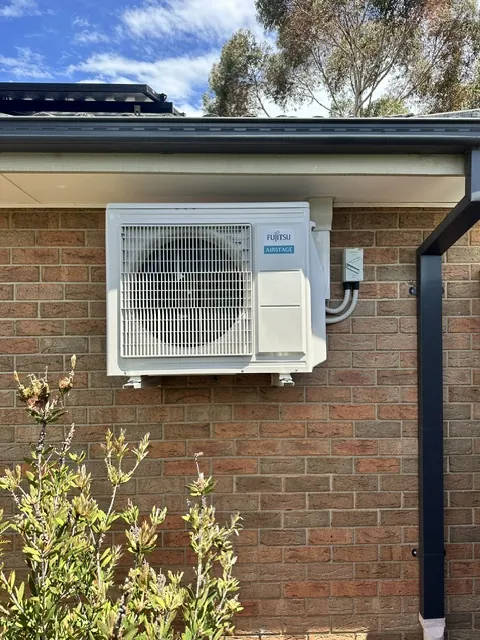
From one of our jobs
Outdoor units set on level mounts, clear of the fence line
Photographed on site in Melbourne’s west. REC 37223.
- Installed range
- $2,500 - $7,500
- 2.5kW bedroom unit
- $2,500 - $3,200
- 5kW living area
- $3,200 - $4,300
- New dedicated circuit
- $350 - $800
What is actually in the price
A split system installation is an indoor head, an outdoor condenser, an insulated refrigerant pipe run and drain between them, a bracket or pad for the outdoor unit, the electrical connection, and the commissioning that makes the whole thing work. The unit itself is usually less than half the invoice on a standard job.
Most quotes are built around a standard installation, and it is worth knowing what that phrase usually means: an indoor head on an external wall, an outdoor unit on the other side of that wall or immediately below it, a pipe run of about three to four metres, a drain that can fall to a suitable point, mounting on brackets or a ground pad, and connection to an existing suitable circuit. Everything beyond that is priced as an extra, which is exactly why two quotes for the same model can differ by $800.
The other thing in the price is licensing. Refrigerant work requires an ARC licence, and the electrical connection requires a licensed electrician who issues a Certificate of Electrical Safety. On a proper split system installation both of those are covered by the one contractor, and both should be visible on the paperwork you receive.
What it costs by capacity
Capacity is the first driver. Bedrooms generally take 2.5 to 3.5kW, medium rooms 3.5 to 5kW, open plan living areas 5 to 7.1kW, and large open plan or poorly insulated spaces 8 to 9kW. Sizing to the room rather than to the budget matters, because an undersized unit runs at full output all summer and never quite gets there.
These are indicative supplied and installed ranges for a standard back to back installation in a Melbourne home. They are a planning guide and a written quote after a site visit replaces them.
| Capacity | Typically suits | Indicative installed price |
|---|---|---|
| 2.5kW | Bedroom or small study | $2,500 - $3,200 |
| 3.5kW | Larger bedroom or medium room | $2,700 - $3,600 |
| 5.0kW | Living area or open plan kitchen and dining | $3,200 - $4,300 |
| 7.1kW | Large living area | $3,800 - $5,200 |
| 8.0 - 9.0kW | Large open plan or high ceiling spaces | $4,300 - $6,000 |
| Multi split, two heads | Two rooms sharing one outdoor unit | $5,500 - $7,500 |
Supplied and installed, standard back to back installation with a three to four metre pipe run and connection to an existing suitable circuit. Indicative only and replaced by a written quote. Long pipe runs, height, access and new electrical circuits are additional.
Single head or multi head
A multi split runs two or more indoor heads off one outdoor unit. It is the right answer when there is genuinely nowhere to put a second condenser, which on narrow inner west blocks and in townhouse developments around Seaholme is a real constraint, or when a body corporate limits how many outdoor units can go on a wall.
What it is not, usually, is cheaper. Two single head systems covering two rooms often come in below a two head multi split, because multi split outdoor units carry a price premium, the pipe runs are longer and the commissioning is more involved. People assume sharing one outdoor unit must save money, and on the equipment alone it sometimes does, but by the time the extra pipework and labour are in the number the gap closes or reverses.
There is a performance argument too. Single head systems run independently, so a failure takes out one room rather than three, and each unit modulates purely for its own space. Multi splits share a compressor, which means the rooms interact and a fault affects everything connected. Where the choice is genuinely open, we usually recommend separate units and keep the multi split for cases where the site demands it.
Single head
One indoor unit, one outdoor unit. Simplest, most reliable and usually the better value where there is wall space for the condenser.
Multi split, two heads
Indicatively $5,500 to $7,500 installed. Right where outdoor space or a body corporate restricts you to one condenser.
Three or more heads
Possible, but the pipe runs and the design complexity climb quickly. At that point compare it honestly against ducted.
Failure mode
A single head failure costs you one room. A multi split failure costs you every room connected to that outdoor unit.
Back to back, long pipe runs, height and access
Back to back means the indoor head and the outdoor unit are on opposite sides of the same wall. It is the cheapest installation there is: one core hole, a short pipe run, a simple drain, minimal labour. If you have flexibility about which wall the head goes on, choosing a back to back position is the single biggest saving available on this job.
Once the outdoor unit has to move away from that wall, cost climbs steadily. Additional pipe run beyond the standard allowance is an indicative $80 to $130 per metre supplied and installed, and it adds up faster than people expect because the pipe rarely travels in a straight line. A run that goes up into the roof, across the house and back down an internal wall can be fifteen metres on a house that measures ten across.
Height and access are the other pair. A head high on a wall in a double height void, an outdoor unit that has to be mounted on a first floor wall, or a condenser positioned where a ladder will not safely reach all bring in either a scaffold or an elevated work platform. Indicatively that is $300 to $900 depending on what is needed and how long it is on site. Roof mounting brackets or an upper level wall bracket add an indicative $150 to $400.
Drainage is the quiet one. An indoor head produces condensate that has to fall to a suitable discharge point. On a wall where gravity works, this is nothing. On an internal wall, in a room with no external drainage, or on a unit mounted low, it can mean a condensate pump and a longer drain line, which is an indicative $250 to $500 addition.
The electrical side, and when you need a dedicated circuit
Small splits can sometimes connect to an existing suitable circuit with an isolator, which is why the standard installation price assumes it. Larger units, and any installation where the existing circuit is already loaded or does not have appropriate protection, need their own dedicated circuit run back to the switchboard.
A new dedicated circuit is an indicative $350 to $800 depending on the distance from the board, whether the cable can run through a roof space or has to go around a slab, and what the wall construction is. It is straightforward work but it is real work, and it is the item most commonly missing from a very cheap online quote.
Behind the circuit sits the board itself. If there are no spare ways, no physical room for another protective device, or no RCD protection on the final subcircuits, a switchboard upgrade comes first at $800 to $3,500 or more. That is not padding, it is the sequence the work has to happen in. Our switchboard cost guide explains the three tiers, and the electrician cost guide covers how hourly and fixed price electrical work is charged in Melbourne generally.
If you are adding a split system to a house that will also be getting solar, a battery or an EV charger over the next few years, say so at quote stage. Sizing the board once for the whole plan is materially cheaper than opening the same enclosure three times.
What makes a quote go up or down
Same room, same model, two quotes hundreds of dollars apart. These are the reasons, in roughly the order they move the number.
Pipe run length
The largest variable on most jobs. Back to back is the cheap case. Additional run is an indicative $80 to $130 per metre and the pipe rarely takes the short way.
Electrical scope
Connection to an existing suitable circuit costs little. A new dedicated circuit is $350 to $800 indicatively, and board work on top of that is $800 to $3,500 or more.
Height and access
Anything needing a scaffold or an elevated work platform adds an indicative $300 to $900. A first floor outdoor unit is the usual trigger.
Wall construction
Core drilling through timber frame and brick veneer is routine. Solid double brick, rendered concrete or a heritage wall takes longer and costs an indicative $100 to $250 more per penetration.
Drainage
Gravity drainage to a suitable point is included. A condensate pump and extended drain line is an indicative $250 to $500.
Removing the old unit
Decommissioning and removing an existing system, including recovering refrigerant properly, is a genuine cost and should be a visible line rather than an assumption.
Cosmetic finishing
Ducted pipe covers instead of exposed lagging on a visible wall run add an indicative $80 to $200. Worth it on a front elevation, not worth it behind a garage.
How to compare split system quotes fairly
Split system quoting has more hidden variation than almost any other trade job, because the headline is a familiar model number and everything that differs is in the installation detail.
Ask every contractor for five things in writing. The exact model and rated capacity, since a 5kW from two brands can be $600 apart at wholesale. The included pipe run length and the rate for anything beyond it. Whether the electrical connection is to an existing circuit or a new dedicated one, and whether any switchboard work is priced or assumed away. The mounting method for the outdoor unit. And whether removal of the old system is included.
Then check credentials rather than assuming them. Refrigerant work requires an ARC licence. The electrical connection requires a licensed electrician issuing a Certificate of Electrical Safety. A quote that mentions neither is not a bargain. Also ask about the workmanship warranty as distinct from the manufacturer warranty, because on a split system the most common problems in the first two years are installation related rather than equipment related.
Pivot Trade Services holds REC 37223 and SAA accreditation S3962281, installs across Melbourne western suburbs from the Altona workshop, and carries a 100% workmanship guarantee on top of the manufacturer warranty. If a split is not the right answer for your house, we will say so and price heating and cooling alternatives instead. To get a fixed price in writing, contact us.
Figures in this guide are indicative and were accurate at the time of writing (3 August 2026). Rebate values, eligibility rules and certificate-linked discounts change regularly. Confirm current amounts with the program administrator, and treat your written quote as the accurate figure for your property.
Answers
Frequently asked questions
Between $2,500 and $7,500 supplied and installed depending on capacity and how many indoor heads are involved. A 2.5kW bedroom unit sits near the bottom at about $2,500 to $3,200, a 5kW living room unit around $3,200 to $4,300, and a two head multi split around $5,500 to $7,500. Long pipe runs and new circuits are extra.
As a general guide, 2.5 to 3.5kW suits a bedroom, 3.5 to 5kW a medium room, 5 to 7.1kW an open plan living area and 8 to 9kW a large or high ceiling space. Glazing, orientation and insulation shift it. A west facing room with large windows needs more capacity than its floor area suggests.
Usually not. Multi split outdoor units carry a price premium, the pipe runs are longer and commissioning is more involved, so two single head systems often come in below a two head multi split. Multi splits earn their place where there is genuinely only room for one outdoor unit or where a body corporate restricts you.
The indoor head and the outdoor unit sit on opposite sides of the same wall, so the pipe run is a metre or two through one core hole. It is the cheapest possible configuration. If you have any flexibility about which wall the head goes on, choosing a back to back position is the biggest saving available on the job.
Often. Smaller units can sometimes connect to an existing suitable circuit with an isolator, which is what a standard installation price assumes. Larger units, or any board without appropriate protection or spare capacity, need a dedicated circuit at an indicative $350 to $800, plus switchboard work at $800 to $3,500 or more if the board cannot take it.
A reverse cycle split heats very efficiently, delivering roughly 3 to 4 units of heat per unit of electricity against 80 to 92 percent for gas. That is about 28 to 36 cents an hour to heat a room against 50 to 72 cents for ducted gas, and $200 to $450 a year for most households. It heats the rooms it is in, not the whole house.
Victorian Energy Upgrades can apply where an efficient reverse cycle system replaces gas heating. The discount is applied directly to your invoice rather than claimed afterwards, there is no income test, the property must be at least two years old and there is a $200 including GST minimum customer contribution. The program changed on 30 September 2026, so confirm the amount at quote.
A standard single head back to back installation is typically half a day to a day. Longer pipe runs, a new dedicated circuit, first floor mounting or removal of an old system push it toward a full day or occasionally two. A two head multi split is generally a full day. The expected duration should be on your quote.
Browse every cost, rebate and comparison guide in the Pivot guides library, or claim the $60 off your first job voucher.
Want this priced for your place?
Tell us what you need and we will give you a written price, not a range that moves on the day.
- Free
- On-site quotes
- Fixed
- Written pricing
- 100%
- Workmanship guarantee
- 5.0★
- 69 Google reviews