
Rebates & incentives · Updated 3 August 2026
Gas to Electric Heating Rebate in Victoria (2026 Guide)
Replacing a ducted gas heater with reverse cycle is the upgrade Victorian Energy Upgrades supports most heavily. The discount comes straight off the invoice, but the amount is not a fixed number and it is not the same at every property.
- 9 min read
- Written for Victoria
- 2026 figures
The short answer
Victorian households replacing ducted gas heating with reverse cycle can access a Victorian Energy Upgrades discount applied directly to the installation invoice. There is no income test, the property must be at least two years old, and you contribute at least $200 including GST. The amount varies with the certificate market and the property, so confirm it at quote. Reverse cycle costs roughly 28 to 36 cents an hour to heat a room against 50 to 72 cents for ducted gas, saving roughly $200 to $450 a year.
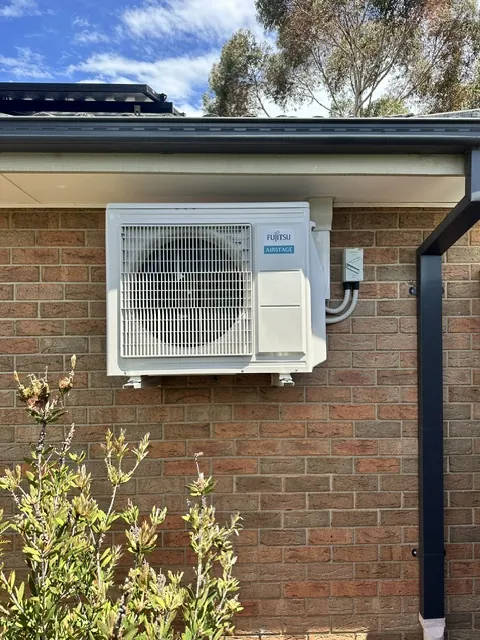
From one of our jobs
Outdoor units set on level mounts, clear of the fence line
Photographed on site in Melbourne’s west. REC 37223.
- Reverse cycle efficiency
- 3 - 4 units heat per unit power
- Running cost per hour
- 28c - 36c vs 50c - 72c gas
- Typical annual saving
- $200 - $450
- VEU minimum contribution
- $200 inc GST
What this upgrade actually is
The activity most people mean when they ask about a gas to electric heating rebate is the replacement of a ducted gas heater with reverse cycle air conditioning. Victorian Energy Upgrades supports it because the efficiency difference between the two is large and measurable, which is exactly what a certificate based scheme is built to reward.
A gas heater burns fuel to make heat, and a good modern unit converts roughly 80 to 92 percent of the fuel into useful warmth. Reverse cycle does not make heat at all, it moves it, which is why it delivers roughly 3 to 4 units of heat for every unit of electricity it consumes. That is a fundamentally different machine doing the same job, and the program pays for the difference.
In practice the changeover takes one of two shapes. Either a ducted reverse cycle system replaces the gas furnace and reuses or replaces the ductwork, or the house moves to split systems in the rooms that are actually used. Both can be eligible activities. Which one suits your house is a separate question to which one attracts more support, and it is worth answering in that order.
What qualifies, and what quietly does not
The program is specific about what it will pay for, and the specificity is where most confusion starts. The activity is defined partly by what is being removed, not only by what is being installed.
There has to be a gas heater to replace
The upgrade is a replacement activity. Installing reverse cycle in a house that has never had ducted gas is a different proposition, and the existing appliance forms part of the eligibility test. The old unit is decommissioned as part of the work.
The property must be at least two years old
This rules out new builds. In the newer estates around Point Cook and Werribee it is the condition that most often ends the conversation early, so check it before you plan a budget around it.
Approved products, accredited installers
The equipment has to be on the program product register and the work has to be done by an accredited provider. A quote that is cheaper because the unit is not registered is not cheaper, it is a quote without a discount attached.
A minimum customer contribution of $200 including GST
The program is designed so the household always pays something toward the work. You will not receive an eligible upgrade for nothing, regardless of how the arithmetic looks.
No income test
Unlike Solar Homes, VEU does not care what the household earns. That makes it the most broadly available support in the state, and it applies equally to owner occupiers and, subject to the usual consent requirements, to rental properties.
How the discount reaches your invoice
This is not a rebate you claim and wait for. Nothing is reimbursed, nothing arrives in your bank account, and there is no form for you to lodge with a department. The discount is applied to the installation invoice before you pay it.
The mechanism behind it is a certificate. When an accredited provider installs an eligible upgrade, certificates are created based on the modelled energy saved by that specific activity at that specific property. Those certificates are sold into a market, and the proceeds fund the discount that appears on your invoice. The installer carries the paperwork and the market risk, and you see a reduced price.
The practical consequence is that you should be able to read the discount on the quote as a line item, dated, with a net amount payable underneath it. If a quote mentions a rebate in general terms without showing it as a figure against the total, ask for the figure. A verbal rebate is not a rebate.
It also means the discount is bound to the job being done properly. Certificates are only created when the activity is completed and documented to the program requirements, including decommissioning the old appliance. Cutting corners on that paperwork is not a shortcut, it is how a discount fails to materialise.
Why the number is different at every property
We will not quote a fixed dollar figure for this upgrade on a website, and no honest contractor should. That is not evasiveness, it is a description of how the scheme works. Four things move the number.
| Factor | Why it moves the number |
|---|---|
| The certificate market | Certificates are traded and the price moves. The discount funded this month is not the discount funded last quarter. |
| The property and the system | Certificates are calculated from modelled energy savings for the specific activity, which depend on the equipment installed and the property it goes into. |
| The equipment chosen | Registered products carry different efficiency ratings, and a more efficient unit models a larger saving than a baseline one. |
| The installer | Providers price the job and pass through certificate value differently. Two accredited installers can produce genuinely different net figures for the same house. |
| Program changes | Announced VEU changes commence on 30 September 2026. Rules and values are set by government and can move at short notice. |
Because of all five, the only reliable figure is the one on a current written quote. Confirm the position with the program administrator at energy.vic.gov.au before committing, and treat the quote as the accurate number.
The practical changeover, start to finish
The rebate is the easy part. The physical work is where the planning matters, and it is where quotes most often differ without appearing to.
The assessment covers what is there now. On a ducted changeover we look at the condition of the existing ductwork and whether it is suitable for reverse cycle airflow, the return air path, where an outdoor unit can sit with clearance and without annoying a neighbour, the indoor unit location, and the switchboard. Ducted reverse cycle is a larger electrical load than a gas furnace with a fan, which is why the board and the supply get checked properly rather than assumed. The ducted air conditioning cost guide sets out what that scope costs.
If the house is being split into zones with individual units instead, the assessment is simpler and the cost is lower. Sizing each room properly matters more than brand, and the split system installation cost guide covers what drives the price. Many households in the older parts of Yarraville and Newport end up here, because retrofitting ducts into a period house is expensive and heating three rooms well beats heating seven badly.
On the day, decommissioning the gas appliance is part of the job, not an afterthought. If the gas heater was the last gas appliance in the house, that is also the moment to think about whether you want to keep paying a daily supply charge for a connection you no longer use. A Certificate of Electrical Safety is issued for the electrical work on completion.
What it costs to run afterwards
The discount changes the purchase price once. Running cost changes the bill every winter, and it is usually the larger number over the life of the system.
Heating a room with a reverse cycle split costs roughly 28 to 36 cents an hour. The same room heated by ducted gas costs roughly 50 to 72 cents an hour. Across a Melbourne winter that difference works out at roughly $200 to $450 a year for a typical household, and more if the gas system is old or the ducts leak.
The saving grows if you have solar. Reverse cycle running on daytime generation costs close to nothing, which is a real advantage over gas because gas cannot use your panels. That interaction is worth understanding before sizing anything, and the feed-in tariff guide explains why self-consumption is now where solar value sits.
For a broader look at where the winter bill actually goes and what to change first, the winter heating bills guide works through it in order of cost.
Getting a straight answer before you commit
Ask every installer the same four questions. Is the product I am being quoted on the program register. Is the discount shown as a figure on the quote or described verbally. Who lodges the paperwork and when. What happens to my price if the certificate value moves between quote and installation.
A provider who answers those four cleanly and in writing is a provider whose number will survive contact with the program. One who cannot is quoting you a hope. The other thing worth checking is whether switchboard work has been priced or quietly assumed away, because no program pays for it and it is the most common reason a final invoice exceeds expectations.
Pivot Trade Services holds REC 37223 and SAA accreditation S3962281, ABN 87 689 296 937, and installs across Melbourne west from Altona. Every installation carries a 100% workmanship guarantee on top of the manufacturer warranty. To get the current figure for your property, contact us or call 0401 500 446 or 1300 748 688.
Program values and eligibility change, sometimes with little notice, and must be confirmed with the program administrator at the time you commit. Nothing on this page is a quote. The written quote is the accurate figure.
Figures in this guide are indicative and were accurate at the time of writing (3 August 2026). Rebate values, eligibility rules and certificate-linked discounts change regularly. Confirm current amounts with the program administrator, and treat your written quote as the accurate figure for your property.
Answers
Frequently asked questions
There is no single figure, and any website quoting one is guessing. The Victorian Energy Upgrades discount is funded by tradeable certificates calculated from the modelled energy saving at your specific property with your specific equipment, so it varies by house, by product and by installer, and it moves with the certificate market. Get it in writing on a current quote.
Yes. This is a replacement activity, so the existing ducted gas heater is decommissioned as part of the work and that decommissioning is documented for the claim. Installing reverse cycle alongside a gas heater you intend to keep using is a different activity with different rules, and it will not attract the same support.
Often yes, and for many older western suburbs homes it is the more sensible answer. Retrofitting ductwork into a period house is expensive, and heating three rooms properly usually beats heating seven badly. The eligible activity and the discount differ between the two paths, so ask for both to be quoted with the discount shown separately on each.
No. Victorian Energy Upgrades has no income test, which is what separates it from the Solar Homes rebate. What it does require is that the property is at least two years old and that you contribute a minimum of $200 including GST toward the work. Household earnings are not part of the eligibility assessment at all.
A correctly sized system will. The failures we get called to are almost always sizing and design rather than technology, such as ducts built for gas airflow reused without assessment, or an outdoor unit chosen on price rather than on the heat load of the house. Insist on a proper heat load assessment rather than a unit picked off a price list.
Sometimes. Reverse cycle moves air differently to a gas furnace, so ducts have to be assessed for condition, sizing and leakage rather than assumed to be fine. Reusing sound ductwork saves real money. Reusing failing ductwork produces a system that underperforms in a way nobody can fix afterwards without doing the work twice.
A straightforward split system installation is usually a single day. A ducted changeover reusing existing ducts is commonly one to two days. Add new ductwork, a switchboard upgrade or a difficult outdoor unit location and it can run longer. The gas decommissioning and the electrical certification happen as part of the same job.
No. Victorian Energy Upgrades pays for the eligible heating activity, not for the electrical infrastructure it connects to. Ducted reverse cycle is a substantially larger electrical load than a gas furnace, so on older boards an upgrade is sometimes required. Have that assessed and priced before you sign, not discovered on installation day.
Browse every cost, rebate and comparison guide in the Pivot guides library, or claim the $60 off your first job voucher.
Want this priced for your place?
Tell us what you need and we will give you a written price, not a range that moves on the day.
- Free
- On-site quotes
- Fixed
- Written pricing
- 100%
- Workmanship guarantee
- 5.0★
- 69 Google reviews