
Finding the cause, not just resetting the switch
Electrical Fault Finding in Melbourne
A safety switch that keeps tripping is not being annoying. It is doing exactly what it was designed to do, which is to cut the supply when current is escaping somewhere it should not. The job is to find where.
- REC 37223
- Melbourne west
- Fixed quotes
The short answer
Electrical fault finding is the systematic isolation of a fault using insulation resistance testing, earth leakage measurement and progressive circuit isolation. Melbourne electricians typically charge $90 to $160 per hour plus a call-out fee of $60 to $120, with most faults located within the first hour. The most common causes of a tripping safety switch are a faulty appliance, water in an outdoor outlet or light fitting, and cumulative earth leakage from many electronic devices on one RCD.
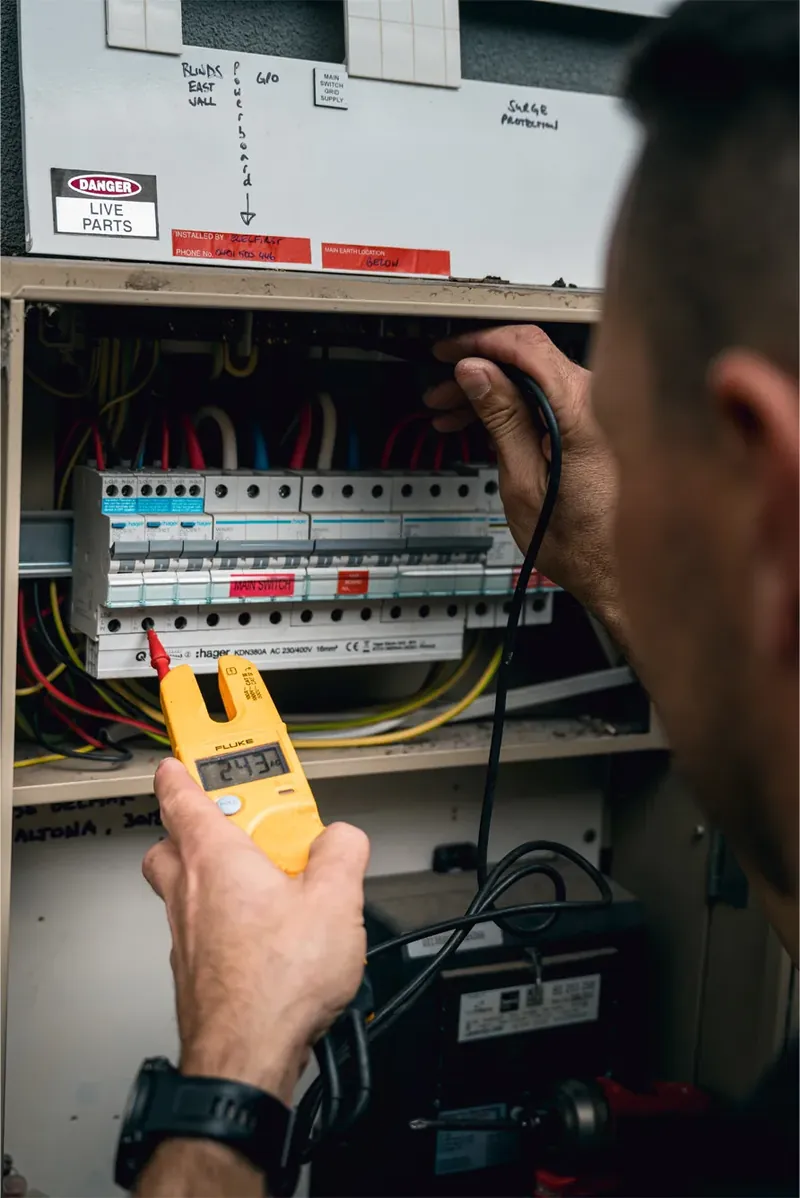
From one of our jobs
Live testing after a switchboard upgrade in Melbourne's west
Photographed on site in Melbourne’s west. REC 37223.
Fault finding is the part of electrical work that rewards method over speed. Guessing costs the customer money. We work through it in a fixed order, and in most houses that locates the problem within the first hour.
The five-minute test you can do first
Before you call anyone, this is worth doing, and it resolves a good proportion of tripping problems on the spot. Unplug everything on the affected circuit. Every appliance, charger and lamp. Then reset the safety switch.
If it holds, the fault is in an appliance, not in your wiring. Plug things back in one at a time, waiting a minute between each. The one that trips it is your culprit, and it is usually a kettle, a toaster, an old fridge, a washing machine or a dishwasher with a failing element or a damp motor. If the switch will not reset with everything unplugged, the fault is in the fixed wiring or in a hardwired appliance, and that is when to call us.
How we trace a fault
The method is a progressive split. We isolate at the board, then divide the installation into sections and test each one, halving the search area with every measurement rather than working through the house room by room.
The instruments do the work. An insulation resistance tester finds breakdown between active, neutral and earth. A clamp meter measures leakage current on a live circuit, which is how we find a circuit that is not faulty enough to trip on its own but is contributing to a problem. A thermal camera picks up hot terminations behind a faceplate before they become a fire. And a good deal of it is simply knowing where these faults hide in Melbourne housing stock.
Confirm the symptom
When does it trip, what is running at the time, does it trip immediately or after ten minutes, does it only happen in the rain.
Isolate at the board
Split the installation and test each section separately to narrow it to a single circuit.
Measure, do not assume
Insulation resistance and leakage readings give a number. A number tells you which way to go next.
Locate physically
Once the circuit is identified, we work along it to the actual point of failure and confirm it before repairing.
Retest after repair
The circuit is retested and, where prescribed work has been done, a Certificate of Electrical Safety is issued.
Where the faults usually are
After enough years in the same housing stock, patterns emerge. These are the ones we find most often in the western suburbs.
Water in outdoor outlets and lights
The classic rain-only trip. Water tracks into a weathered outdoor GPO, a garden light or a sensor floodlight and provides a path to earth.
Roof leaks into downlights
A slipped tile drips onto a ceiling fitting. It trips at night during rain and dries out by morning, which makes it maddening to find without testing.
Failing heating elements
Ovens, cooktops, dishwashers and hot water elements break down internally and leak to earth once hot, so the trip happens partway through a cycle.
Rodent damage
Rats and possums chew cable sheath in roof spaces. Common in older weatherboard houses and near open paddocks in the outer west.
Nail and screw strikes
Picture hooks, decking screws and pergola bolts through a hidden cable. The fault appears weeks after the DIY project that caused it.
Deteriorated old cable
Rubber-insulated cable in a hot roof space eventually leaks enough to trip a modern RCD, which is often how a house discovers it needs rewiring.
Nuisance tripping and cumulative leakage
Not every trip is a fault in the traditional sense. Modern electronics all leak a tiny amount of current to earth by design, through the filters in their power supplies. A standard allows up to a few milliamps per appliance. Individually that is harmless.
Put a dozen devices on one circuit protected by a 30mA RCD, though, and the standing leakage can sit at 20mA before anything goes wrong. Then one appliance adds a few more milliamps as it warms up and the RCD trips, with nothing actually broken. The fix is usually to redistribute circuits and to protect them individually with RCBOs rather than putting half the house behind one RCD. This is one of the most common causes of the trip nobody can explain, and it is frequently misdiagnosed as a faulty safety switch.
What you get from us
We tell you what the fault is, what caused it, what it costs to fix, and whether it needs doing today or can wait. If the fault turns out to be inside an appliance, we say so rather than inventing wiring work, and we will tell you if it is worth repairing or replacing.
Where the fault is in the fixed wiring, we quote the repair before doing it. Where it is a symptom of a broader problem, such as degraded cable or an overloaded board, we will say that too, with the test results that support it. Fault finding is charged at our hourly rate plus a call-out fee, and if the repair follows immediately in the same visit you are not paying twice for the trip.
Book fault finding if
- 1A safety switch trips repeatedly, or only when it rains
- 2A circuit is dead but nothing looks obviously wrong
- 3Lights flicker or dim when an appliance starts
- 4A switch, outlet or faceplate is warm or discoloured
- 5You can smell hot plastic and cannot find the source
- 6Power comes and goes in one part of the house
- 7You get a small tingle from a tap, an appliance or a metal fitting
On the job
Fault Detection in Melbourne's west
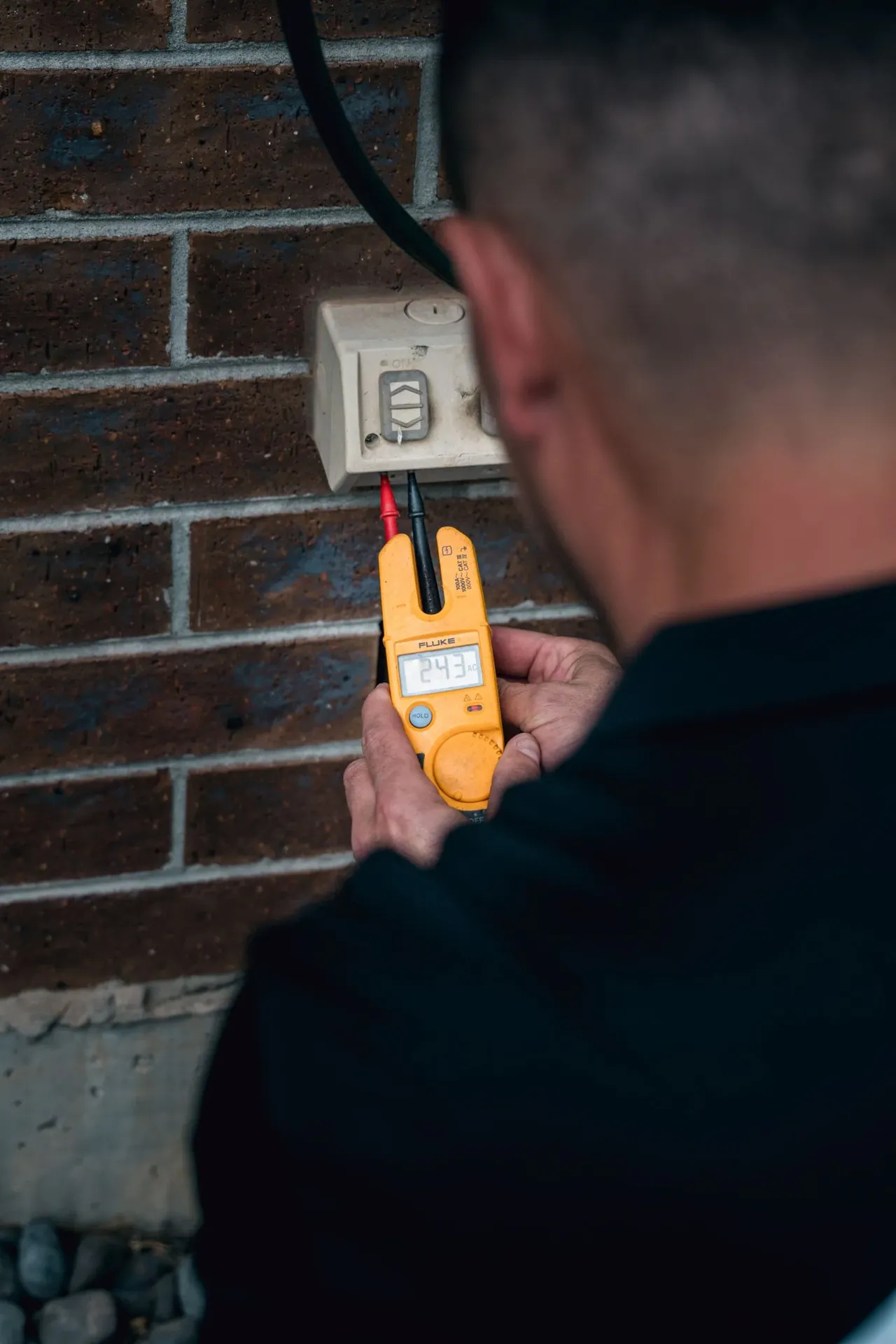
Testing an outdoor power point after installation
Licensed and accredited work by a local team. Read about Pivot Trade Services or see recent jobs across the western suburbs.
Answers
Frequently asked questions
Melbourne electricians generally charge $90 to $160 per hour with a call-out fee of $60 to $120. Most domestic faults are located within the first hour. Intermittent faults, faults that only appear in wet weather, and houses with no circuit labelling take longer because the fault has to be provoked before it can be measured. We tell you where we are at the one-hour mark rather than quietly running up hours.
Water is finding a path to earth somewhere in the installation. The usual suspects are outdoor power points with perished seals, garden and sensor lights, and roof leaks dripping onto a downlight or a junction in the ceiling. It dries out and works again, which is why it is so often left alone. It is worth chasing, because the same path can energise something metal outside.
Usually yes. Insulation resistance testing finds degraded cable even when the circuit is behaving, and leakage measurement shows a circuit sitting close to its trip threshold before it actually trips. For genuinely intermittent faults we sometimes need to provoke the conditions, for example by loading a circuit or by testing after rain, and we will be upfront about that.
Only after testing. RCDs do wear out and can become over-sensitive, so it is a real possibility, but it is the least likely explanation and the most expensive assumption. Replacing a device that was correctly detecting a genuine earth fault removes your protection and leaves the fault in place. We measure the trip current and time before condemning a device.
A brief dip when a large motor starts is normal. Persistent flickering, or a dip severe enough to be obvious across the whole house, points to a loose connection somewhere in the supply path, an undersized consumer main, or a neutral problem. A loose neutral is a serious fault that can damage appliances, so this one should not be left. It is also worth checking whether neighbours see it, because that points to the network side.
Almost certainly, and it needs attention immediately. A tingle from a tap or a metal appliance usually means a fault has energised metalwork or that the earthing system is not doing its job. Do not use the tap or appliance, and call us. This is one of the few faults we treat as an emergency, because the same conditions that give a tingle in dry shoes can be lethal in a wet bathroom.
Book fault detection
Tell us what you need and we will give you a written price, not a range that moves on the day.
- Free
- On-site quotes
- Fixed
- Written pricing
- 100%
- Workmanship guarantee
- 5.0★
- 69 Google reviews