
Know the wall before you hang anything on it
Home Battery Installation in Norlane
Norlane is Housing Commission housing built between 1947 and 1976, 2,464 houses with the peak between 1951 and 1957. More than 1,200 of them are prefabricated units shipped in from Holland and France. They do not behave like standard brick veneer when you open a wall, and a battery is a heavy thing to hang on a wall you have assumed rather than checked.
- Norlane 3214
- Powercor network
- REC 37223
The short answer
Home battery installation in Norlane 3214 needs the wall confirmed before anything is mounted. The Housing Commission built 2,464 houses here between 1947 and 1976, and more than 1,200 of them were prefabricated units imported from Holland and France, whose wall construction is not what an electrician expects from Australian brick veneer. Norlane is a Powercor address, so the inverter needs a Powercor application. Original installations were sized for 1950s Ford and International Harvester households, so board work usually comes first.
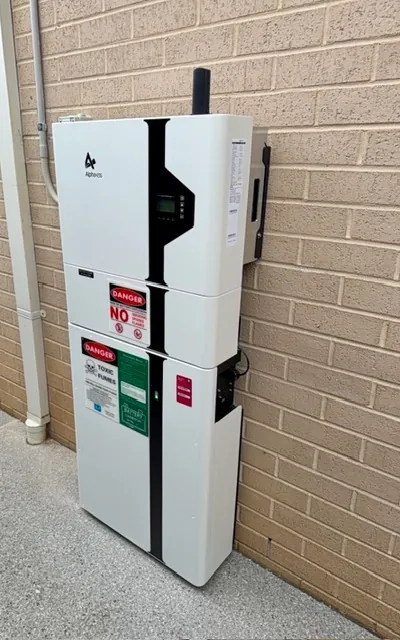
From one of our jobs
A battery stack tucked down the side of the house
Photographed on site in Melbourne’s west. REC 37223.
That is the whole difference on a Norlane battery job. The blocks are uniform and wide, the access is clear, and the roof orientation is consistent street by street because the estates were planned as a whole. It is the building fabric and the age of the installation that decide the work.
Prefabricated Dutch and French houses
More than 1,200 houses here are imported prefabricated units from Holland and France. Their wall construction is not what an electrician expects, so cable routes have to be confirmed rather than assumed, and the same applies to fixings. A wall-mounted battery is a substantial load and it needs a structure that will actually carry it.
On those houses we look at what the wall is made of before choosing between a wall-mounted and a floor-standing unit. Frequently the sensible answer is floor-standing in a garage or shed, on a proper base, which sidesteps the question entirely and makes future servicing easier as well.
Confirm, do not assume
Prefabricated wall panels are not brick veneer, so both cable routes and fixings get verified on site.
Floor-standing is often better
A floor-mounted unit on a base removes the structural question and makes service access simpler.
Ask which house you have
Not every Norlane home is prefabricated, so the first thing we establish is which type is in front of us.
Installations sized for a 1950s household
These houses were built for Ford, International Harvester and phosphate works employees in the early 1950s, and the original installations were sized for a fraction of a modern household load. Add three generations of appliances and the board is usually the limiting factor before anything else.
A battery adds circuits and normally a backup sub-board, so on most Norlane homes the switchboard work comes first. It runs $800 to $3,500 or more depending on the supply arrangement. Housing of this vintage also frequently has asbestos in sheeting and meter box backing, which changes how a board is removed.
Board before battery
On most homes here the switchboard upgrade is the first stage and the battery is the second.
Meter box backing
Asbestos backing behind an original meter box changes the method and the price of removing a board.
Load sized for 1953
The original installation assumed a household with a fraction of today’s appliances, which is the real constraint.
Uniform blocks and consistent roof orientation
The estates were laid out for standardised house types rather than individual designs, which gives uniform blocks with wide frontages and clear side access. For an installer that means simple, short cable runs and no access surprises, which keeps the physical part of a battery job cheap.
The roofs are consistent street by street for the same reason. Low to moderate pitch tile and steel on single-storey homes with consistent orientation means an assessment on one house tells you a lot about its neighbours, and it means the array feeding the battery performs predictably.
No access surprises
Standardised layouts mean wide frontages and clear side access on nearly every block.
Predictable roofs
Planned estates give consistent pitch and orientation, so generation estimates here are reliable.
Cheap physical install
Short runs and easy placement mean the installation labour is not where the money goes on a Norlane job.
Sizing and what the return looks like
Capacity comes from what the household uses between roughly 5pm and midnight. On Norlane stock, single-storey homes progressively electrified over decades, that usually lands at 8kWh to 12kWh usable rather than the larger systems that suit big estate homes further south.
The return is the gap between exporting a kilowatt hour for under 5 cents and importing it in the evening at 30 to 45 cents. Payback typically runs 7 to 10 years against a real world life of 12 to 15. On a home where the board also needs replacing, count that cost separately when deciding whether the project stacks up.
Measure the evening
Interval data from your retailer gives the sizing answer far more reliably than floor area does.
Count board work separately
The payback maths on the battery should not be asked to carry the cost of fixing a 1950s installation.
Usable, not advertised
Both the federal discount and your evening savings run off usable capacity, which is lower than nameplate.
Backup, the federal discount and Powercor
Backup is a backup-capable battery plus a gateway and a sub-board carrying nominated circuits. On a Norlane job that sub-board is best installed as part of the switchboard upgrade, because the access and the certification are already being paid for once.
A 10kWh battery is $8,000 to $12,000 installed before rebates and $5,500 to $9,500 after the federal Cheaper Home Batteries discount, roughly 30 percent at about $250 per usable kilowatt hour from 1 May 2026. Norlane is Powercor, the same distributor as our own area in the western suburbs of Melbourne, and at about 55km it is one of the closer parts of the region for us to schedule.
One visit, two outcomes
Board upgrade and backup sub-board together is the efficient sequence on this stock.
Applied at point of sale
The federal discount is taken off the installed price by the accredited installer, not claimed afterwards.
Scheduled, not same-day
At 55km from Altona we book Norlane work in blocks and nominate the week.
On the ground
Norlane battery notes
- More than 1,200 of the 2,464 Commission houses here are prefabricated units imported from Holland and France, so wall construction and fixings are confirmed before a battery is mounted.
- Original installations were sized for early 1950s Ford, International Harvester and phosphate works households, so board capacity is usually the constraint before anything is added.
- Asbestos in sheeting and meter box backing is common in this vintage, which changes how an original board is removed and what that work costs.
- Uniform Commission blocks with wide frontages and clear side access make the physical install simple, and planned estate layouts give predictable roof orientation.
Licensed and accredited work by a local team. Read about Pivot Trade Services or see recent jobs across the western suburbs.
Answers
Norlane questions
Yes, in two ways. More than 1,200 houses here were shipped in from Holland and France in the 1950s, and their wall construction is not what an electrician expects from brick veneer. Cable routes get confirmed rather than assumed, and a wall intended to carry a battery gets verified. Often a floor-standing unit is the better answer.
Yes, and on prefabricated stock here it is frequently the sensible choice. A floor-mounted unit on a proper base removes any question about what the wall panel will carry, and it makes servicing in year three and year seven easier. It needs a suitable position with the required clearances, usually a garage or shed.
On most Norlane homes, yes. These installations were sized for a fraction of a modern household load, and a battery adds circuits plus normally a backup sub-board. Upgrades run $800 to $3,500 or more, and asbestos in the meter box backing can affect the method. We price it separately so the sequence is clear.
Usually 8kWh to 12kWh usable. These are single-storey Commission houses progressively electrified over decades rather than large modern homes with big ducted loads. The figure comes from consumption between 5pm and midnight, and twelve months of interval data from your retailer answers it far better than floor area does.
The physical part is usually cheap. The estates were laid out for standardised house types, so blocks are uniform with wide frontages and clear side access, and cable runs are short. What costs money on a Norlane job is the electrical starting point, not getting equipment to where it needs to go.
Yes, on a scheduled basis. It is about 55km from our Altona base, which makes it one of the closer parts of the Geelong region for us. Powercor covers the network here, and the battery connection application is lodged before the installation is booked. We work in blocks and nominate the week.
Other work we do in Norlane
- Electrician in NorlaneTwelve hundred prefabricated houses that do not open like brick veneer
- Solar installation in NorlaneThe houses shipped in from Holland and France
- EV charger in NorlaneThe walls here are not what most electricians expect
- Split system in NorlaneThe wall you are drilling is not what you think it is
- Heat pump hot water in NorlanePrefabricated walls, original boards, off peak tanks
Get a Norlane quote
Tell us the address and what you need. We quote Norlane 3214 and the surrounding western suburbs in writing, with no obligation.
- Free
- On-site quotes
- Fixed
- Written pricing
- 100%
- Workmanship guarantee
- 5.0★
- 69 Google reviews