
Big blocks, big roofs, tanks at the end of their run
Heat Pump Hot Water Systems in Hoppers Crossing
Hoppers Crossing is a settled family suburb of mostly 1980s and 1990s brick homes on generous blocks, and that combination produces a very consistent hot water job. The original tank has usually been replaced once, that replacement is now itself fifteen years old, and the switchboard behind it has breakers but not necessarily safety switches on every circuit.
- Hoppers Crossing 3029
- Powercor network
- REC 37223
The short answer
Heat pump hot water in Hoppers Crossing costs $3,000 to $4,500 supplied and installed before incentives and uses roughly one third of the electricity of a conventional electric storage tank. After Solar Homes of up to $1,000, or up to $1,400 for a locally made product, the Victorian Energy Upgrades invoice discount and federal STCs worth roughly $300 to $600, most households pay a few hundred dollars up to about $1,500. Boards of this era often need RCD work first.
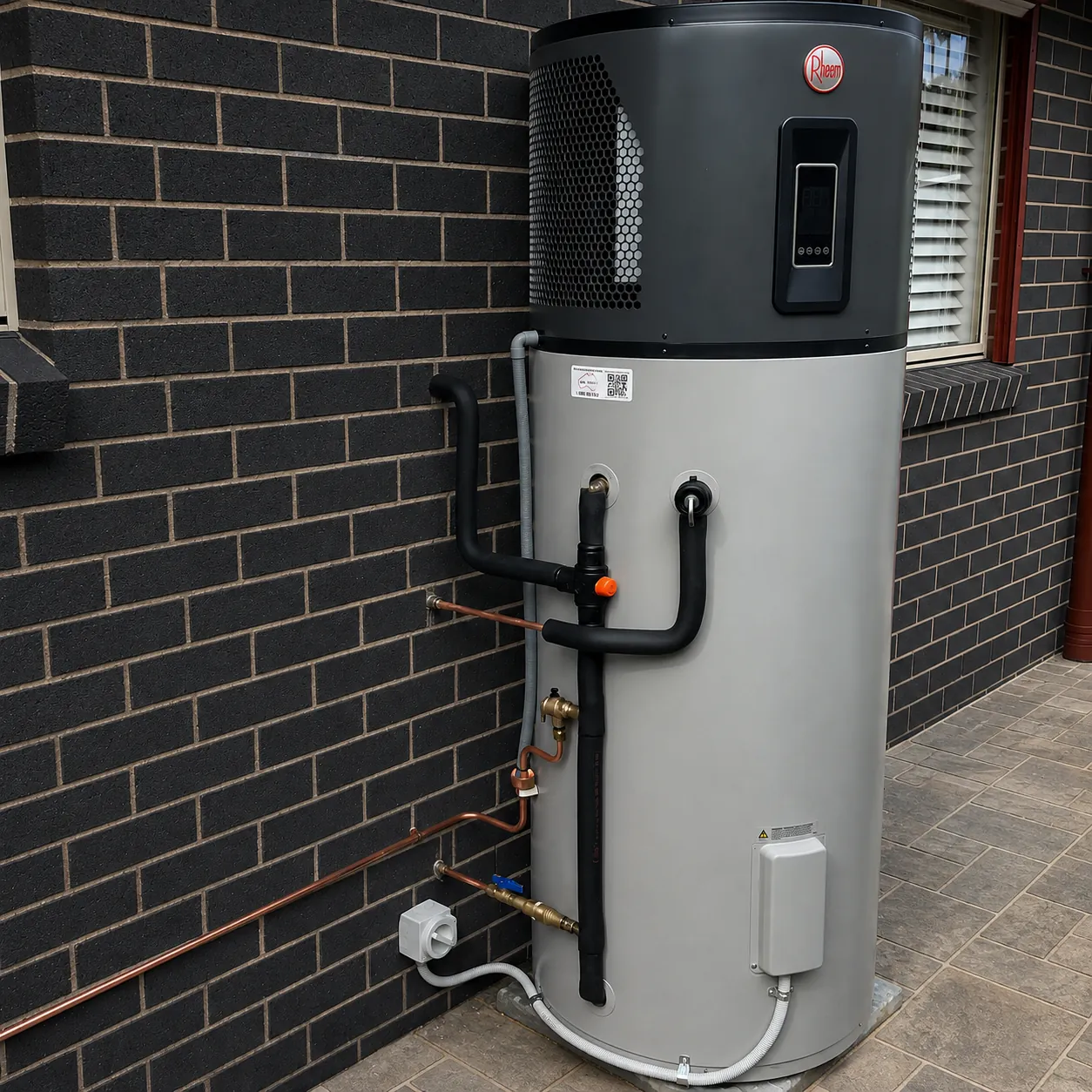
From one of our jobs
New electric heat pump replacing an old, expensive gas hot water unit
Photographed on site in Melbourne’s west. REC 37223.
Physically it is one of the easier suburbs to work in. Large family blocks with detached garages, sheds and long rear yards give real choice about where a heat pump stands, and broad unshaded single-storey roofs mean plenty of homes here have solar to run it on.
What is on the wall or the slab right now
The two we replace most often are a 250 to 315 litre electric storage tank running on controlled load overnight, and a gas storage unit fitted during the 1990s or as a like for like swap in the 2000s. Both are past the age where another replacement of the same type makes economic sense.
An electric element gives you one unit of heat for one unit of electricity and cannot do better. A heat pump gets the same result on roughly a third of the electricity by moving heat out of the outside air. On a four person Hoppers Crossing household with a heavy morning shower load, that is a material change to the bill rather than a marginal one.
RCDs, and why the board comes up on almost every quote here
Boards from the 1980s and 1990s frequently need RCD retrofits before any new circuit is added. That is the single most common finding on a Hoppers Crossing quote. It is not a scare tactic and it is not optional dressing on the invoice. A new dedicated hot water circuit needs to be protected properly, and once we are in the board it is usually sensible to look at whether the rest of the house is.
How much work that is varies. Sometimes there is room for a single RCBO on the new circuit and the rest of the board is acceptable. Sometimes the enclosure is full, the busbar arrangement is dated, and a proper upgrade is the honest answer. We quote it as its own line so you can decide with the numbers in front of you.
Single new RCBO
The cheapest outcome. Works where the board has a spare way and the existing arrangement is otherwise sound.
Partial board work
Adding RCD protection to unprotected final subcircuits while the board is open, without a full replacement.
Full board upgrade
Needed when the enclosure is out of room or the arrangement is too dated to extend safely. Most single phase upgrades finish within a day.
Shed and garage circuits
Detached buildings here were often wired informally by previous owners. Worth checking while the board is open.
Placement on a big block is a choice, not a compromise
Long rear yards, detached garages and sheds mean there is almost always a good position available in Hoppers Crossing. That is genuinely different from the terrace suburbs, where the job is finding the least bad option.
The trade off is distance. Putting the unit somewhere out of the way adds hot water pipe run, which means a longer wait at the tap and more heat lost on the way, and it adds cable from the board. We usually recommend staying reasonably close to the original position unless there is a noise or airflow reason to move, and we price the alternative so you can compare.
Broad unshaded roofs make the timer the easy win
Hoppers Crossing roofs are broad single-storey tile, generally unshaded, and well suited to solar. A large proportion of homes here already have an array, often a decent sized one, because the roof space made it worthwhile.
Set the heat pump to heat in the early afternoon and that array carries most of the hot water load. Export is worth very little now, so the choice is between selling generation for a few cents or putting it into a tank you will use that night. It is not a close call. We set the window at commissioning and show whoever runs the house how to change it.
On the ground
Hoppers Crossing specifics
- 1980s and 1990s boards frequently need RCD work before a new dedicated hot water circuit is added
- Large family blocks with detached garages and long rear yards give genuine choice about unit placement
- Detached sheds and garages were often wired informally by previous owners and are worth checking while the board is open
- Broad unshaded single-storey roofs mean high solar uptake and a straightforward case for an early afternoon heating window
- Original hot water services and their first replacements are both now at end of life across large parts of the suburb
Licensed and accredited work by a local team. Read about Pivot Trade Services or see recent jobs across the western suburbs.
Answers
Hoppers Crossing questions
Because boards of this era in Hoppers Crossing very often have circuit breakers but no RCD protection on every final subcircuit. A new dedicated hot water circuit has to be protected properly. Depending on the board that might be one RCBO, some partial work, or a full upgrade. It appears as its own line so you can see exactly what it is.
It can, but weigh it up. Extra distance means more hot water pipe, a longer wait at the tap, more heat lost in the run, and more cable from the board. Unless there is a noise or airflow reason to move it, staying near the original position is usually the better outcome. We price both so you can compare properly.
It is worth more, not less. Set the heating window to the early afternoon and your array carries most of the hot water load. With feed-in rates as low as they are, the alternative is exporting that generation for a few cents. Hoppers Crossing roofs are large and unshaded, so most homes here have plenty of midday production to work with.
Generally 250 to 280 litres for three or four people and 300 litres or more for five plus, or for a household with a heavy morning run of showers. Heat pumps reheat more slowly than gas instantaneous units, so it is better to size for the busiest morning than the average one. We ask how the house actually runs before quoting.
The system is $3,000 to $4,500 supplied and installed before incentives. Solar Homes contributes up to $1,000, or up to $1,400 for a locally made product, Victorian Energy Upgrades applies its discount to the invoice, and federal STCs are worth roughly $300 to $600. Most households pay a few hundred dollars up to about $1,500 once those are stacked.
Other work we do in Hoppers Crossing
- Electrician in Hoppers CrossingBig flat floorplans, big roofs, and heating on its last legs
- Solar installation in Hoppers CrossingBig flat roofs, big daytime loads
- Home battery in Hoppers CrossingA big evening load to discharge into
- EV charger in Hoppers CrossingLong blocks, detached garages and boards that need a retrofit
- Split system in Hoppers CrossingDucted country, but splits still win in a lot of these houses
Get a Hoppers Crossing quote
Tell us the address and what you need. We quote Hoppers Crossing 3029 and the surrounding western suburbs in writing, with no obligation.
- Free
- On-site quotes
- Fixed
- Written pricing
- 100%
- Workmanship guarantee
- 5.0★
- 69 Google reviews