
Adding one more load to an already busy switchboard
Heat Pump Hot Water Systems in Point Cook
Point Cook is the suburb where we most often do the full stack: solar already on the roof, a battery going in, and an EV charger that has to share capacity with both. Hot water is frequently the fourth item on that list, and it is worth thinking about at the same time rather than in isolation.
- Point Cook 3030
- Powercor network
- REC 37223
The short answer
Heat pump hot water in Point Cook costs $3,000 to $4,500 supplied and installed before incentives and uses roughly one third of the electricity of a conventional electric storage tank. With Solar Homes worth up to $1,000, or up to $1,400 for a locally made product, the Victorian Energy Upgrades invoice discount and federal STCs of roughly $300 to $600, most households pay a few hundred dollars up to about $1,500. Existing solar makes a daytime heating timer especially worthwhile here.
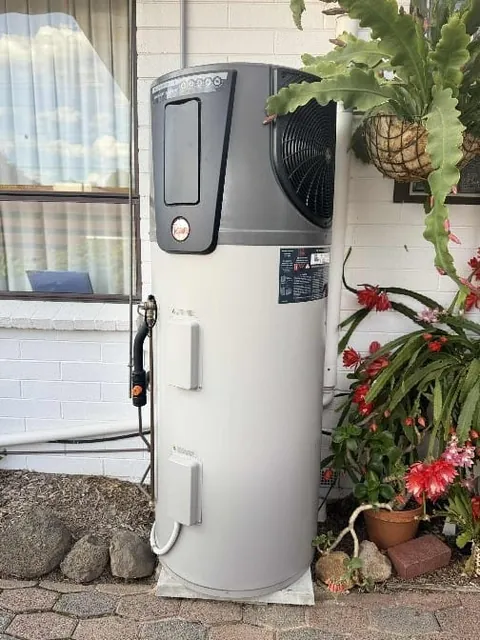
From one of our jobs
Same footprint, roughly a third of the running cost
Photographed on site in Melbourne’s west. REC 37223.
The housing is large modern estate stock built from the early 2000s onward, much of it double storey, on lots with attached double garages, limited eaves and tight side setbacks. The switchboards are modern and generally compliant, so the real question here is almost never safety. It is spare capacity, and it is space.
The incumbent is usually gas, not old electric
Estate homes of this era were mostly built with gas instantaneous or gas storage hot water, which is a different starting point from the post-war suburbs closer to the bay. Those units are now fifteen to twenty years old and starting to fail, and the households looking at them are usually also carrying a daily gas supply charge for very little else.
That changes the arithmetic. If hot water is the last significant gas appliance in the house, moving it to a heat pump lets you disconnect gas entirely and drop the supply charge as well as the usage. We see that decision made more often in Point Cook than anywhere else we work.
Tight side setbacks and where the unit fits
Modern estate lots put houses close together with narrow side setbacks and limited eaves. The side corridor where the gas unit currently hangs on the wall is often barely a metre wide, and that is a poor place to stand a heat pump. Airflow is restricted, the cold exhaust has nowhere to go, and the sound reflects off two parallel walls straight into the neighbouring house.
On double storey estate homes the neighbouring bedroom window is often directly above that corridor as well. So the answer here is usually a rear yard position, or a split configuration that puts the compressor somewhere sensible and the tank somewhere convenient. We measure the pipe and cable implications and put both options on the quote.
Side corridor
Rarely the right answer on an estate lot. Restricted airflow and two parallel walls make it the worst case for both efficiency and noise.
Rear yard
The usual outcome. Costs extra pipe and cable but gives the unit air to breathe and points the noise away from boundaries.
Alfresco distance
Point Cook homes are built around outdoor living. Keep the unit away from the alfresco or it will run during exactly the hours you are out there.
Meter box distance
Attached double garages usually put the board at the front. A rear position adds cable, and that length is a real line in the price.
Spare capacity, not compliance, is the switchboard question
Boards in Point Cook are modern and usually compliant, which means we are not normally having a safety conversation. We are having a capacity conversation. A house with a large solar array, a battery, a ducted system, an induction cooktop and an EV charger has already committed a lot of its supply, and a heat pump needs one more dedicated circuit.
Where the board is full or the main switch rating is getting tight, the options are load management on the EV charger, a board expansion, or in some cases a supply upgrade. A heat pump is a modest load compared with a charger, so it is usually the easy one to accommodate, but it is worth doing the sums once across the whole house rather than circuit by circuit.
You almost certainly already have the solar to run it
Solar penetration in Point Cook is high, and roofs here are complex modern hip-and-valley tile with multiple orientations and short unbroken runs. That means arrays are often spread across several faces, generating a broad, moderate curve through the day rather than one sharp northern peak.
That curve suits a heat pump well. Set the heating window to the early afternoon and the tank absorbs generation you would otherwise export for a few cents. If you have a battery, it is worth deciding whether the hot water or the battery gets the surplus first, and that depends on your tariff. We will talk it through rather than pretending there is one right answer.
On the ground
Point Cook specifics
- Estate homes from the early 2000s onward were mostly built with gas hot water, so this is often the job that lets a household disconnect gas entirely
- Tight side setbacks with limited eaves make the side corridor a poor position for both airflow and noise, especially under a double storey neighbour window
- Boards are modern and compliant, so the question is spare capacity rather than safety
- Very high solar and EV ownership means the hot water circuit should be planned alongside charger load management, not after it
- Complex hip-and-valley roofs spread arrays across several orientations, producing a broad daytime curve that suits an afternoon heating window
Licensed and accredited work by a local team. Read about Pivot Trade Services or see recent jobs across the western suburbs.
Answers
Point Cook questions
If hot water is your last significant gas appliance, yes, and it is one of the better reasons to do this job in Point Cook. Disconnecting gas removes the daily supply charge as well as the usage, which for a household using gas only for hot water is often the larger half of the bill. We handle the electrical side and coordinate the rest.
Usually the rear yard. A narrow side corridor between two estate homes restricts airflow, traps the cold exhaust and reflects compressor noise off two parallel walls into the neighbouring house, often directly under an upstairs bedroom window. We price the rear position properly, including the extra pipe and cable, rather than squeezing it in where the gas unit was.
Usually, because a heat pump is a modest load compared with a charger. What we do is look at the whole picture once: main switch rating, spare ways, and whether the charger has load management. That is a better exercise than adding one circuit at a time and discovering the limit on the fourth upgrade.
It depends on your tariff and how much surplus you actually have. Hot water is cheap storage and you use it every day. A battery is more flexible but more expensive per unit stored. On most Point Cook setups we set the hot water window to the early afternoon and let the battery take what is left. We will talk through your numbers rather than give a blanket answer.
The system is $3,000 to $4,500 supplied and installed before incentives. Solar Homes contributes up to $1,000, or up to $1,400 for a locally made product, Victorian Energy Upgrades applies a discount to the invoice, and federal STCs are worth roughly $300 to $600. Most households pay a few hundred dollars up to about $1,500, and the net figure is on the quote.
Other work we do in Point Cook
- Electrician in Point CookSolar on the roof, a battery going in and a car to charge
- Solar installation in Point CookEstate roofs, EVs and second systems
- Home battery in Point CookThe suburb where the full stack happens
- EV charger in Point CookWhere the charger has to share the house with solar and a battery
- Split system in Point CookDouble storey estate homes and the upstairs problem
Get a Point Cook quote
Tell us the address and what you need. We quote Point Cook 3030 and the surrounding western suburbs in writing, with no obligation.
- Free
- On-site quotes
- Fixed
- Written pricing
- 100%
- Workmanship guarantee
- 5.0★
- 69 Google reviews