
Two housing stocks, two different arrays
Solar Panel Installation in Altona North
Altona North is two suburbs wearing one name. On one street you have solid post-war brick and weatherboard on generous blocks, and on the next you have a townhouse estate built in the last decade with compact Colorbond roofs and shared driveways. The right solar design is not the same on both.
- Altona North 3025
- Jemena network
- REC 37223
The short answer
Solar installation in Altona North typically means a 6.6kW system at $3,000 to $6,000 after federal STCs, on either an older tiled hip roof or a new estate skillion. Altona North is a Jemena address, so Jemena handles pre-approval and sets any export limit. The Bradmill and Millers Road townhouse estates have smaller but simpler Colorbond roofs that take dense panel layouts well, while older post-war homes often need a switchboard assessment first.
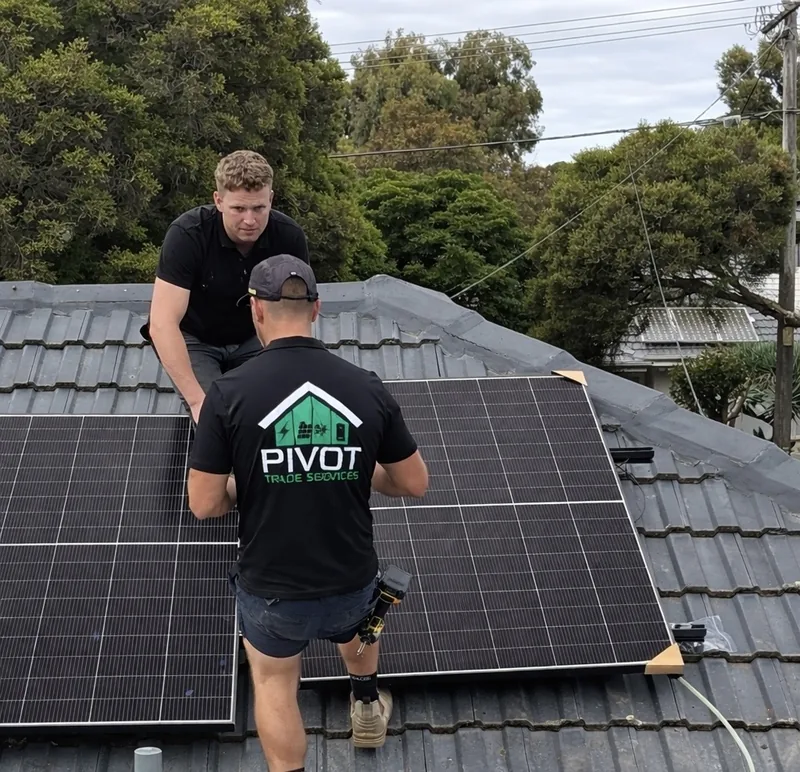
From one of our jobs
Panels going on over a tiled roof in Melbourne's west
Photographed on site in Melbourne’s west. REC 37223.
We are four kilometres away in Altona and work both sides of it, including the light-industrial strip toward Kororoit Creek Road. That mix means we quote a lot of three-phase properties here, which is unusual for a residential suburb and changes the inverter conversation.
Older homes: good roof planes, uncertain boards
The post-war stock around The Circle and the older residential grid gives you what solar likes best: broad, single-storey tiled hips with a clear northern face and enough unbroken run to lay out a full 6.6kW array without splitting it across four orientations.
The variable is the switchboard. On these streets we still find 1950s boards that have been added to over decades rather than replaced. A solar circuit needs somewhere compliant to land, and where the board cannot take it, an upgrade runs $800 to $3,500 or more depending on what is behind the cover. We assess that at quote stage so it does not appear as a surprise on install day.
Estate townhouses: smaller roofs, cleaner installs
The newer estates around Millers Road and the old Bradmill site have Colorbond skillion roofs. They are smaller in total area than the post-war homes, but they are a single plane at a consistent pitch, which means high panel density and no awkward cut-outs around hips and valleys.
Be realistic about size. A compact townhouse roof with one usable orientation often lands at 4kW to 6.6kW rather than 10kW, and if the skillion faces east or west that is fine, it just shifts the generation curve. Sheet roofs also install faster and with no tile breakage, so labour on these is generally cheaper than on the older stock.
Skillion means density
One continuous plane at one pitch fits more panels per square metre than a hip roof of the same footprint.
Klip-lok and trimdek mounting
Sheet roofs use clamps rather than tile hooks, so there are no roof penetrations to seal on most profiles.
Check the shared boundary
Estate meter boxes often sit on a shared wall, which affects where the inverter can be mounted and how far the AC run travels.
Jemena approval, not Powercor
Altona North is a Jemena address, unlike neighbouring Altona which is Powercor. It is a common point of confusion because the suburbs share a name and a border. Jemena runs its own pre-approval process with its own forms and timeframes, and it decides whether an export limit applies to your connection.
We lodge the application before the install is booked. Any installer telling you export is unlimited is describing something outside their control. In practice, with exports under 5 cents per kWh and peak imports at 30 to 45 cents, a system designed around daytime self-consumption barely notices a limit.
Three-phase and larger systems
The light-industrial fringe means three-phase supply turns up here more often than in most residential suburbs. If you have it, a three-phase inverter spreads generation evenly across the phases, which helps with voltage rise and often gives you more headroom on what the distributor will approve for export.
It also makes a larger array more practical. Where roof space allows and consumption justifies it, three-phase homes in Altona North can sensibly run 10kW or more. We size to consumption first and roof second, because a big array exporting at 4 cents is a slow way to spend money.
On the ground
Altona North details that change the quote
- Altona North is Jemena while Altona proper is Powercor. Same border, different pre-approval process and different export rules, so we confirm the address before lodging anything.
- Three-phase supply is more common here than almost anywhere else residential in the west, thanks to the industrial zoning near Kororoit Creek Road. That opens up three-phase inverters and larger arrays.
- New estate townhouses commonly share a meter position on a boundary wall. The inverter location and AC cable route need to be walked before pricing, not assumed.
- West Gate Freeway proximity means more airborne grime on panels in the streets closest to it, so an occasional wash is more worthwhile here than in leafier suburbs.
Licensed and accredited work by a local team. Read about Pivot Trade Services or see recent jobs across the western suburbs.
Answers
Altona North questions
No. Altona North is a Jemena address while Altona 3018 is Powercor. They share a boundary but not a distributor. It matters because Jemena runs a different pre-approval process and sets its own export conditions. We check the address against the network before lodging anything, so the approval goes to the right place first time.
Typically 4kW to 6.6kW on a single skillion plane. It is less than an older Altona North home takes, but the install is cleaner and panel density is higher because there is one pitch and no hips or valleys. If the plane faces east or west, output shifts later or earlier in the day rather than disappearing.
Only if your existing board cannot safely take the new circuit, which is common in unrenovated post-war Altona North homes and rare in the newer estates. Where it is needed it runs $800 to $3,500 or more. We inspect the board at quote stage so it is priced upfront rather than discovered on install day.
Usually yes, on systems above about 5kW. A three-phase inverter balances generation across all three phases, which reduces voltage rise at your point of connection and often improves what the distributor will approve. It costs more than a single-phase unit, so on a small array the maths sometimes still favours single-phase.
A quality 6.6kW system is $4,500 to $8,500 before incentives and roughly $3,000 to $6,000 after federal STCs worth $2,000 to $3,000. Eligible households can claim up to $1,400 more through Solar Victoria Solar Homes, subject to a $150,000 combined household income cap from 1 July 2026. STCs taper each year until the scheme ends in 2030.
Other work we do in Altona North
- Electrician in Altona NorthOld streets and new estates, four kilometres from base
- Home battery in Altona NorthEstate garages and post-war boards
- EV charger in Altona NorthOld streets and new estates need two different jobs
- Split system in Altona NorthSolid brick on one street, new townhouse on the next
- Heat pump hot water in Altona NorthTwo very different housing types, one appliance
Get a Altona North quote
Tell us the address and what you need. We quote Altona North 3025 and the surrounding western suburbs in writing, with no obligation.
- Free
- On-site quotes
- Fixed
- Written pricing
- 100%
- Workmanship guarantee
- 5.0★
- 69 Google reviews