
Heritage roofs, realistic arrays
Solar Panel Installation in Williamstown
Williamstown is the suburb where the honest answer is most often smaller than the one people expect. Heritage Victorian and Edwardian homes have beautiful roofs and difficult ones: slate, multiple chimneys, dormers, and short unbroken runs between them.
- Williamstown 3016
- Jemena network
- REC 37223
The short answer
Solar installation in Williamstown is heritage work. Slate and heritage tile roofs with chimneys and dormers break up panel runs, and heritage overlays around Nelson Place and The Strand can restrict where visible hardware is mounted, so realistic system sizes here are often 3kW to 6.6kW rather than 10kW. Williamstown is a Jemena address for connection approval and export limits. A 6.6kW system costs roughly $3,000 to $6,000 after federal STCs.
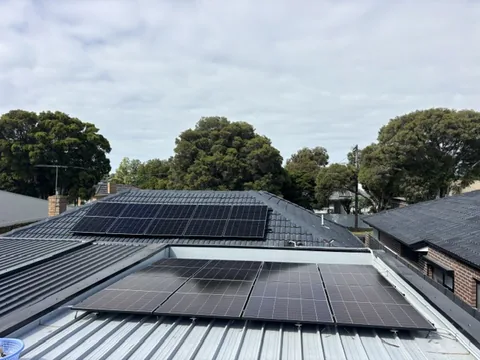
From one of our jobs
A finished array split across two roof faces
Photographed on site in Melbourne’s west. REC 37223.
That does not mean solar is a bad idea here. It means the design conversation starts with what the roof can actually carry compliantly, and the financial conversation starts with self-consumption rather than array size. A well-placed 4kW array that runs the house through the day beats an 8kW one that never got approved.
Slate, chimneys and what actually fits
Slate is the first constraint. It is brittle, it is expensive to replace, and it needs mounting methods appropriate to the material rather than the tile hooks used on a standard concrete roof. Some slate roofs are fine to work on. Some are not, and we will say so rather than take the job and hope.
The second constraint is geometry. Chimneys, dormers, finials and hip-and-valley detailing chop a heritage roof into short runs. Panels need continuous plane length, so a roof that looks generous from the street can yield a surprisingly small usable area once setbacks and access paths are applied. Realistic outcomes in Williamstown are often 3kW to 6.6kW.
Slate needs slate methods
Standard tile hooks are not appropriate. Mounting has to suit the material or the roof pays for it later.
Chimney shading is real
A chimney casts a moving shadow across a small roof all day. String layout has to account for it or one shaded panel drags a whole string.
Rear planes often win
The rear extension or lean-to frequently offers the only continuous run, and it is also the least visible from the street.
Heritage overlays and visible hardware
Parts of Williamstown, particularly around Nelson Place, The Strand and the waterfront streets, sit under heritage controls that affect where visible equipment can be mounted. That can rule out a street-facing roof plane, which is often the north-facing one.
We work with that rather than against it. Rear and side planes, split arrays and careful inverter placement usually produce a workable system. What we will not do is design an array on a controlled elevation and leave you to discover the problem later.
What is behind the walls matters first
Period homes here hide genuine surprises: rubber-insulated wiring that has gone hard, metalwork that was never bonded, and switchboards that have been extended piece by piece across four decades rather than replaced once properly.
Adding a solar circuit to that is not a matter of finding a spare way on the board. We inspect before we design, and where the existing installation needs remediation we price it plainly. Board upgrades run $800 to $3,500 or more. It is not the part of the quote anyone enjoys, but it is the part that makes the rest of it safe and compliant under AS/NZS 3000.
Jemena approval and coastal exposure
Williamstown is a Jemena address, not Powercor, despite sitting alongside Powercor suburbs on the Altona side. Jemena runs its own pre-approval process and sets any export limit based on network capacity. We lodge it before install day and confirm the outcome before energising.
Williamstown is also genuinely coastal. Point Gellibrand and the beachfront streets take direct salt exposure, so mounting hardware, fixings and isolator enclosures need coastal-rated specification for the same reasons they do in Seaholme and Altona.
On the ground
Williamstown heritage notes
- Slate roofs need mounting systems designed for slate. We assess the roof before committing, and occasionally the answer is that this particular roof should not carry an array.
- Heritage overlays around Nelson Place, The Strand and the waterfront can restrict visible hardware on street-facing elevations, which sometimes rules out the best-oriented plane.
- Rubber-insulated wiring and progressively extended switchboards are common in unrenovated period homes here. That is assessed before the array is designed, not after.
- Williamstown is Jemena while Altona and Seaholme next door are Powercor. The pre-approval process differs, so the address decides the paperwork.
Licensed and accredited work by a local team. Read about Pivot Trade Services or see recent jobs across the western suburbs.
Answers
Williamstown questions
Often, with the right mounting system. Slate is brittle and expensive to repair, so it needs hooks and flashing designed for slate rather than standard tile hardware. We assess condition and substrate first. On some Williamstown roofs the honest answer is that the slate is too fragile or too valuable to penetrate, and we say so before quoting.
Rarely outright, but it can restrict where panels and inverters are visible from the street. Around Nelson Place, The Strand and the waterfront that sometimes rules out the front elevation, which may be the north-facing one. We design to rear and side planes where needed, and flag the constraint before you commit rather than after.
Frequently 3kW to 6.6kW. Chimneys, dormers and hip detailing break a heritage roof into short runs, and panels need continuous plane length. Once required edge setbacks and access paths are applied, usable area is usually smaller than the roof appears. A smaller array sized to daytime use still pays well at current tariffs.
Jemena. That surprises people because neighbouring Altona and Seaholme are Powercor. Jemena runs its own connection pre-approval process, with its own forms and timeframes, and sets any export limit based on network capacity in your area. We lodge the application before booking the install so approval is confirmed before energising.
It can. Period Williamstown homes regularly have rubber-insulated wiring, unbonded metalwork and switchboards extended rather than replaced. A solar circuit has to land somewhere compliant, so where remediation is needed we price it upfront. Board work runs $800 to $3,500 or more depending on what the inspection finds.
Other work we do in Williamstown
- Electrician in WilliamstownPeriod homes, heritage constraints, and what is actually behind the wall
- Home battery in WilliamstownPeriod homes, modern storage
- EV charger in WilliamstownHeritage frontages, rear lanes and the parking question
- Split system in WilliamstownHigh ceilings, solid walls and a heritage overlay
- Heat pump hot water in WilliamstownHeritage homes, modern appliance, careful planning
Get a Williamstown quote
Tell us the address and what you need. We quote Williamstown 3016 and the surrounding western suburbs in writing, with no obligation.
- Free
- On-site quotes
- Fixed
- Written pricing
- 100%
- Workmanship guarantee
- 5.0★
- 69 Google reviews