
Half heritage cottage, half converted warehouse
Heat Pump Hot Water Systems in Spotswood
Spotswood is small but unusual. On one side of Hudsons Road there are compact period cottages on tight blocks. On the other there are converted industrial buildings around the Pumping Station and Scienceworks with large flat roofs, high internal volumes and legacy supply arrangements that houses have to pay to add. Hot water in those two building types is not the same job.
- Spotswood 3015
- Jemena network
- REC 37223
The short answer
A heat pump hot water system in Spotswood costs $3,000 to $4,500 supplied and installed before incentives and uses roughly one third of the electricity of a conventional electric storage tank. Solar Homes contributes up to $1,000, or up to $1,400 for a locally made product, Victorian Energy Upgrades applies a discount to the invoice, and federal STCs are worth roughly $300 to $600. Most Spotswood households pay a few hundred dollars up to about $1,500.
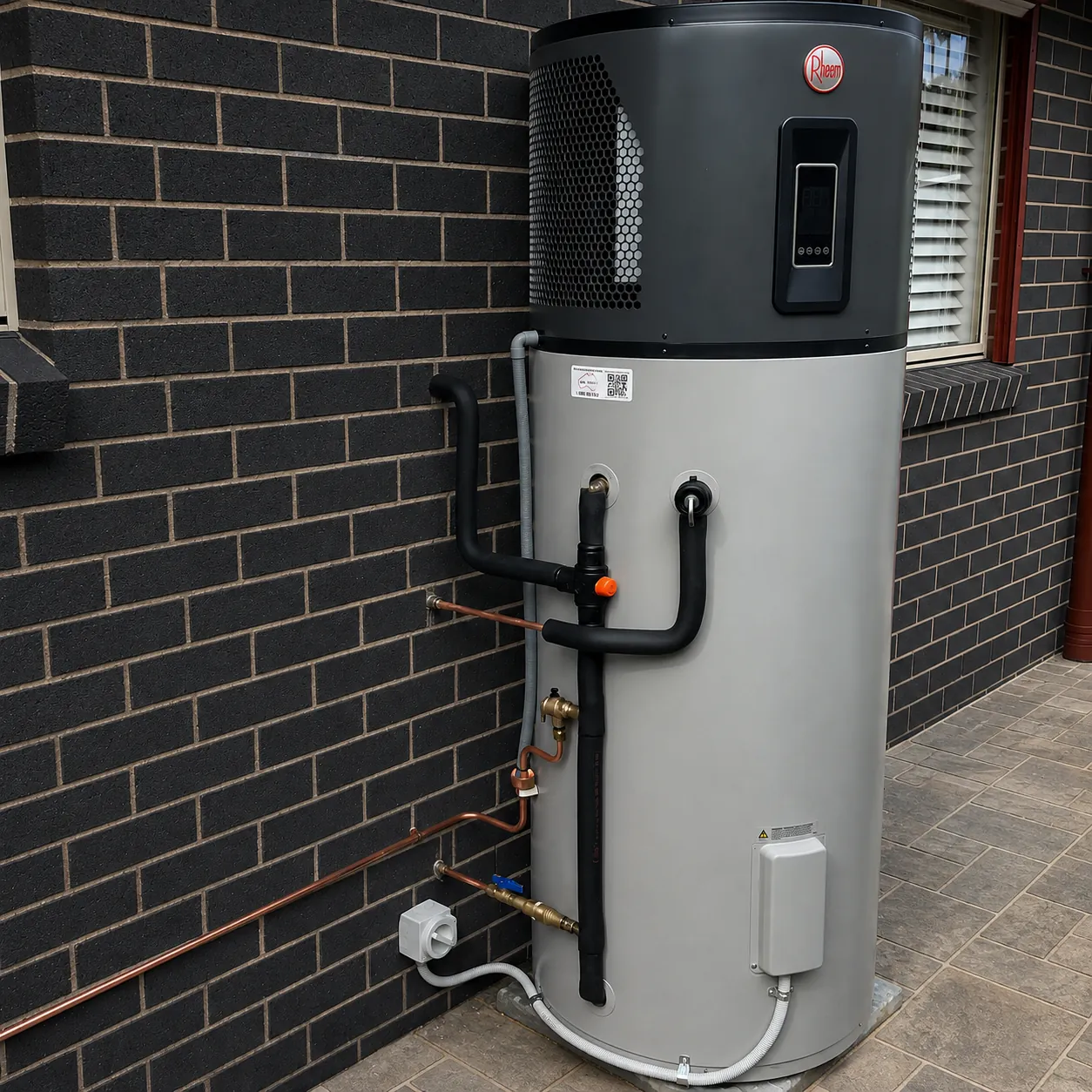
From one of our jobs
New electric heat pump replacing an old, expensive gas hot water unit
Photographed on site in Melbourne’s west. REC 37223.
What they share is exposure. Spotswood sits between the bay and the West Gate Bridge approach, and outdoor equipment here takes real weather: salt off the water and wind funnelled along the bridge corridor. Anything mounted outside needs to be fixed and specified for that rather than for a sheltered inland yard.
Cottages: original wiring and undersized supply
Cottage wiring in Spotswood is frequently original and undersized for modern appliance loads. These houses were built when the electrical demand was lighting and a couple of power points, and everything since has been layered on top. Adding a dedicated hot water circuit to that means understanding what the existing arrangement can actually carry.
It is a solvable problem and usually a modest one. Where the board needs replacing we say so and price it separately. Where there is genuine capacity and a spare way, the electrical part of a heat pump changeover on a Spotswood cottage is a couple of hours work.
What we do check carefully is the main switch rating and the incoming supply, because a cottage that was adequate for lighting and a fridge is now running an air conditioner, an induction cooktop and possibly a car charger as well. Hot water is a modest load on its own, but it is rarely the only thing that has been added, and the honest answer about capacity depends on the whole picture rather than the one appliance in front of us.
Converted industrial buildings already have the capacity
The warehouse and studio conversions here often carry legacy three phase supply left over from their industrial life. For hot water specifically that is not required, since domestic heat pump systems are single phase, but it does mean the supply capacity question that dominates a cottage quote simply does not arise.
What does arise is everything else. Hot water demand in a converted building is often unusual, with a single large bathroom and a kitchen a long way apart, or a live-work arrangement with commercial style usage. Tank position, pipe run length and where an outdoor unit can be mounted on a large masonry or steel structure all need working out on site.
Legacy three phase
Common in conversions. Not needed for hot water, but it removes the capacity question and helps if EV charging is on the list.
Long internal pipe runs
Converted buildings often have wet areas a long way apart. Tank position affects how long you wait at the tap.
Masonry and steel mounting
Fixing an outdoor unit to a heritage brick or steel-framed structure needs proper brackets and, in heritage cases, some care about visible plant.
Large flat roofs
Excellent solar space by local standards, which makes a daytime heating window especially easy to justify.
Weather exposure between the bay and the bridge
Bay-adjacent and bridge-adjacent exposure means outdoor gear here takes more punishment than a sheltered yard three suburbs inland. Salt attacks the coil fins and the fasteners, and sustained wind drives moisture into enclosures that would stay dry elsewhere.
We use coastal rated fixings and a weatherproof isolator as standard in Spotswood, mount units off wet ground on a proper base, and avoid positions that funnel wind straight into the fan discharge. A fresh water rinse of the coil each spring is worth the five minutes it takes.
Small blocks and close neighbours
Compact cottage blocks put houses close together, and the side gap where a tank might traditionally sit is often narrow enough to compromise airflow and reflect compressor noise into the house next door. In the converted buildings the issue is different: internal courtyards and shared external walls can carry sound in unexpected ways.
Either way, the approach is the same. Position the unit with clear air on at least three sides, point the fan discharge away from windows and boundaries, fit anti vibration mounts, and set the heating window into daylight hours. Running the compressor in the early afternoon is more efficient anyway.
On the ground
Spotswood specifics
- Converted industrial buildings often carry legacy three phase supply, which removes the capacity question that dominates cottage quotes
- Cottage wiring here is frequently original and undersized for modern appliance loads
- Exposure between the bay and the West Gate Bridge approach means salt and sustained wind on any outdoor equipment
- Large flat conversion roofs are some of the better solar space in the inner west, making a daytime heating window easy to justify
- Compact cottage blocks put neighbouring walls close, so airflow clearance and fan direction are decided on site
Licensed and accredited work by a local team. Read about Pivot Trade Services or see recent jobs across the western suburbs.
Answers
Spotswood questions
Easier electrically, harder physically. Legacy three phase supply means capacity is rarely the issue. What takes the planning is where the tank sits relative to wet areas that may be a long way apart, how an outdoor unit mounts to masonry or steel, and whether there are rules about visible plant on a heritage structure.
It can. Sustained wind drives moisture and salt into enclosures that would stay dry in a sheltered yard, and a position that funnels wind straight into the fan discharge affects performance. We use coastal rated fixings and a weatherproof isolator as standard, mount units off wet ground, and choose a position with that exposure in mind.
No. Domestic heat pump hot water systems are single phase. If your Spotswood property already has three phase from its industrial past that is useful for other things, particularly fast EV charging, but it makes no difference to the hot water appliance itself.
We look at what the existing arrangement can actually carry first. Original Spotswood cottage wiring was designed for lighting and a couple of power points, and everything since has been layered on. If the board can give a compliant dedicated circuit and isolator, it is a short job. If not, we price the board work separately.
The system is $3,000 to $4,500 supplied and installed before incentives. Solar Homes contributes up to $1,000, or up to $1,400 for a locally made product, Victorian Energy Upgrades discounts the invoice with a minimum customer contribution of $200 including GST, and federal STCs are worth roughly $300 to $600. Most households pay a few hundred dollars up to about $1,500.
Other work we do in Spotswood
- Electrician in SpotswoodHalf heritage cottage, half converted industrial
- Solar installation in SpotswoodHalf cottage, half warehouse
- Home battery in SpotswoodCottages and converted industrial
- EV charger in SpotswoodHalf heritage cottage, half converted warehouse
- Split system in SpotswoodCottage rooms and warehouse volumes in the same street
Get a Spotswood quote
Tell us the address and what you need. We quote Spotswood 3015 and the surrounding western suburbs in writing, with no obligation.
- Free
- On-site quotes
- Fixed
- Written pricing
- 100%
- Workmanship guarantee
- 5.0★
- 69 Google reviews