
Cottages and converted industrial
Home Battery Installation in Spotswood
Spotswood is small but unusual. Half of it is heritage cottage and half is converted industrial, and those two building types produce almost opposite battery answers on the same street.
- Spotswood 3015
- Jemena network
- REC 37223
The short answer
Home battery installation in Spotswood divides between small period cottages and converted industrial buildings. Cottages have limited array size and few compliant siting positions, pointing to 8kWh usable. Converted warehouses often carry legacy three-phase supply and large flat roofs, which supports much larger storage and higher-output backup. Spotswood is a Jemena address, so the battery inverter needs a Jemena application. A 10kWh battery costs $8,000 to $12,000 installed and $5,500 to $9,500 after the federal rebate.
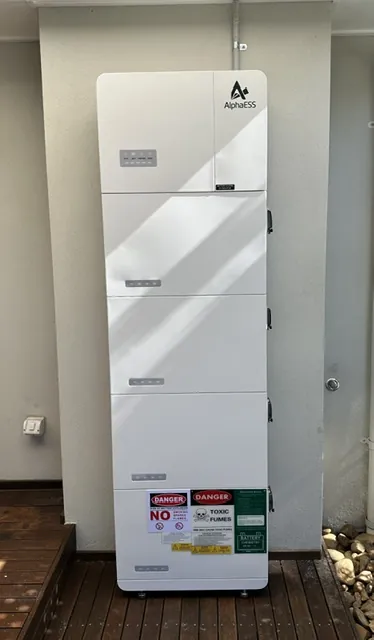
From one of our jobs
A completed home battery cabinet with isolation labelling
Photographed on site in Melbourne’s west. REC 37223.
The industrial buildings often already have the supply capacity that houses have to pay to add. That single difference changes what size storage is practical, what backup can run, and how straightforward the distributor application is.
Legacy three-phase is a real head start
Converted warehouses and studios in Spotswood frequently retain three-phase supply from their industrial past. For a battery that means a three-phase hybrid inverter is possible, which delivers more output than a single-phase unit and allows backup to support genuinely useful loads rather than just a fridge and some lights.
It also means the property has room for storage plus fast EV charging without a supply upgrade. A cottage in the same street would have to fund that from scratch. When comparing what is possible between two Spotswood properties, the supply arrangement usually explains most of the difference.
More usable backup
Three-phase hybrid inverters carry larger simultaneous loads, which makes whole-of-space backup realistic in a converted building.
Space for a floor-standing unit
Industrial conversions usually have wall and floor space that a cottage simply does not, which widens equipment choice.
Check the building class
Mixed-use and converted buildings can carry fire and egress requirements a standalone house does not, and they affect siting.
Cottages: small arrays, tight positions
Original Spotswood cottages have small roof planes, so solar here is often 3kW to 5kW and the daily charging surplus is correspondingly modest. Around 8kWh usable is generally the honest sizing, and buying more means paying for capacity that will not fill on an ordinary day.
Siting is the other constraint. Compact cottage blocks with habitable rooms behind most external walls leave few positions meeting clearance and fire separation requirements. A rear laundry wall, a sheltered rear position or a shed are the usual answers, and cottage wiring here is frequently original and undersized, so the board assessment comes first.
Exposure, temperature and where the unit goes
Spotswood is bay-adjacent and sits under the West Gate Bridge approach, so outdoor equipment takes real weather including salt-laden air and strong wind. A ventilated battery enclosure on an exposed external wall is a poor choice for the same reasons it is in Altona and Seaholme.
We look for an internal or sheltered position first, with attention to ambient temperature. In a converted industrial space with a large uninsulated volume, summer temperatures can be higher than expected, and sustained heat above the manufacturer’s range costs cycle life. It is worth measuring rather than assuming.
Jemena approval and honest payback
Spotswood is Jemena. A battery inverter is a grid-connected inverter under AS/NZS 4777.2, so it changes the inverter capacity at your connection and needs its own application. On three-phase connections that assessment is usually more favourable than on single-phase.
The federal Cheaper Home Batteries Program pays roughly $250 per usable kWh, about 30 percent off, and tapers above 14kWh. Payback runs 7 to 10 years against a 10 to 15 year life, and it depends entirely on cycling the battery most days. A converted building with steady evening or overnight load will sit at the shorter end. A weekender cottage with a small array will not.
On the ground
Spotswood battery notes
- Converted industrial buildings often carry legacy three-phase supply, which allows higher-output hybrid inverters, more capable backup and larger storage than a cottage supports.
- Cottage arrays of 3kW to 5kW cap the daily surplus, which makes around 8kWh usable the honest sizing for most period homes in the suburb.
- Bay and bridge-adjacent exposure means an external wall is a poor battery position. Sheltered or internal siting is the default here.
- Large uninsulated converted spaces can run hotter in summer than people expect. Ambient temperature is worth measuring, since sustained heat reduces cycle life.
Licensed and accredited work by a local team. Read about Pivot Trade Services or see recent jobs across the western suburbs.
Answers
Spotswood questions
A three-phase hybrid inverter, which delivers more output than a single-phase unit. That makes backup genuinely useful rather than limited to a fridge and lights, supports larger storage, and generally receives more favourable inverter capacity assessment from Jemena. It also leaves room for fast EV charging without a supply upgrade.
Around 8kWh usable for most. Small original roof planes limit solar to roughly 3kW to 5kW, and that caps the daily surplus available for charging. A battery that fills and empties most days pays back far better than a larger one that half fills, and the rebate is calculated per usable kilowatt hour either way.
We avoid it in Spotswood. The suburb is bay-adjacent and sits in an exposed position near the bridge approach, so outdoor equipment takes salt-laden air and strong wind. Batteries need ventilation, and that same airflow carries salt to the electronics. A sheltered or internal position is preferred wherever one is available.
Sometimes. Mixed-use and converted buildings can carry fire and egress requirements that a standalone house does not, and those affect where a battery may be located. Owners corporation arrangements may also apply. Those questions are resolved before design, because they can rule out otherwise ideal positions.
Jemena, along with Newport, Yarraville, Williamstown and Footscray. A battery inverter is a grid-connected inverter under AS/NZS 4777.2, so it changes the inverter capacity at your point of connection and requires its own application, even where existing solar was approved separately years earlier.
Other work we do in Spotswood
- Electrician in SpotswoodHalf heritage cottage, half converted industrial
- Solar installation in SpotswoodHalf cottage, half warehouse
- EV charger in SpotswoodHalf heritage cottage, half converted warehouse
- Split system in SpotswoodCottage rooms and warehouse volumes in the same street
- Heat pump hot water in SpotswoodHalf heritage cottage, half converted warehouse
Get a Spotswood quote
Tell us the address and what you need. We quote Spotswood 3015 and the surrounding western suburbs in writing, with no obligation.
- Free
- On-site quotes
- Fixed
- Written pricing
- 100%
- Workmanship guarantee
- 5.0★
- 69 Google reviews