
Narrow blocks, careful planning
Home Battery Installation in Yarraville
Yarraville cottages have usually been renovated at least twice, and both renovations show up in a battery job. The rear extension is where the solar went, the rear yard is where the battery has to go, and the wiring between them is a record of three different decades of work.
- Yarraville 3013
- Jemena network
- REC 37223
The short answer
Home battery installation in Yarraville is constrained by space and by wiring history. Cottage blocks have almost no side clearance, so compliant battery positions are usually at the rear, and renovation-era wiring layered over original wiring means the switchboard often needs sorting first. Yarraville is a Jemena address, so the battery inverter needs a Jemena application. Arrays here are commonly 4kW to 6.6kW on rear extension roofs, which points to 8kWh to 10kWh usable at $5,500 to $9,500 after the federal rebate.
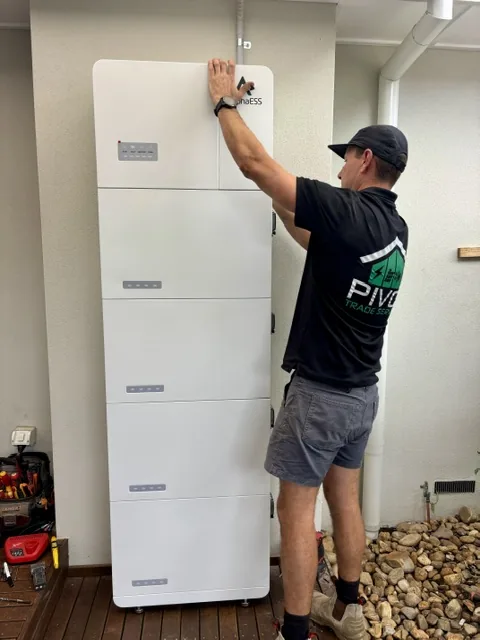
From one of our jobs
Stacking the modules on a home battery install
Photographed on site in Melbourne’s west. REC 37223.
None of that is a barrier. It does mean the design starts with a proper look at the switchboard and a walk of the available positions, rather than with a product recommendation.
Untangling the switchboard first
The single most common thing we find in Yarraville is renovation-era wiring layered over original wiring, with a board that has been added to at each stage rather than rationalised. Circuits from different decades, occasionally sharing neutrals in ways that were acceptable once and are not now.
A battery installation adds a battery inverter connection and usually a backup sub-board, and it cannot be certified onto an installation with unresolved legacy issues. So the honest sequence is: assess, remediate what needs remediating, upgrade the board where required at $800 to $3,500 or more, then install storage. Doing it in that order costs less than discovering it mid-install.
Finding a position on a narrow block
Yarraville blocks leave almost nothing between the house and the fence, so a side-passage battery position rarely meets clearance requirements. Fire separation rules also exclude walls backing onto bedrooms and living areas, which in a cottage with a rear extension is most of them.
The workable answers are typically the rear of the extension under weather protection, a laundry or store wall, or a floor-standing unit in a rear shed or garage where one exists. Street parking rather than driveways is normal here, so if an EV charger is also part of the plan, that decision interacts with the battery position and should be made at the same time.
Rear extension wall
Usually the most viable position, provided the wall does not back onto a bedroom and weather protection is properly handled.
Side passages rarely work
Clearance requirements and access needs mean a narrow side passage is almost never a compliant battery location.
Plan the charger at the same time
With street parking common here, charger placement and battery placement affect each other and should be decided together.
Sizing to what a cottage array can deliver
Solar in Yarraville is usually mounted on the rear extension roof, often on a tilt frame, which typically yields 4kW to 6.6kW rather than the 10kW an estate roof supports. That sets a real ceiling on the daily surplus available for charging.
On that basis 8kWh to 10kWh usable is the sensible range for most Yarraville homes. It fills most days, discharges through a normal evening between 5pm and midnight, and avoids buying capacity that will sit unused. The federal rebate is calculated per usable kWh, so paying for capacity you cannot cycle is a double loss.
Jemena, backup and payback
Yarraville is Jemena. A battery inverter is a grid-connected inverter under AS/NZS 4777.2, so adding one needs its own Jemena application, whatever the history of your solar approval.
Backup here is normally an essential circuits sub-board covering the fridge, lights, internet and a few power points. Payback runs 7 to 10 years against a 10 to 15 year life, and on a 5kW cottage array expect the middle to upper part of that range. Warranties are generally 10 years or around 10,000 cycles with 60 to 70 percent capacity retention at end of term, and that retention figure is the number worth comparing between products.
On the ground
Yarraville battery notes
- Layered wiring from multiple renovations is the norm here, and a battery cannot be certified onto an installation with unresolved legacy issues. Assessment comes before product selection.
- Almost no side clearance means the compliant position is nearly always at the rear, on the extension, in a laundry or store, or floor-standing in a rear shed.
- Rear extension arrays of 4kW to 6.6kW cap the daily charging surplus, which points to 8kWh to 10kWh usable rather than the larger systems that suit estate suburbs.
- Street parking rather than driveways is normal, so if an EV charger is part of the plan its position and the battery position should be resolved together.
Licensed and accredited work by a local team. Read about Pivot Trade Services or see recent jobs across the western suburbs.
Answers
Yarraville questions
Almost never. Yarraville side passages are too narrow to meet the clearance requirements around the unit, and access for service would be compromised even if the clearances worked. The realistic positions are at the rear: the extension wall under weather protection, a laundry or store wall, or a floor-standing unit in a rear shed or garage.
Frequently, yes. Layered wiring from different decades and a board extended at each stage are the norm here. A battery adds circuits and normally a backup sub-board, and it cannot be certified onto an installation with unresolved legacy issues. We assess first, remediate what is needed, then install, which costs less than finding it mid-job.
Usually 8kWh to 10kWh usable. Arrays here sit on the rear extension roof and typically produce 4kW to 6.6kW, which limits the daily surplus available to charge from. A battery that fills and empties most days returns better than a larger one that half fills, and the rebate is calculated per usable kWh either way.
Usable capacity rather than nameplate, warranty expressed in cycles or throughput rather than years alone, and the guaranteed capacity retention at end of warranty, commonly 60 to 70 percent. Also whether it supports backup, whether solar can recharge it during an extended outage, and whether it needs a new inverter or works with your existing one.
Jemena, which covers Yarraville along with Footscray, Newport, Spotswood and Williamstown. A battery inverter changes the inverter capacity at your point of connection, so it needs its own application under AS/NZS 4777.2. We lodge it before installation and confirm the outcome before anything is energised.
Other work we do in Yarraville
- Electrician in YarravilleUntangling which circuit came from which decade
- Solar installation in YarravilleThe array usually goes on the extension
- EV charger in YarravilleCottage blocks, no side clearance, and a real parking conversation
- Split system in YarravilleTwo different houses under one roof line
- Heat pump hot water in YarravilleCottages that have been renovated at least twice
Get a Yarraville quote
Tell us the address and what you need. We quote Yarraville 3013 and the surrounding western suburbs in writing, with no obligation.
- Free
- On-site quotes
- Fixed
- Written pricing
- 100%
- Workmanship guarantee
- 5.0★
- 69 Google reviews