
Installed from our own workshop on Jordan Close
Heat Pump Hot Water Systems in Altona
Pivot Trade Services is based at 11/23-25 Jordan Close, Altona 3018, which is a few minutes from most of the streets on this page. That matters less for marketing than it does for the practical side of a hot water changeover: we can look at the tank position, take a reading at the switchboard and come back with a quote without turning it into a two week exercise.
- Altona 3018
- Powercor network
- REC 37223
The short answer
A heat pump hot water system in Altona uses roughly one third of the electricity of the electric storage tank it replaces, and costs $3,000 to $4,500 supplied and installed before incentives. After the Solar Homes contribution of up to $1,000, or up to $1,400 for a locally made product, the Victorian Energy Upgrades invoice discount and federal STCs worth roughly $300 to $600, most Altona households pay from a few hundred dollars up to about $1,500. Coastal rated fixings are standard here.
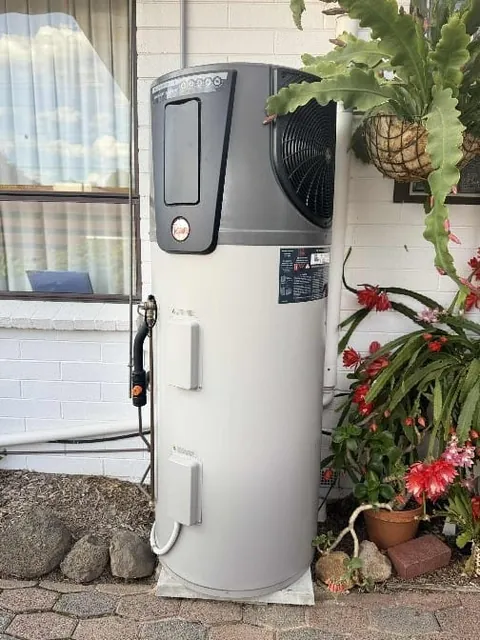
From one of our jobs
Same footprint, roughly a third of the running cost
Photographed on site in Melbourne’s west. REC 37223.
Altona housing is mostly post-war weatherboard and brick with pockets of 1960s brick veneer and newer infill townhouses. That mix produces a very predictable set of hot water problems, and a fairly predictable set of solutions. The version of this job we do most often is a failed electric storage tank on the side of a post-war house, replaced with a heat pump on the same slab, on a new dedicated circuit, with the timer set to run in the middle of the day.
What is usually being replaced in an Altona house
The tank we find most often is a 250 to 315 litre electric storage unit on controlled load, installed anywhere between fifteen and thirty years ago and quietly running an element every night at the off peak rate. Those tanks fail from the bottom, usually as a slow weep onto the path before anything dramatic happens. The second most common is a gas storage unit from the 1990s, which fails the same way and takes the daily gas supply charge with it when it goes.
Both are straightforward heat pump replacements. The heat pump does the same job for roughly a third of the electricity, because it moves heat out of the outside air into the tank rather than making heat with an element. The part that needs thought is not the appliance, it is where it sits and what it is connected to.
Where the outdoor unit goes on a standard Altona block
Altona blocks are mostly quarter-acre and half-block frontages with usable side access, which puts us in a better position than the terrace suburbs closer to town. In practice that means we can usually keep the new system near the old tank position and avoid a long hot water run through the roof.
The decision comes down to airflow, noise direction and drainage. A heat pump pulls air across a coil and blows the cold exhaust back out, so it needs to breathe on at least three sides. Boxing one into a narrow alcove between a fence and a wall costs efficiency every day of its life.
Original tank position
Usually the best option on a post-war Altona block. Existing plumbing, existing slab, existing drainage point, shortest run to the kitchen and bathroom.
Rear corner of the house
Worth considering when the old tank sat directly under a bedroom window. Adds pipe and cable but removes the noise complaint before it happens.
Condensate drain
The unit produces water while it runs. It needs a proper drain point, not a trickle across the side path where it becomes a slip hazard in winter.
Service clearance
Leave room to get a full tank out again in ten years. Fencing a unit in tightly makes the next replacement more expensive than it needs to be.
Salt air, and why the hardware spec is different here
Altona sits on Port Phillip Bay, and the air along The Esplanade, Pier Street and the streets running back from Altona Beach carries enough salt to shorten the life of ordinary outdoor hardware. We see it constantly on isolators, enclosure screws, bracket feet and condenser fins. The failure is rarely the appliance itself, it is the fittings around it.
So on Altona jobs we specify a weatherproof isolator rated for the exposure, stainless or coastal grade fixings, and a mounting position that is not directly in the salt spray path where we can avoid it. We also tell owners to rinse the outdoor coil with fresh water each spring. It takes five minutes and it genuinely adds years near the bay.
Switchboards, ceramic fuses and the dedicated circuit
Unrenovated post-war Altona homes still turn up with original ceramic-fuse boards. A heat pump needs its own dedicated circuit and its own isolator, and a rewireable fuse board cannot give you that safely or compliantly. When we find one, the board upgrade goes on the quote as a separate line item so you can see exactly what is the appliance and what is the infrastructure.
The other thing worth checking at the same time is whether the house is still on a controlled load tariff for hot water. Many Altona homes are. Moving a heat pump onto a normal circuit with a daytime timer is usually the better arrangement, particularly if there is solar on the roof, but it is a metering conversation as well as an electrical one and it is easier to have it once rather than twice.
Running it on the solar you already have
A lot of Altona roofs are single-storey tile or Colorbond with a clear northern pitch, and a good number already carry panels. Feed-in rates are low enough now that exporting surplus generation is close to giving it away, so the sensible move is to set the heat pump to heat the tank in the early afternoon and soak up your own production.
That timing helps twice. It uses solar you would otherwise export for a few cents, and it runs the compressor during the warmest part of the day, which is when a heat pump is most efficient. Households without solar can still benefit by moving the heating cycle out of the evening peak.
On the ground
What we know about Altona specifically
- We are based on Jordan Close in Altona 3018, so same-day attendance here is realistic rather than a marketing line
- Ceramic-fuse boards still appear in unrenovated post-war homes and usually need replacing before a dedicated hot water circuit can be added
- Salt-laden air off the bay corrodes isolators, enclosure fixings and condenser fins faster than inland suburbs
- Most blocks have genuine side access, so the new unit can usually stay near the original tank position
- Rinsing the outdoor coil with fresh water each spring is the single cheapest thing an Altona owner can do for the system
Licensed and accredited work by a local team. Read about Pivot Trade Services or see recent jobs across the western suburbs.
Answers
Altona questions
Supplied and installed, $3,000 to $4,500 before incentives, depending on tank size, brand and how much work the changeover involves. Once the Solar Homes contribution, the Victorian Energy Upgrades invoice discount and federal STCs are applied, most households pay from a few hundred dollars up to about $1,500. We put the net figure on the quote rather than the headline price.
It will shorten the life of the outdoor components if the hardware is not specified for it. We use coastal grade fixings and weatherproof isolators as standard here, keep the unit out of the direct spray path where the block allows, and recommend a fresh water rinse of the coil each spring. Done that way, a coastal install performs close to an inland one.
No, but it changes the scope. A heat pump needs a dedicated circuit and its own isolator, which a rewireable fuse board cannot provide compliantly. We quote the board upgrade as a separate line so you can see what belongs to the hot water job and what belongs to the house. Most single phase board upgrades are done within a day.
Roughly comparable to a split system outdoor unit, and only while it is running, which is a few hours a day. Almost every noise complaint we hear about traces back to placement rather than the appliance. We keep the fan discharge away from bedroom windows on both sides of the fence and use anti vibration mounts.
You can, but it is usually not the best outcome any more. Heating overnight on controlled load means running the compressor in the coldest part of the day and, if you have solar, exporting your own generation for a few cents while you do it. A daytime timer on a normal circuit almost always works out better now.
Other work we do in Altona
- Electrician in AltonaBased on Jordan Close, not dispatched from across town
- Solar installation in AltonaOur own postcode, 3018
- Home battery in AltonaTen minutes from your switchboard
- EV charger in AltonaInstalled by the crew whose workshop is in your postcode
- Split system in AltonaSized for weatherboard, specified for salt air
Get a Altona quote
Tell us the address and what you need. We quote Altona 3018 and the surrounding western suburbs in writing, with no obligation.
- Free
- On-site quotes
- Fixed
- Written pricing
- 100%
- Workmanship guarantee
- 5.0★
- 69 Google reviews