
Ten minutes from your switchboard
Home Battery Installation in Altona
We are based on Jordan Close in Altona, so battery work here is close to home in the literal sense. That matters more for storage than for most jobs, because a battery is a piece of equipment you will want someone to look at again in year three and year seven.
- Altona 3018
- Powercor network
- REC 37223
The short answer
A 10kWh home battery in Altona costs $8,000 to $12,000 installed before rebates and $5,500 to $9,500 after the federal Cheaper Home Batteries Program, which pays roughly $250 per usable kWh. Altona is a Powercor address, so adding a battery inverter needs a new Powercor application. Many Altona homes already have solar from the mid-2010s, which is what makes a battery worth considering, and salt exposure means the unit should be sited inside a garage rather than on an exposed external wall.
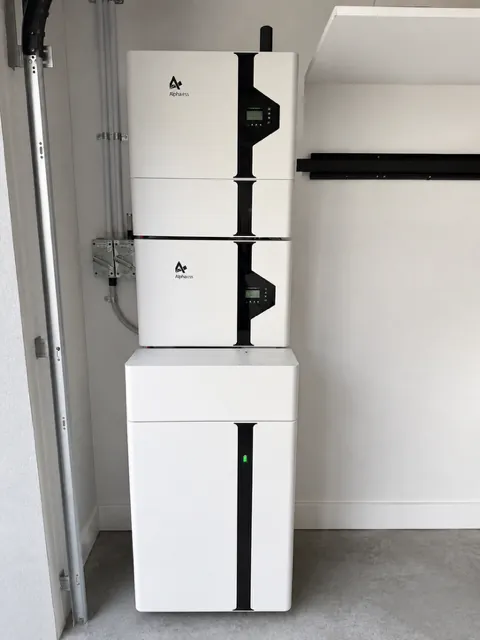
From one of our jobs
Battery and inverter stacked inside the garage
Photographed on site in Melbourne’s west. REC 37223.
Altona is also a good battery suburb on the numbers. A lot of homes here put solar on between 2013 and 2018, those systems are still producing, and since Victoria removed the mandatory minimum feed-in tariff on 1 July 2025 that generation has been leaving the property for under 5 cents per kWh. Storing it instead of selling it is where the case begins.
Why an existing solar system changes the maths
A battery does not make energy. It moves it. The saving is the difference between what you would have received for exporting a kilowatt hour, currently under 5 cents, and what you would have paid to import it in the evening peak, currently 30 to 45 cents. That gap is the entire business case.
Which is why a battery makes sense on a house that already has solar and almost never on one that does not. Without a solar system you are buying grid energy off peak and using it at peak, and the margin between two grid tariffs is far too thin to repay $8,000 to $12,000 of hardware inside its service life.
Sizing it to your evening, not your roof
The number that decides battery capacity is how many kilowatt hours you use between roughly 5pm and midnight. For most Altona households that lands between 8kWh and 13kWh of usable capacity, and usable is the word that matters. Nameplate capacity is what is in the cells. Usable is what the battery management system will actually let you take out, and it is always lower.
The federal rebate is calculated on usable kWh at roughly $250 each, which is about 30 percent off, or around $2,500 on a 10kWh battery. Above 14kWh the rebate tapers, so the marginal cost of extra capacity climbs. Combined with the fact that capacity you cannot cycle earns nothing, that taper is a useful natural stopping point for most homes here.
Count the evening, not the day
Your 5pm to midnight consumption in kWh is the number that sets sensible capacity. Everything else is secondary.
Usable beats nameplate
Compare quotes on usable kWh per dollar. Two batteries advertised at the same number can differ meaningfully.
The taper at 14kWh
Rebate value drops off above 14kWh usable, so very large systems cost proportionally more per kilowatt hour stored.
Where a battery can go in an Altona home
Siting is not a matter of convenience. Batteries have clearance requirements, fire separation rules that rule out some internal walls and positions near exit paths, and temperature limits that matter more than people expect. A unit that spends every summer afternoon at 45 degrees will not deliver the cycle life on its warranty certificate.
In Altona the extra factor is salt. An exposed external wall on the bay side of the suburb is a poor choice for any outdoor electrical enclosure, and it is a worse one for something with cooling vents. Where a garage or an interior-facing wall is available, we use it. Most Altona homes have a garage or carport with a suitable wall, which is one of the quieter advantages of post-war housing stock.
Backup, boards and Powercor
A standard grid-connected battery shuts down during a blackout. That is a safety requirement, not a fault. To keep running you need a backup-capable battery plus a gateway or changeover device, and a backup sub-board carrying the circuits you nominate, usually the fridge, some lights, the internet and a few power points. Running ducted air conditioning off backup is a different and much larger conversation.
Altona also still has homes with ceramic-fuse boards, and a battery cannot be connected to one. Where board work is needed it runs $800 to $3,500 or more. And because a battery inverter is a grid-connected inverter under AS/NZS 4777.2, Powercor needs a new application before it is energised, even where you already have approved solar.
On the ground
Altona battery notes
- Salt-laden air makes an exposed external wall a poor battery location here. A garage or sheltered interior-facing wall is preferred, and most Altona homes have one.
- A large share of Altona homes installed solar between 2013 and 2018. Those systems are the reason a battery makes sense here, and they are usually AC-coupled to rather than replaced.
- Unrenovated post-war homes still turn up with ceramic-fuse boards. A battery cannot connect to one, so the board upgrade sits ahead of the battery in the sequence.
- Adding a battery inverter requires a fresh Powercor application even if your solar was already approved, because it changes the inverter capacity at your point of connection.
Licensed and accredited work by a local team. Read about Pivot Trade Services or see recent jobs across the western suburbs.
Answers
Altona questions
Usually yes. An AC-coupled battery works alongside most existing solar inverters without replacing them, which suits the mid-2010s systems common here. DC-coupled options are slightly more efficient but need a hybrid inverter, meaning your current one comes off the wall. If that inverter is nearing end of life anyway, replacing it during the battery install is often the cheaper path.
Almost always a garage or a sheltered interior-facing wall. Batteries have clearance and fire separation requirements that rule out some positions, and temperature limits that affect real cycle life. In Altona there is the added issue of salt, which makes an exposed bay-facing external wall a poor location for anything with cooling vents.
Only if it is specified and wired for backup. A standard grid-connected battery shuts down in an outage for line worker safety. Backup requires a backup-capable battery, a gateway or changeover device and a sub-board carrying nominated circuits. That is a decision made at install time, not a setting you can switch on later from an app.
Typically 7 to 10 years against an expected life of 10 to 15 years. The saving per cycle is roughly the peak import rate you avoid, 30 to 45 cents, minus the export rate you gave up, under 5 cents, times the usable kilowatt hours you genuinely cycle. A battery that only half empties most nights saves about half what the brochure implies.
Yes. A battery inverter is a grid-connected inverter under AS/NZS 4777.2, so it changes the inverter capacity at your connection point and needs a fresh application, even where existing solar was already approved. We lodge it before installing. All associated wiring follows AS/NZS 3000 and finishes with a Certificate of Electrical Safety.
Other work we do in Altona
- Electrician in AltonaBased on Jordan Close, not dispatched from across town
- Solar installation in AltonaOur own postcode, 3018
- EV charger in AltonaInstalled by the crew whose workshop is in your postcode
- Split system in AltonaSized for weatherboard, specified for salt air
- Heat pump hot water in AltonaInstalled from our own workshop on Jordan Close
Get a Altona quote
Tell us the address and what you need. We quote Altona 3018 and the surrounding western suburbs in writing, with no obligation.
- Free
- On-site quotes
- Fixed
- Written pricing
- 100%
- Workmanship guarantee
- 5.0★
- 69 Google reviews