
Heritage homes, modern appliance, careful planning
Heat Pump Hot Water Systems in Williamstown
Williamstown work is heritage work. Around Nelson Place, The Strand and the streets running back from Williamstown Beach the housing is Victorian and Edwardian with post-war infill mixed through it, and almost every job starts with a proper look at what is behind the walls before anyone talks about adding load.
- Williamstown 3016
- Jemena network
- REC 37223
The short answer
A heat pump hot water system in Williamstown costs $3,000 to $4,500 supplied and installed before incentives and uses roughly one third of the electricity of a conventional electric storage tank. Solar Homes contributes up to $1,000, or up to $1,400 for a locally made product, Victorian Energy Upgrades discounts the invoice directly, and federal STCs are worth roughly $300 to $600. Most households pay a few hundred dollars up to about $1,500. Heritage overlays affect where visible plant can go.
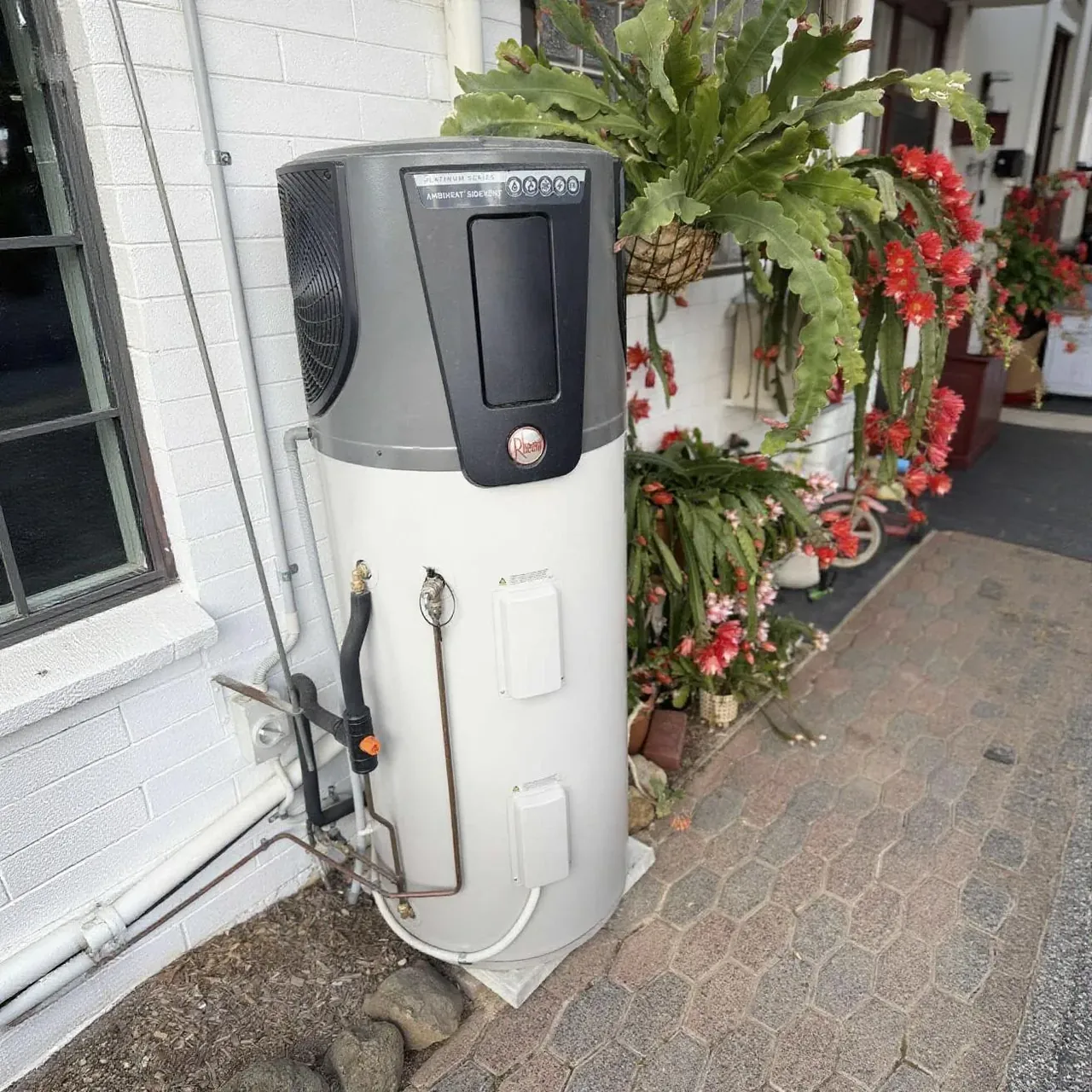
From one of our jobs
Heat pump hot water, swapped in where the old gas unit sat
Photographed on site in Melbourne’s west. REC 37223.
A heat pump hot water changeover is a good example. The appliance itself is simple. What is not simple is a narrow heritage frontage, a rear laneway, a switchboard that has been added to rather than replaced across four decades, and an overlay that has an opinion about visible hardware. All of that is workable. It just has to be worked out first.
What period homes are usually running now
Two things dominate. Either a gas storage or instantaneous unit fitted on an external wall during a renovation, or an electric storage tank in a laundry or lean-to that has been there far longer than anyone remembers. Both are commonly at the end of their service life, and in a lot of Williamstown homes the hot water service, the switchboard and the original wiring are all aged out at roughly the same time.
That coincidence is worth planning around. Replacing the tank on its own, then finding six months later that the board needs doing anyway, costs more than doing them as one considered piece of work. We will tell you at quote if that is the situation you are in.
Heritage overlays and where visible plant can sit
Overlays in Williamstown affect where visible hardware such as panels, inverters and outdoor units can be mounted, particularly on elevations that read from the street. A heat pump is a box with a fan in it, and it is not a thing anyone wants on a heritage frontage.
In practice this pushes almost every Williamstown install to the rear or a screened side position. That is usually fine, but it needs to be settled before the order goes in, because it can change the model, the pipe run and the cable route. We plan it at quote stage and flag anything that looks like it needs a conversation with council rather than assuming it does not.
Rear yard placement
The default on heritage frontages. Adds pipe and cable but keeps plant off the street elevation entirely.
Screened side position
Workable where the side is not visible from the street, provided the screen does not choke airflow to the unit.
Split configuration
Useful on very constrained sites: the tank in one place, the compressor unit somewhere more discreet.
Laneway access
Rear laneways change how a tank gets in and out. Worth confirming before install day, along with parking.
What is actually behind the walls
Period Williamstown homes hide surprises: rubber insulated wiring that has gone brittle, metal that was never bonded, and boards that have been extended rather than replaced. None of that stops a heat pump going in, but it does mean the electrical inspection is a real part of the job rather than a formality.
A heat pump needs its own dedicated circuit and its own isolator. On a board that has already absorbed a kitchen renovation, an air conditioner and a shed circuit, there is often no clean way to add that. When that is the case we quote a board upgrade as its own line item, and we say plainly what we found and why.
Narrow frontages, close neighbours and compressor noise
Heritage frontages are narrow and the houses either side are close. A compressor and fan running in a side passage between two period homes carries, and older weatherboard construction does not stop much sound.
We treat this as a design constraint, not an afterthought. Fan discharge points away from bedroom windows on both sides, anti vibration mounts go on as standard, and where a good position genuinely does not exist we set the heating window into daylight hours. Running the unit early afternoon is more efficient anyway, so it is rarely a real compromise.
Solar is harder here, which changes the running cost picture
Slate and heritage tile roofs with chimneys and dormers make panel layout genuinely difficult in Williamstown, and overlays restrict what can go on street-facing planes. Plenty of homes here have no solar and are not likely to get a large array.
That does not change the case for a heat pump, it changes how you run it. Without panels the goal is simply to move the heating cycle out of the evening peak. With a modest array, a daytime timer still captures most of the benefit. Either way, using roughly a third of the electricity of a resistance element is where the saving comes from.
On the ground
Williamstown specifics
- Heritage overlays affect where visible outdoor plant can be mounted, which pushes most installs to a rear or screened position
- Rubber insulated wiring, unbonded metal and boards that were extended rather than replaced are common in period homes
- Narrow heritage frontages put neighbouring bedroom windows very close to any side passage placement
- Rear laneway access affects how tanks are delivered and removed, and where a vehicle can park on the day
- Slate and heritage tile roofs with chimneys and dormers limit solar, so the running cost case rests on efficiency rather than free daytime power
Licensed and accredited work by a local team. Read about Pivot Trade Services or see recent jobs across the western suburbs.
Answers
Williamstown questions
It very rarely stops the installation. What it affects is placement of visible plant, particularly on elevations that read from the street. In practice that means a rear or screened position. We settle that at quote stage because it can change the model, the pipe run and the cable route, and we flag anything that looks like it needs council input.
It is a reason to look properly before adding load. Rubber insulated wiring, unbonded metal and heavily extended boards are common in period Williamstown homes. A heat pump needs a dedicated circuit and isolator, and if the board cannot provide that cleanly we quote the upgrade as a separate line and explain exactly what we found.
Physically quite close, but that is not the right question. The right question is which way the fan discharges and whose bedroom window is on the other side. We orient the unit away from both, use anti vibration mounts, and if there is genuinely no good position we run it in a daylight timer window instead.
Yes. The core saving comes from using roughly one third of the electricity of a resistance element, and that applies with or without panels. Solar makes it cheaper again, but on a slate roof with chimneys and an overlay that is often not on the table. Shifting the heating cycle out of the evening peak still helps.
Supplied and installed the system is $3,000 to $4,500 before incentives. Solar Homes contributes up to $1,000, or up to $1,400 for a locally made product, Victorian Energy Upgrades applies a discount straight to the invoice on properties at least two years old, and federal STCs are worth roughly $300 to $600. Most households pay a few hundred dollars up to about $1,500.
Other work we do in Williamstown
- Electrician in WilliamstownPeriod homes, heritage constraints, and what is actually behind the wall
- Solar installation in WilliamstownHeritage roofs, realistic arrays
- Home battery in WilliamstownPeriod homes, modern storage
- EV charger in WilliamstownHeritage frontages, rear lanes and the parking question
- Split system in WilliamstownHigh ceilings, solid walls and a heritage overlay
Get a Williamstown quote
Tell us the address and what you need. We quote Williamstown 3016 and the surrounding western suburbs in writing, with no obligation.
- Free
- On-site quotes
- Fixed
- Written pricing
- 100%
- Workmanship guarantee
- 5.0★
- 69 Google reviews