
Access is the problem before electrics are
Home Battery Installation in Geelong West
Geelong West is the suburb where we most often have to solve access before we solve anything electrical. A late Victorian timber cottage built to both boundaries is a completely different battery job to a house with a driveway, and no photograph will tell you which one you have.
- Geelong West 3218
- Powercor network
- REC 37223
The short answer
Home battery installation in Geelong West 3218 is limited by access more than by anything electrical. Lots run 250 to 450 square metres on 9 to 12 metre frontages and many Victorian cottages are built to one or both boundaries, so side access is often under a metre or absent entirely. That decides where a battery can be carried, mounted and later serviced. Geelong West is a Powercor address, and about a kilometre from Corio Bay, so sheltered-bay salt still matters for an outdoor enclosure.
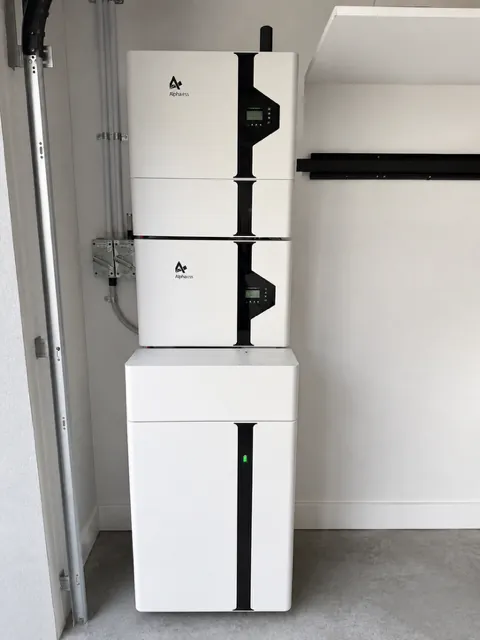
From one of our jobs
Battery and inverter stacked inside the garage
Photographed on site in Melbourne’s west. REC 37223.
A home battery is heavy, it needs clearances around it, and someone has to get it to its position and back to it again in year seven. On a tight inner block that is a genuine constraint, and it is worth saying plainly rather than discovering it on install day.
When there is no side access at all
Plenty of Geelong West cottages are built hard to one or both boundaries, leaving a gap under a metre or nothing at all. Where that is the case, a battery cannot simply be walked to a rear wall, and a cable cannot simply be run down the side of the house.
The honest answer is that some of these homes need a rear-yard position reached through the house or from a rear lane, a run through the roof space, or a floor-standing unit in a shed rather than a wall-mounted one. Occasionally the answer is that the position the owner had in mind will not work. Saying that early is worth more than a cheap quote that changes later.
Under a metre changes everything
A side gap below a metre limits both the equipment route and where conduit can be run and protected.
Roof space or around the front
With no side path, a cable run goes through the roof space or around the front elevation, which is longer and slower.
Plan the service visit too
A battery gets looked at again in year three and year seven. The position has to stay reachable, not just be reachable once.
Timber framing and mounting weight
Original timber framing on Victorian cottages here is often undersized by modern standards, and a wall-mounted battery is a serious load to hang on it. Framing needs to be checked rather than assumed, and on a lined internal wall that means opening up enough to see what is actually there.
Where the framing will not carry it, the alternatives are a floor-standing unit, a purpose-built stand, or mounting to a masonry element that can take the load. None of these are exotic, but they change the price, and they are decided on site rather than from a phone call.
Check, do not assume
Undersized original studs and rafters are common in this housing. A wall gets verified before weight goes on it.
Floor-standing is a real option
Where the wall will not take it, a floor-mounted unit in a shed or laundry solves the problem without compromise.
Weather protection either way
Any outdoor position needs proper cover, because a battery left in the weather ages faster than its warranty assumes.
Sheltered-bay salt, about a kilometre from the water
Geelong West sits roughly a kilometre from Corio Bay. That is sheltered-bay exposure rather than open ocean, so it is milder than Torquay or Ocean Grove, but it is still enough to shorten the life of outdoor enclosures, isolators and fixings.
The practical answer is unglamorous. Put the battery under cover where possible, specify the enclosure and the hardware around it for a coastal address, and do not treat an exposed west-facing external wall as a default just because it is the easiest place to reach with a drill.
Milder than the surf coast
Sheltered bay exposure is not open ocean exposure, but it still rules out general-purpose outdoor hardware.
Cover the unit
A roofed or sheltered position does more for enclosure life here than any upgrade to the enclosure itself.
Isolators age first
Outdoor isolators and fixings usually show salt damage before the battery does, so they get specified accordingly.
What a battery costs and what it returns
A 10kWh battery is $8,000 to $12,000 installed before rebates and $5,500 to $9,500 after the federal Cheaper Home Batteries discount, which is roughly 30 percent, about $250 per usable kilowatt hour from 1 May 2026, tapering above 14kWh. The battery has to be capable of joining a virtual power plant to qualify, though enrolling is optional.
The return comes from the gap between exporting a kilowatt hour for under 5 cents and importing it in the evening at 30 to 45 cents. Geelong West roofs are narrow planes running east to west on long allotments, so arrays here are often modest, which caps the daily surplus. That points to 8kWh to 10kWh usable rather than a large system, and payback toward the longer end of the 7 to 10 year range.
Size to the array you have
A battery that only half fills each day takes roughly twice as long to repay itself as one that cycles fully.
Narrow east-west planes
Long cottage allotments give narrow roof planes, so the array is usually smaller than a comparable suburban roof.
Access is a cost line
Longer cable routes around or through the building are a real part of the price, not a way of padding a quote.
Boards, backup and Powercor
A battery adds circuits and normally a backup sub-board, so the existing board has to be able to carry it. Renovated cottages here often have a modern board, and unrenovated ones often do not. Where an upgrade is needed it runs $800 to $3,500 or more, and it sits ahead of the battery in the sequence rather than alongside it.
Geelong West is Powercor, the same distributor as our own area in the western suburbs of Melbourne, so the inverter application is a process we run weekly. We are about 60km away in Altona, so work here is booked into scheduled blocks. On a job where access has to be assessed in person anyway, that is the sensible way to run it.
Renovated or not
Board condition here tracks renovation history rather than build year, so it gets inspected instead of guessed.
Backup circuits chosen at design
The fridge, some lights, the internet and a few power points is the usual list, and it is wired at install time.
One assessment visit
Because access has to be seen anyway, we combine the site assessment with the measurements the application needs.
On the ground
Geelong West battery notes
- Many cottages are built to one or both boundaries on 9 to 12 metre frontages, so side access is often under a metre or absent, which is a genuine blocker rather than an inconvenience.
- Original Victorian timber framing is frequently undersized by modern standards, so a wall intended to carry a battery is verified before anything is hung on it.
- About a kilometre from Corio Bay gives sheltered-bay salt exposure, milder than the surf coast but enough to matter for enclosures, isolators and fixings.
- Narrow east to west roof planes on long allotments cap array size, which points to 8kWh to 10kWh usable rather than a larger system.
Licensed and accredited work by a local team. Read about Pivot Trade Services or see recent jobs across the western suburbs.
Answers
Geelong West questions
Often yes, but not in the obvious place and not at the obvious price. With no side path, the equipment route and the cable run go through the roof space, around the front, or in from a rear lane. Sometimes a floor-standing unit in a rear shed is the only sensible answer. We would rather look at it than guess.
It has to be checked. Original timber framing on Victorian cottages in Geelong West is often undersized by modern standards, and a battery is a substantial weight to hang on it. Where the framing will not carry the load, a floor-standing unit or a purpose-built stand solves it. That is decided on site, not from a floor plan.
Less than on the Bellarine, but yes. Geelong West is about a kilometre from Corio Bay, which is sheltered-bay exposure rather than open ocean. It still shortens the life of outdoor enclosures, isolators and fixings. A sheltered or covered position does more good here than upgrading the enclosure and leaving it exposed.
Usually 8kWh to 10kWh usable. Long narrow allotments give roof planes running east to west, so arrays here tend to be modest and the daily surplus available for charging is limited. A 13kWh battery on a small array rarely fills, and capacity that does not cycle earns nothing regardless of what the brochure says.
Almost certainly access. Grovedale blocks are 600 to 750 square metres with a gate wide enough to run cable to the rear. A Geelong West cottage on both boundaries needs a longer route through the roof space or around the front, and possibly a different mounting arrangement. Same equipment, genuinely different labour.
Yes. The battery inverter is a grid-connected inverter under AS/NZS 4777.2, so it changes inverter capacity at your connection point and needs its own approval, even where your solar was approved years ago. Powercor runs the network across Geelong and our own area, so it is the same lodgement we do every week.
Other work we do in Geelong West
- Electrician in Geelong WestWhere access gets solved before the electrical work does
- Solar installation in Geelong WestLong allotments, narrow planes, no side gap
- EV charger in Geelong WestSolve the access before you solve the electrics
- Split system in Geelong WestWhen the cottage is built to both boundaries
- Heat pump hot water in Geelong WestWhere access is solved before anything electrical is
Get a Geelong West quote
Tell us the address and what you need. We quote Geelong West 3218 and the surrounding western suburbs in writing, with no obligation.
- Free
- On-site quotes
- Fixed
- Written pricing
- 100%
- Workmanship guarantee
- 5.0★
- 69 Google reviews