
Three phase country, salt and dust together
Home Battery Installation in North Geelong
North Geelong is a small residential pocket set among industrial land, with the port, the saleyards and the Federal Mills business park alongside. That mix shapes battery work here more than the housing does.
- North Geelong 3215
- Powercor network
- REC 37223
The short answer
Home battery installation in North Geelong 3215 differs from the rest of the region because this is the most industrial suburb in it. A large share of connections are three phase, which allows a higher output hybrid inverter and a backup board that carries more than the minimum. North Geelong is a Powercor address. The residential pocket is 1920s to 1960s weatherboard and brick on 450 to 650 square metre lots, and fronting Corio Bay beside the port means outdoor equipment sees salt and dust together.
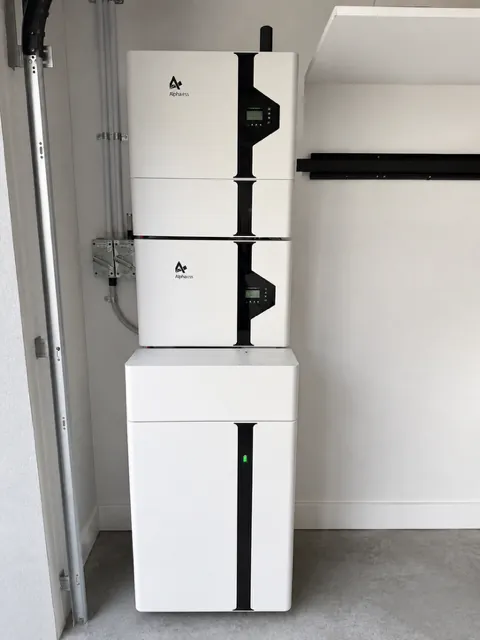
From one of our jobs
Battery and inverter stacked inside the garage
Photographed on site in Melbourne’s west. REC 37223.
Three phase supply is common, which changes what storage can realistically do in a blackout. And the environment is harder on outdoor equipment than almost anywhere in the region except the open coast, because salt off Corio Bay and dust off the industrial land arrive together.
Three phase and what it means for backup
This is the most industrial suburb in the region, so a large share of the work is three phase rather than single. For a battery that matters mainly at the backup board. A three phase hybrid inverter delivers higher output, which means backup can carry more than a fridge, a light circuit and the internet.
It also generally means headroom. A property with three phases can usually take a battery, an existing array and a substantial charger without a supply upgrade, which is a real cost avoided if you are electrifying over several years rather than all at once.
Higher output backup
Three phase hybrid inverters support a wider list of backed-up circuits than a single phase system can.
Headroom for later
Three phases usually means no supply upgrade needed when a charger or heat pump is added afterwards.
Check what you have
Whether the property is single or three phase changes the sizing conversation before anything else does.
Salt and dust on the same enclosure
Fronting Corio Bay with the port and saleyards alongside means outdoor equipment sees salt and dust together. That combination is harder on a ventilated enclosure than salt alone, because dust loads filters and vents while salt attacks what is behind them.
The practical answer is to keep the battery indoors or fully sheltered wherever possible, and to plan for the vents actually being cleaned rather than assuming they stay clear. Where an outdoor position is unavoidable, the enclosure rating, weather protection and fixings all get specified for this address rather than generically.
Dust loads the vents
Airborne dust from industrial land blocks cooling paths, which is a maintenance item rather than a one-off.
Indoors first
A garage or internal position removes both exposures at once and is the default recommendation here.
Plan the cleaning
Vent and filter checks belong in the handover, because in this environment they genuinely matter.
Older residential stock among industrial parcels
The houses here are 1920s to 1960s weatherboard and brick on lots of roughly 450 to 650 square metres, with modest side setbacks that usually allow a cable run. So access is workable, but the boards are the age you would expect from that era and often need attention first.
Buildings on the older industrial sites are a separate story again. The Federal Mills business park supports over a thousand jobs on a restored industrial site, and distribution in buildings of that age predates modern standards, so any storage project there starts with an assessment of what is actually installed.
Modest but workable setbacks
Side clearance on the residential lots is usually enough for a cable run, unlike inner Geelong West.
Boards match the era
1920s to 1960s stock means board work is common before circuits and a backup sub-board can be added.
Older commercial buildings differ
Restored industrial buildings have distribution predating modern standards, so they get assessed on their own terms.
Sizing, cost and the federal discount
Sizing still starts with evening consumption between roughly 5pm and midnight. On the residential stock here that generally lands at 8kWh to 12kWh usable, and on a three phase property with a workshop or a home business it can be higher, because the load profile is genuinely different.
A 10kWh battery is $8,000 to $12,000 installed before rebates and $5,500 to $9,500 after the federal Cheaper Home Batteries discount, roughly 30 percent at about $250 per usable kilowatt hour from 1 May 2026, tapering above 14kWh. The battery has to be capable of joining a virtual power plant to qualify, though enrolling stays optional.
Home business changes it
A workshop or business load on the property shifts sizing more than house size does.
Taper above 14kWh
Support reduces above 14kWh usable, so larger systems have to justify themselves on cycling alone.
Net figure on the quote
Ask for the price before the discount, the discount, and the amount payable as three separate numbers.
Powercor approval and how we schedule
A battery inverter is a grid-connected inverter under AS/NZS 4777.2, so North Geelong needs a fresh Powercor application even where solar was approved years ago. On a three phase connection that assessment is usually more favourable on inverter capacity, which is worth knowing before choosing equipment.
Powercor runs the network here and in our own area in the western suburbs of Melbourne, so this is a lodgement we make weekly rather than a process we have to relearn. We are about 55km away, so North Geelong work is booked into scheduled blocks with a nominated week rather than promised same-day.
Three phase assessed differently
Inverter capacity treatment is usually more favourable on a three phase connection than a single phase one.
Lodged before booking
The application goes in before the installation date is set, not after equipment arrives.
Blocks from Altona
At 55km, work here is scheduled in blocks. We nominate the week and we keep it.
On the ground
North Geelong battery notes
- This is the most industrial suburb in the region, so a large share of connections are three phase, which supports a higher output hybrid inverter and a broader backup circuit list.
- Fronting Corio Bay with the port and saleyards alongside means outdoor equipment sees salt and dust together, which loads vents and filters as well as attacking fixings.
- The residential pocket is 1920s to 1960s weatherboard and brick on 450 to 650 square metre lots with modest but workable side setbacks for a cable run.
- Restored industrial buildings such as Federal Mills have distribution predating modern standards, so a storage project there begins with an assessment rather than a product choice.
Licensed and accredited work by a local team. Read about Pivot Trade Services or see recent jobs across the western suburbs.
Answers
North Geelong questions
More common than in most residential suburbs, because this is the most industrial part of the region. For a battery it means a hybrid inverter with higher output, so backup can carry more than the minimum circuits, and it usually means headroom to add a charger later without a supply upgrade. We confirm what your property has first.
It affects cooling. A battery needs airflow to stay within its temperature range, and airborne dust from the port, saleyards and industrial land loads vents and filters over time. Combined with salt off Corio Bay, that makes an indoor or fully sheltered position the sensible default, and vent checks a real handover item.
It is a different project to a house. The Federal Mills business park supports over a thousand jobs on a restored industrial site, and buildings of that age have distribution predating modern standards. Any storage there starts with an assessment of what is actually installed, and the work is usually three phase and commercial in scale.
Often. The residential stock here is 1920s to 1960s weatherboard and brick, and boards of that era rarely have room for battery circuits plus a backup sub-board. Upgrades run $800 to $3,500 or more depending on the supply arrangement. Access on these lots is usually fine, so it is the board rather than the block that costs.
Usually 8kWh to 12kWh usable on the residential stock, set by consumption between 5pm and midnight. If there is a workshop or a home business on the property, that changes the profile more than house size does. Above 14kWh usable the federal support tapers, so extra capacity has to earn its place on cycling.
Powercor, which runs the network across the whole Geelong region as well as our own area. A battery inverter is a grid-connected inverter under AS/NZS 4777.2, so it needs its own application even where solar was approved separately. On a three phase connection the inverter capacity assessment is generally more favourable.
Other work we do in North Geelong
- Electrician in North GeelongThe most industrial postcode in the region, and it shows
- Solar installation in North GeelongThe best commercial roof space in the region
- EV charger in North GeelongThe one suburb where three phase is the normal answer
- Split system in North GeelongSalt and dust together, and three phase down the road
- Heat pump hot water in North GeelongAn industrial suburb with houses tucked inside it
Get a North Geelong quote
Tell us the address and what you need. We quote North Geelong 3215 and the surrounding western suburbs in writing, with no obligation.
- Free
- On-site quotes
- Fixed
- Written pricing
- 100%
- Workmanship guarantee
- 5.0★
- 69 Google reviews