
Great roofs, original switchboards
Solar Panel Installation in Corio
Corio was built around the Shell refinery that opened in 1956, in five Housing Commission estates totalling roughly 2,500 houses. Standardised planning produced exactly what solar likes: single storey homes, wide regular allotments, clear side access and very little mature canopy.
- Corio 3214
- Powercor network
- REC 37223
The short answer
Corio 3214 has some of the best solar roofs in Geelong and some of the oldest switchboards. The Housing Commission built five estates totalling around 2,500 houses from the late 1950s through the 1970s, and those tile and steel hips at 20 to 25 degrees are wide, single storey and almost unshaded by canopy. The catch is that many still carry their original board, which has to be upgraded before a solar circuit can land. Powercor approves the connection.
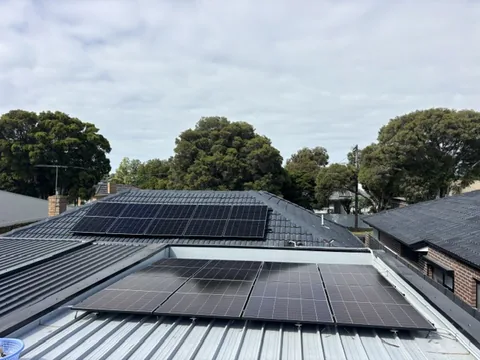
From one of our jobs
A finished array split across two roof faces
Photographed on site in Melbourne’s west. REC 37223.
The electrical side has not kept pace. A lot of these homes still have the board they were built with, so on a fair share of Corio jobs the first question is not which plane faces north, it is whether the switchboard can safely carry anything new at all.
Why Commission roofs suit solar
Concrete tile and corrugated steel hips at 20 to 25 degrees on single storey homes, laid out on a planned street grid. The planes are wide and unbroken, there is no second storey next door casting a shadow, and the estates were built before large street trees matured over the roofline.
That means a full 6.6kW usually fits on one face with clean rows and correct setbacks, and access is genuinely easy: regular allotments with clear side access make the cable run short and the setup uncomplicated.
Wide unbroken planes
Standard house types give long continuous roof runs, which fit more panels per square metre than a cut up roof.
Little canopy shading
Unlike the Bellarine, there is minimal mature tree cover over these roofs, so shade studies rarely change the design.
Clear side access
Generous Commission allotments keep the DC run short and the setup simple, which shows up in the labour price.
The switchboard comes first
Housing Commission stock from the late 1950s and 60s routinely still has its original board, and the first job on any upgrade is bringing protection up to current standard. A solar circuit cannot land on a board without residual current protection and compliant isolation.
That work runs $800 to $3,500 or more depending on what is behind the cover. It is the most common extra line on a Corio quote, and it is also the upgrade that has to happen before a heat pump, an induction cooktop or a charger, so the money is not spent twice.
Board assessed at survey
We open the board before quoting so the upgrade sits in the written price rather than appearing on the day.
Protection to current standard
Residual current protection and compliant isolation are the baseline before any generation is connected.
One upgrade covers what follows
The same board work unlocks a heat pump or a charger later, so it is worth doing properly the first time.
Asbestos in homes of this era
Houses from this period commonly contain asbestos sheeting in eaves, meter box backing and wet areas. That has to be identified before anyone cuts or drills, and it is directly relevant to solar because meter box backing is exactly where a board upgrade happens.
Handled properly it is a manageable step, not a crisis. Handled badly it is a health issue and a legal one. We identify it at survey and price the correct removal or the correct approach rather than treating it as a variation discovered mid job.
Meter box backing
Old meter panels are a common asbestos location, and that is precisely where board work has to happen.
Identified before drilling
Eaves penetrations for cable entry get checked first rather than opened up and dealt with afterwards.
Priced, not improvised
Where removal is needed it appears in the quote with the right method, not as a surprise on install day.
Refinery air and bay salt together
Corio sits on Corio Bay with the Shell refinery alongside. Outdoor enclosures here see both salt and an industrial atmosphere, and standard grade fixings do not last as long as they would on an inland suburb of the same distance from the water.
The response is stainless fixings, quality rail and properly sealed enclosures for isolators and any rooftop combiner. It is a modest addition to the material cost and it removes the corrosion related callouts that otherwise show up around year eight or ten.
Stainless fasteners
Fixings corrode long before panels do, and stainless is the cheapest insurance on the whole system.
Sealed isolator enclosures
Properly rated and sealed enclosures keep salt and industrial deposits out of the switching.
Rail quality matters
Cheap rail on a bay facing roof in an industrial atmosphere is a false economy over a twenty five year life.
Powercor approval, cost and scheduling
Powercor runs the network here and at our own Altona base, which is why the connection paperwork is routine for us rather than a new process. Powercor decides the connection outcome and any export limit, and we confirm both in writing before energising.
A quality 6.6kW system is $4,500 to $8,500 before incentives and roughly $3,000 to $6,000 after federal STCs worth $2,000 to $3,000, with up to $1,400 through Solar Homes for eligible households under the $150,000 combined income cap from 1 July 2026. Corio is around 55km from us, among the closest parts of the region.
Two lines, clearly separated
Solar and any board upgrade are quoted separately so you can see what each part actually costs.
Rebate eligibility checked
We confirm Solar Homes eligibility against the income cap before quoting rather than after.
Closer, still scheduled
Corio is one of the nearer suburbs at 55km, but work here is still booked into a planned block.
On the ground
Corio specifics we plan around
- Housing Commission stock from the late 1950s and 60s routinely still has its original board, so bringing protection up to current standard is usually the first job before solar.
- Homes of this era commonly contain asbestos sheeting in eaves, meter boxes and wet areas, which has to be identified before anyone cuts or drills for a board upgrade or a cable entry.
- Concrete tile and steel hips at 20 to 25 degrees on single storey homes, with wide unshaded planes and very little mature canopy, which is a genuinely good starting point.
- On Corio Bay with the refinery alongside, so outdoor enclosures see salt and an industrial atmosphere together and standard grade fixings do not last as long as they should.
Licensed and accredited work by a local team. Read about Pivot Trade Services or see recent jobs across the western suburbs.
Answers
Corio questions
Because Commission era homes here often still have their original board, and a solar circuit cannot legally or safely land on one without residual current protection and compliant isolation. It runs $800 to $3,500 or more depending on the inspection, and it is the same work needed before a heat pump or an EV charger.
It is a step rather than a barrier. Houses of this era commonly have asbestos in eaves sheeting and meter box backing, which is exactly where board work happens. We identify it at survey, price the correct removal method, and do not cut or drill into unknown sheeting. Handled properly it is routine.
Among the best in the region. The Commission estates gave single storey homes with wide unbroken tile and steel hips at 20 to 25 degrees, regular allotments, clear side access and almost no mature canopy overhead. A full 6.6kW usually fits on one plane with clean rows, which is not true in the older inner suburbs.
Yes. Being on the bay with an industrial neighbour means enclosures and fixings see salt and industrial deposits together. We specify stainless fixings, quality rail and sealed isolator enclosures here. It is a modest cost that prevents the corrosion failures that otherwise appear around year eight to ten.
Usually 6.6kW, and the roof will often take more. Size follows daytime consumption rather than roof area, because Victorian exports pay under 5 cents while peak imports run 30 to 45 cents. If the house is occupied during the day or hot water can be shifted into daylight, a larger array starts to make sense.
About 55km, which makes it one of the closer parts of the Geelong region to us. That does not mean same day attendance. We book work here into planned blocks, give you a nominated week and confirm the day closer to the time, which is the honest way to run a job at this distance.
Other work we do in Corio
- Electrician in CorioCommission houses, original boards, and what comes first
- Home battery in CorioThe board comes before the battery
- EV charger in CorioThe board comes first here, and we will say so upfront
- Split system in CorioOriginal boards, wide blocks and refinery air
- Heat pump hot water in CorioThe board is usually the first job, not the last
Get a Corio quote
Tell us the address and what you need. We quote Corio 3214 and the surrounding western suburbs in writing, with no obligation.
- Free
- On-site quotes
- Fixed
- Written pricing
- 100%
- Workmanship guarantee
- 5.0★
- 69 Google reviews