
The best commercial roof space in the region
Solar Panel Installation in North Geelong
North Geelong is the most industrial suburb in the region, and its roofs reflect that. Wide span warehouse roofing at Federal Mills, along Corio Quay and around the saleyards is the best commercial array real estate anywhere in Geelong, and it is a completely different job to a house in Belmont.
- North Geelong 3215
- Powercor network
- REC 37223
The short answer
North Geelong 3215 has the best commercial solar real estate in the region. Wide span warehouse roofs across the industrial land here carry substantial arrays with long uninterrupted purlin runs, and most sites are three phase, so a 30kW or 100kW system is a normal install rather than a supply upgrade. The small residential pocket of 1920s to 1960s homes has tile and steel hips at 22 to 30 degrees. Fronting Corio Bay with the port alongside, outdoor equipment sees salt and dust together. Powercor approves the connection.
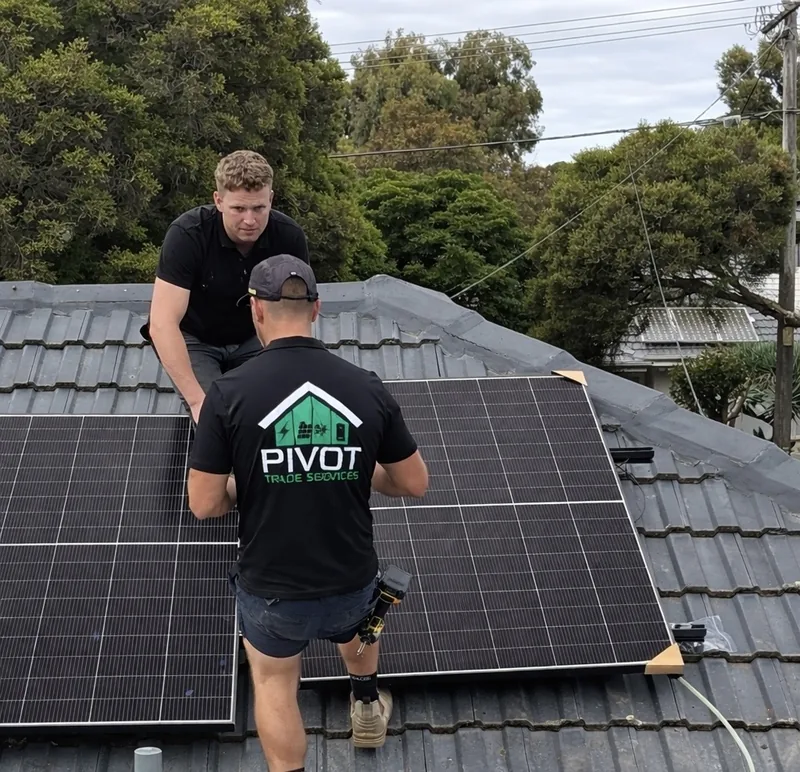
From one of our jobs
Panels going on over a tiled roof in Melbourne's west
Photographed on site in Melbourne’s west. REC 37223.
There is also a small residential pocket of 1920s to 1960s weatherboard and brick set among the industrial parcels. Those homes get a normal domestic install, with the same salt and dust exposure the warehouses next door deal with.
Why warehouse roofs are worth so much
A wide span industrial roof gives you what no house can: hundreds of square metres of continuous plane at a consistent low pitch, with structural purlins in a regular grid and no hips, valleys or chimneys breaking up the run.
That means high panel density, fast install rates per kilowatt and a lower cost per watt than any residential job. It also means the structural check is the real work. Purlin spacing, sheet profile and the age of the fixings decide what the roof can carry before anything is ordered.
Continuous purlin runs
Regular structural spacing across a wide span roof lets panels sit in long unbroken rows.
Structural check first
Purlin size, spacing and sheet condition decide the array weight the roof can take, before any order is placed.
Lower cost per watt
Commercial scale spreads the setup and connection cost across far more kilowatts than a house ever will.
Three phase and matching the load profile
Most industrial sites here are three phase, so a three phase inverter is standard and a large system does not trigger a supply upgrade. What decides the sizing is the load profile rather than the roof, because a business that runs machinery from 7am to 4pm is the ideal solar customer.
We size to the daytime demand curve using interval data from the meter rather than an annual bill total. With exports paying very little, a commercial array that matches the load shape returns far better than one sized to fill the roof.
Interval data beats a bill
Half hourly consumption shows the shape of the day, which is what a commercial array should be sized against.
Weekday load is the target
A site that runs machinery through the day converts almost all generation into avoided import.
Three phase balance
A three phase inverter spreads output evenly across the legs and helps manage voltage rise on a long service.
Older industrial distribution
The Federal Mills business park alone supports over a thousand jobs on a restored industrial site, and buildings of that age have distribution that predates modern standards. Main switchboards, submains and metering arrangements often need attention before a large inverter is connected.
That work is not a reason to avoid solar on these sites, but it needs to be in the plan and the budget from the beginning. A commercial array connected into ageing switchgear without an assessment is a problem waiting for a hot afternoon.
Main switchboard assessed
Fault levels, protection and available space are checked before an inverter connection is designed.
Submain capacity
Where the inverter connects matters as much as its size on a site with distributed switchboards.
Metering arrangements
Tenanted industrial buildings need clarity on which meter the array offsets before the design is finalised.
Salt and dust together
Fronting Corio Bay with the port and saleyards alongside, outdoor equipment here sees salt and dust at the same time. Dust holds moisture against a surface and salt does the rest, which is harder on enclosures and fixings than either would be alone.
On any roof in this suburb we specify stainless fixings, quality rail and sealed enclosures, and on large arrays we plan a cleaning and inspection interval rather than leaving it to chance. Panels that are never washed in a dusty industrial setting lose more output than most owners expect.
Sealed enclosures
Rooftop isolators and combiners need properly rated sealed enclosures in a salt and dust environment.
Cleaning interval planned
Industrial dust cuts output measurably, so a wash schedule belongs in the commercial maintenance plan.
Stainless throughout
Fixings fail long before panels do, and stainless is the cheapest part of protecting a large array.
Powercor applications and scheduling a commercial job
Powercor runs the network here and at our Altona base, so the connection process is familiar. Commercial connections are a heavier application than a house, larger systems can require export control, and the timeframe for approval has to be built into the project program rather than assumed.
On the residential pocket, a quality 6.6kW system is $4,500 to $8,500 before incentives and roughly $3,000 to $6,000 after federal STCs. Commercial systems are priced per site after a structural and electrical survey. North Geelong is about 55km from us, and we schedule work here in planned blocks.
Approval in the program
A commercial connection takes longer than a residential one, so it is scheduled rather than hoped for.
Survey before price
Structural and electrical assessment come before a commercial number, because both can change it materially.
Planned visits only
We book Geelong work in blocks from Altona and do not offer emergency attendance at this distance.
On the ground
North Geelong site notes
- This is the most industrial suburb in the region, so a large share of the work is three phase and warehouse roofs here carry commercial arrays rather than domestic ones.
- Wide span warehouse roofing gives long uninterrupted purlin runs, which is the best commercial array real estate in Geelong and installs at a far lower cost per watt than housing.
- Federal Mills supports over a thousand jobs on a restored industrial site, and buildings of that age have distribution predating modern standards, so switchgear is assessed before connection.
- Fronting Corio Bay with the port and saleyards alongside, so outdoor equipment sees salt and dust together, which is harder on fixings and enclosures than either alone.
Licensed and accredited work by a local team. Read about Pivot Trade Services or see recent jobs across the western suburbs.
Answers
North Geelong questions
It depends on the structure rather than the area. A wide span roof can physically hold hundreds of kilowatts, but purlin spacing, sheet condition and the age of the fixings decide the load it can carry. We survey the structure before quoting, then size to the site daytime demand rather than to the available square metres.
Neither. It should be sized to the interval data, which shows the shape of the working day. A site running machinery from 7am to 4pm converts almost all generation into avoided import at retail rates, while exported energy earns very little. The load curve, not the annual total, decides the right size.
Frequently. Buildings around Federal Mills and the older industrial parcels have distribution that predates current standards, so protection, available space and the connection point all get assessed before an inverter is specified. That work belongs in the budget from the start rather than appearing halfway through the project.
It hardens it. Dust holds moisture against surfaces and the bay adds salt, so fixings and enclosures degrade faster than in either condition alone. We use stainless fixings, quality rail and sealed enclosures, and on large arrays we plan a cleaning interval, because industrial dust on panels costs measurable output.
Yes. The residential pocket of 1920s to 1960s weatherboard and brick gets a standard domestic install on tile or steel hips at 22 to 30 degrees, with the same salt and dust hardware specification the industrial buildings need. A quality 6.6kW system runs roughly $3,000 to $6,000 after federal STCs.
Longer than residential, and it varies with the system size and the network. Powercor handles the application, larger systems can require export control, and the timeframe has to sit inside the project program. We lodge early and give you the current expectation rather than promising a date the distributor has not given us.
Other work we do in North Geelong
- Electrician in North GeelongThe most industrial postcode in the region, and it shows
- Home battery in North GeelongThree phase country, salt and dust together
- EV charger in North GeelongThe one suburb where three phase is the normal answer
- Split system in North GeelongSalt and dust together, and three phase down the road
- Heat pump hot water in North GeelongAn industrial suburb with houses tucked inside it
Get a North Geelong quote
Tell us the address and what you need. We quote North Geelong 3215 and the surrounding western suburbs in writing, with no obligation.
- Free
- On-site quotes
- Fixed
- Written pricing
- 100%
- Workmanship guarantee
- 5.0★
- 69 Google reviews