
A year round suburb, not a holiday one
Solar Panel Installation in Leopold
Leopold is a permanent resident suburb on the Bellarine rather than a holiday one, which changes practical things. Access is easy to arrange, someone is usually home, and handover happens with the actual owner rather than through a property manager in another city.
- Leopold 3224
- Powercor network
- REC 37223
The short answer
Leopold 3224 is the most straightforward suburb on the Bellarine to schedule solar in, because 92 per cent of occupied dwellings are separate houses and only about four per cent sit empty, so access can be arranged normally rather than around holiday occupancy. Roofs are hipped concrete tile and Colorbond at 22 to 25 degrees with mixed estate orientation and little canopy shading. Lake Connewarre is a saline estuary and Corio Bay is two kilometres north, so salt exposure is real. Powercor approves the connection.
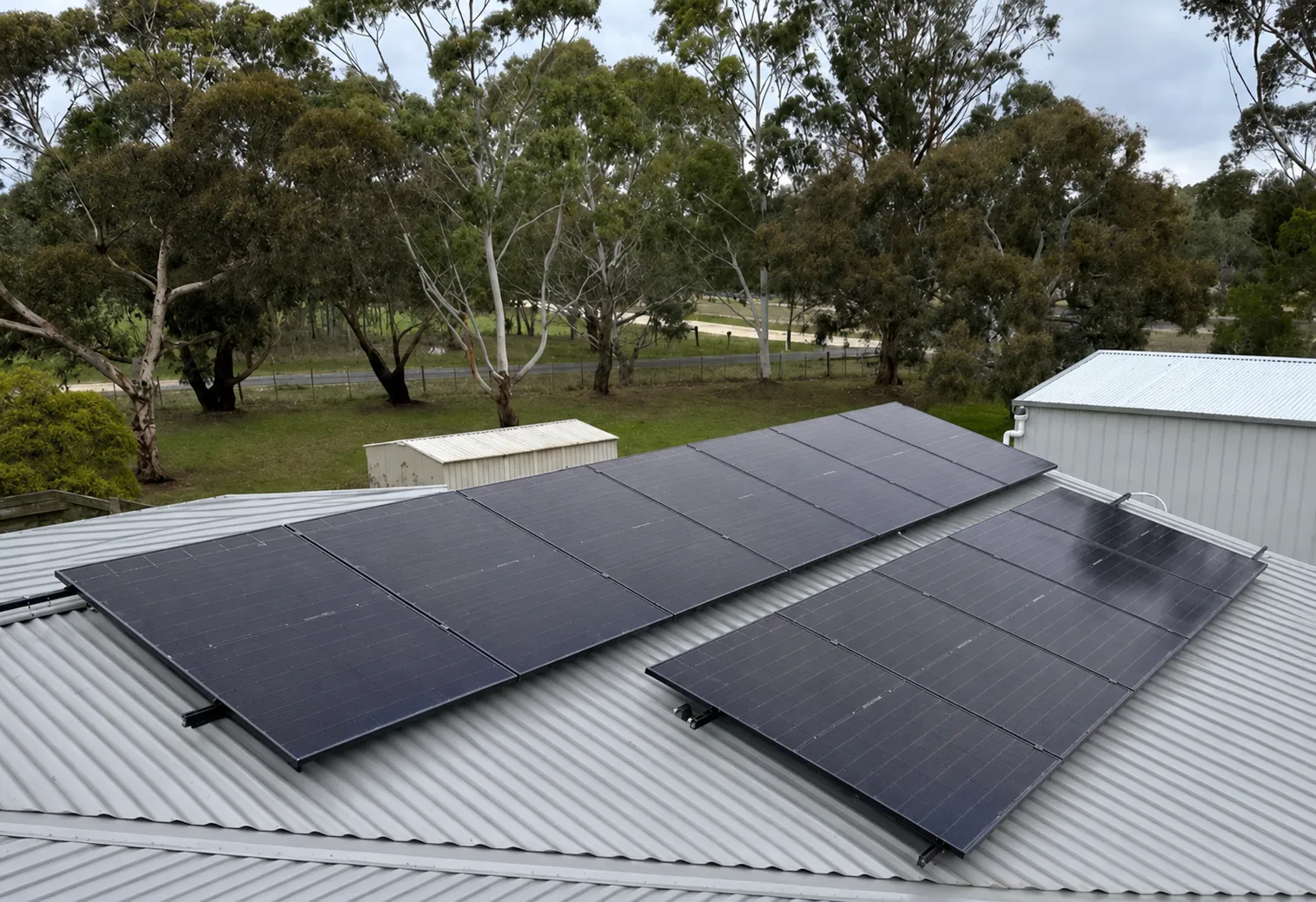
The housing is postwar dormitory stock: single storey brick veneer from the 1960s through the 1990s, with newer estates on the northern and eastern edges. The roofs are simple, the orientation is mixed, and the salt exposure is higher than people expect for a suburb with no beach.
Salt without a beach
Lake Connewarre is a saline estuary and Corio Bay is about two kilometres north, so there is genuine salt in the air here despite the lack of surf frontage. It is milder than Ocean Grove or Torquay and stronger than an inland suburb the same distance from water.
The right answer is stainless fixings and sealed isolator enclosures as standard, with full marine grade rail reserved for the most exposed addresses. Specifying open ocean hardware on every Leopold job would be charging you for protection the site does not need.
Estuary counts as salt
Lake Connewarre is saline, so exposure here comes from two directions rather than only from the bay.
Stainless as standard
Fasteners and brackets corrode first, and stainless removes most of the risk for a small cost.
Spec by address
Exposure varies across the suburb, so hardware is chosen for the site rather than applied as a blanket upgrade.
Mixed orientation on an estate street grid
The estate layouts here produce mixed orientations, so some homes get a clean north plane and others are left with east and west. Both work, they just produce different shapes of day and should be designed differently.
What helps is the lack of canopy. Unlike the older Ocean Grove streets, there is little mature tree cover shading these roofs, so the layout is decided by orientation and roof geometry rather than by working around a protected Moonah in the front yard.
North where it exists
A clear north plane on a 22 to 25 degree hip takes a full array without splitting across faces.
East west split otherwise
Where the main planes run east and west, a split array gives a longer generating day than a cramped north layout.
Little canopy to work around
Estate streets here have limited mature tree cover, so shading rarely drives the panel layout.
Boards from the 1970s and 1980s
The stock that dominates here usually has a serviceable board with limited spare ways rather than an unsafe one. That is a better starting point than Corio or Norlane, but it still means load calculations matter before adding a solar circuit and whatever comes after it.
If a heat pump, an induction cooktop or a charger is on the horizon, planning the board layout once is cheaper than reworking it twice. We check what is there at survey and quote any board work as its own line rather than folding it into the system price.
Serviceable but full
The common issue is spare ways rather than safety, which is a smaller job than a full board replacement.
Load calculated
What the mains and board can carry is checked before anything new is added, not after.
Plan for the next appliance
Laying out the board for solar, storage and a charger together avoids paying for the same work twice.
Access on older and newer Leopold blocks
The older parts run 500 to 750 square metres with clear side access, which keeps cable runs short and setup simple. Those are among the easier installs on the Bellarine and they price accordingly.
The newer Gateway and Estuary estates drop to 350 to 550 square metres where side access is often lost to a garage on the boundary. There the DC run goes through the roof space or around the house, and staging on install day takes more planning.
Older streets are simple
Clear side access on the 1960s to 1990s blocks makes for short external runs and quick setup.
Estate lots lose the gap
A garage to the boundary means routing through the roof space, which takes longer for the same kilowatts.
Quoted after a look
Access is the biggest labour variable here, so the price follows a site visit rather than an aerial image.
Powercor, price and scheduling on the Bellarine
Powercor runs the network across the Bellarine and also at our own Altona base, so the pre-approval process is familiar rather than something learned for the region. The connection outcome and any export limit are confirmed in writing before energising.
A quality 6.6kW system is $4,500 to $8,500 before incentives and roughly $3,000 to $6,000 after federal STCs worth $2,000 to $3,000, with up to $1,400 through Solar Homes for eligible households under the $150,000 combined income cap from 1 July 2026. Leopold is about 70km from us and is booked into a scheduled Bellarine run.
Easy to schedule
With almost every home permanently occupied, access and handover are arranged directly with the owner.
Grouped Bellarine runs
We book Leopold alongside other Bellarine work so the travel is not carried by a single job.
No same day promises
At 70km we schedule planned visits and give you the week rather than the hour.
On the ground
Leopold specifics we plan around
- Ninety two per cent of occupied dwellings are separate houses and only about four per cent sit empty, so this is a permanent resident suburb and jobs can be scheduled normally rather than around holiday occupancy.
- Lake Connewarre is a saline estuary and Corio Bay is about two kilometres north, so salt exposure is real despite there being no beach frontage.
- Hipped concrete tile and Colorbond at 22 to 25 degrees on single storey brick veneer, with estate street grids producing mixed orientations and little mature canopy to shade an array.
- The 1970s and 80s stock usually has a serviceable board with limited spare ways, so load calculations matter before adding a solar circuit and whatever follows it.
Licensed and accredited work by a local team. Read about Pivot Trade Services or see recent jobs across the western suburbs.
Answers
Leopold questions
Yes, a moderate version of it. Lake Connewarre is a saline estuary and Corio Bay sits about two kilometres north, so salt reaches equipment from two directions. We specify stainless fixings and sealed enclosures as standard and reserve full marine grade rail for the most exposed addresses rather than applying it everywhere.
Generally yes. About 92 per cent of occupied dwellings are separate houses and only around four per cent sit empty, so unlike Ocean Grove or Torquay we are not arranging access through absent owners. Someone is usually home, handover happens face to face and a follow up visit is simple to organise.
It is common on the estate grids here and it is not a problem. A split array across both planes generates from early morning to late afternoon, which suits a household that is home at both ends of the day. It beats squeezing panels onto a short north section over a porch or rear wing.
Often a modification rather than a replacement. Boards from that era here are usually serviceable but short on spare ways, which is a smaller job than the full upgrades needed in the Commission suburbs. We check capacity at survey and quote board work separately so you can see what the solar itself costs.
Mainly in access. Gateway and Estuary lots run 350 to 550 square metres with a garage to the boundary, so the cable often routes through the roof space instead of along a side wall, and staging takes planning. The older 500 to 750 square metre blocks with clear side access are quicker for the same system.
Leopold is about 70km from our Altona workshop, so we group Bellarine work into scheduled runs. Monitoring lets us diagnose most issues remotely, and anything needing attendance goes into the next planned visit with a nominated week. We do not offer same day or emergency call outs on the Bellarine.
Other work we do in Leopold
- Electrician in LeopoldA working Bellarine suburb, occupied and easy to schedule
- Home battery in LeopoldA working suburb, not a holiday one
- EV charger in LeopoldA working suburb, not a holiday one, which makes it easy to book
- Split system in LeopoldA lived in suburb, easy to schedule, salt you cannot see
- Heat pump hot water in LeopoldA working suburb, occupied and easy to schedule
Get a Leopold quote
Tell us the address and what you need. We quote Leopold 3224 and the surrounding western suburbs in writing, with no obligation.
- Free
- On-site quotes
- Fixed
- Written pricing
- 100%
- Workmanship guarantee
- 5.0★
- 69 Google reviews