
A working suburb, occupied and easy to schedule
Heat Pump Hot Water Systems in Leopold
Leopold is overwhelmingly postwar dormitory-suburb stock, single-storey brick veneer from the 1960s through the 1990s, with large greenfield estates on the northern and eastern edges since 2000. Ninety two per cent of occupied dwellings are separate houses and only about four per cent sit empty, which makes it one of the more straightforward places on the Bellarine to schedule work. Almost everyone is home in the evening and the houses are occupied year round.
- Leopold 3224
- Powercor network
- REC 37223
The short answer
Heat pump hot water in Leopold 3224 splits by estate age. Older parts run 500 to 750 square metre blocks with clear side access, while the newer Gateway and Estuary estates drop to 350 to 550 where side access is often lost. Powercor is the distributor. Ninety two per cent of dwellings here are separate houses and only about four per cent sit empty, so work can be scheduled normally. Salt from Lake Connewarre and Corio Bay applies despite no beach frontage.
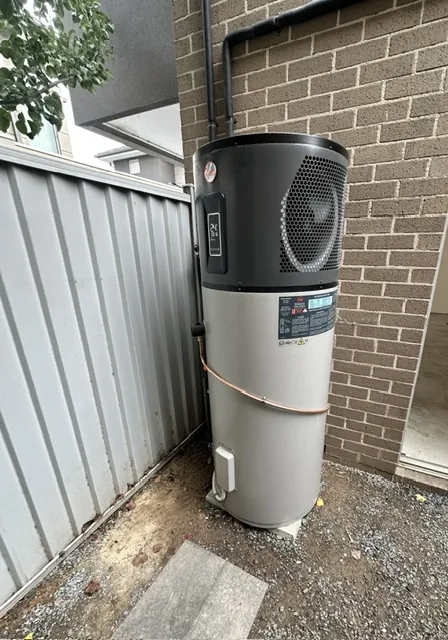
From one of our jobs
Heat pumps sit outside, in the same spot the old gas unit had
Photographed on site in Melbourne’s west. REC 37223.
What decides a hot water changeover here is which half of the suburb you are in. The 1960s to 1990s streets have blocks of 500 to 750 square metres with clear side access and boards that usually work but have no spare ways. The newer Gateway and Estuary estates run 350 to 550 square metres where access is often lost to a garage on the boundary, but the boards are modern.
Older streets: access is fine, the board is not
On the 1970s and 80s blocks the physical side of the job is easy. Five hundred to seven hundred and fifty square metres with clear side access means the old tank comes out without an internal route, the new unit goes near the original position or to a rear corner if that suits the noise better, and the pipe run is short.
The constraint is capacity. The 1970s and 80s stock that dominates here usually has a serviceable board with limited spare ways, so a load calculation matters before adding a charger or a heat pump. A heat pump needs its own dedicated final subcircuit with residual current protection and an isolator, and if there is nowhere for it to go then the board comes first at $800 to $3,500 depending on the meter panel and consumer mains.
Clear side access
Removal and delivery both straightforward, which keeps the labour component low on the older streets.
Limited spare ways
The most common finding in 1970s and 80s Leopold stock. It is a capacity problem, not a rewire.
Load calculated first
Against the real appliance list in the house, particularly where heating or a car charger is also planned.
Gateway and Estuary estates: modern board, no room
The newer estates reverse the problem. Lots of 350 to 550 square metres with a garage running to the boundary mean side access is often lost entirely, so the usable positions come down to a narrow path on one side or the rear yard. A heat pump is a bigger object than the gas instantaneous unit most of these houses were built with, and it needs air on two faces plus a condensate drain.
The board, on the other hand, is usually fine. Modern construction means residual current protection and spare ways are already there, and the dedicated hot water circuit is a straightforward addition. So an estate quote is mostly labour and pipework, and an older street quote is mostly board. Two very different invoices for the same appliance in the same suburb.
Access often lost
A garage to the boundary leaves one narrow path. The rear yard is frequently the only sensible position.
Board rarely an issue
Modern estate construction means the dedicated circuit goes in without a rebuild.
Property age test
The very newest estate houses fail the Victorian Energy Upgrades two year requirement. Check the completion date.
Estuary and bay salt without a beach
Leopold has no beach frontage, which leads people to assume salt is not a factor. Lake Connewarre is a saline estuary and Corio Bay is about two kilometres north, so the exposure is real. It is milder than Ocean Grove or Torquay and considerably more than an inland suburb like Grovedale, and it shows up on isolator enclosures, bracket feet, screws and condenser fins rather than on the appliance itself.
We use a weatherproof isolator and coastal grade fixings as standard here, which costs very little at installation and removes the most common early failure. A fresh water rinse of the outdoor coil each spring is worth doing, and on the streets closest to the estuary it is worth doing properly rather than as an afterthought.
Saline estuary
Lake Connewarre is salt water. Proximity to it matters more than the absence of a surf beach suggests.
Coastal grade fixings
Stainless brackets and screws with a sealed isolator, standard on Leopold installs rather than an upgrade.
Annual coil rinse
Fresh water each spring. It is the cheapest thing an owner can do for the outdoor components.
What a permanent-resident suburb means for the work
Only about four per cent of dwellings here sit empty, which sounds like a statistic until you compare it with Ocean Grove or Torquay where roughly one in five is unoccupied. In practice it means Leopold jobs can be scheduled normally. Somebody is home, access is arranged simply, and handover happens with the person who will actually use the system rather than with a property manager.
It also means the hot water demand profile is a normal household one. Tank sizing follows the busiest morning: 170 to 220 litres for one or two people, 250 to 280 litres for three or four, and 300 litres or more for five or more. That matters because a heat pump reheats more slowly than a gas burner, and undersizing is the only complaint we ever hear about a correctly installed system.
Straightforward access
Ninety two per cent separate houses and about four per cent empty. Scheduling is simple compared with the holiday suburbs.
Handover to the owner
The timer settings get explained to the person who will use them, which is not the case on a holiday property.
Normal demand profile
Size the tank for the busiest weekday morning, not the average day. Undersizing is the only real complaint.
Cost, incentives and the 2027 replacement standard
Supplied and installed the heat pump is $3,000 to $4,500 before incentives. Solar Homes contributes up to $1,000, or up to $1,400 for a locally made product, under a $150,000 combined household income cap from 1 July 2026. Victorian Energy Upgrades discounts the invoice directly with no income test, on a property at least two years old and with a $200 including GST minimum contribution. Federal STCs are worth roughly $300 to $600. Most Leopold households pay a few hundred dollars up to about $1,500.
A large share of the houses here run gas hot water, so the 1 March 2027 standard is relevant. From that date, an existing home replacing an end of life gas hot water system must install an efficient electric system instead. It applies at replacement rather than as a forced early upgrade, so a working gas unit can stay. Leopold is about 70km from our Altona base and we book work here in scheduled blocks, nominating the week rather than the hour.
Board on top where needed
Older streets often add $800 to $3,500. Estate houses generally do not need it at all.
1 March 2027
Triggered by replacing an end of life gas system, not by a deadline on equipment that still works.
Scheduled from Altona
About 70km. Booked in blocks with a nominated week and the unit ordered before we travel.
On the ground
Leopold specifics
- Ninety two per cent of occupied dwellings are separate houses and only about four per cent sit empty, so this is a permanent-resident suburb and work can be scheduled normally
- The 1970s and 80s stock that dominates here usually has a serviceable board with limited spare ways, so load calculations matter before adding a heat pump
- Older parts have blocks of 500 to 750 square metres with clear side access, while the newer Gateway and Estuary estates run 350 to 550 where access is often lost to a garage on the boundary
- Lake Connewarre is a saline estuary and Corio Bay is about two kilometres north, so salt exposure is real despite there being no beach frontage
Licensed and accredited work by a local team. Read about Pivot Trade Services or see recent jobs across the western suburbs.
Answers
Leopold questions
Because the constraints swap over. Older Leopold streets have clear side access but a 1970s or 80s board with limited spare ways, so the board is often the bigger figure. Estate houses have a modern board with capacity but frequently no side access, so the labour and pipework to a rear position is the bigger figure. Same appliance, different invoice.
Yes, milder than the surf coast but real. Lake Connewarre is a saline estuary and Corio Bay is about two kilometres north, so isolator enclosures, bracket feet, screws and condenser fins corrode faster here than in an inland suburb. We fit a sealed isolator and coastal grade fixings as standard and recommend a fresh water coil rinse each spring.
Usually a capacity problem rather than a rewire, because the 1970s and 80s stock here generally has sound cable and consumer mains. A heat pump needs its own dedicated circuit with residual current protection and an isolator, so if there is no spare way the board has to be dealt with first. Expect $800 to $3,500 depending on the meter panel.
Usually the rear yard. A garage on the boundary leaves one narrow path, and a heat pump is bigger than the gas instantaneous unit most estate houses were built with. It needs air on the intake and discharge faces plus a condensate drain. We measure the path and price the rear position rather than forcing it into a corridor.
Easier than anywhere else on the Bellarine. Ninety two per cent of occupied dwellings are separate houses and only about four per cent sit empty, so somebody is generally home and handover happens with the person who will actually use the system. In Ocean Grove or Torquay roughly one in five dwellings is unoccupied and access has to be arranged.
Leopold is about 70km from our base, so we book Geelong and Bellarine work in scheduled blocks and nominate the week rather than the hour. We do not offer same-day attendance at that distance. The unit is ordered before we travel, so a planned changeover including any board work is done in one visit.
Other work we do in Leopold
- Electrician in LeopoldA working Bellarine suburb, occupied and easy to schedule
- Solar installation in LeopoldA year round suburb, not a holiday one
- Home battery in LeopoldA working suburb, not a holiday one
- EV charger in LeopoldA working suburb, not a holiday one, which makes it easy to book
- Split system in LeopoldA lived in suburb, easy to schedule, salt you cannot see
Get a Leopold quote
Tell us the address and what you need. We quote Leopold 3224 and the surrounding western suburbs in writing, with no obligation.
- Free
- On-site quotes
- Fixed
- Written pricing
- 100%
- Workmanship guarantee
- 5.0★
- 69 Google reviews