
Three suburbs sharing one name
Solar Panel Installation in Werribee
Werribee is the hardest suburb in our patch to generalise about. A quote for a Watton Street cottage and a quote for a five-year-old estate home in Wyndham Vale share almost nothing except the rebate figures.
- Werribee 3030
- Powercor network
- REC 37223
The short answer
Solar installation in Werribee covers three very different property types: older town-centre homes with small tiled roofs, large modern estate homes with generous Colorbond and tile, and acreage properties toward Werribee South with sheds and outbuildings. Werribee is a Powercor address. Longer distribution runs on the fringe mean voltage rise can trip inverters, so string design and cable sizing have to account for it. A quality 6.6kW system costs $3,000 to $6,000 after federal STCs.
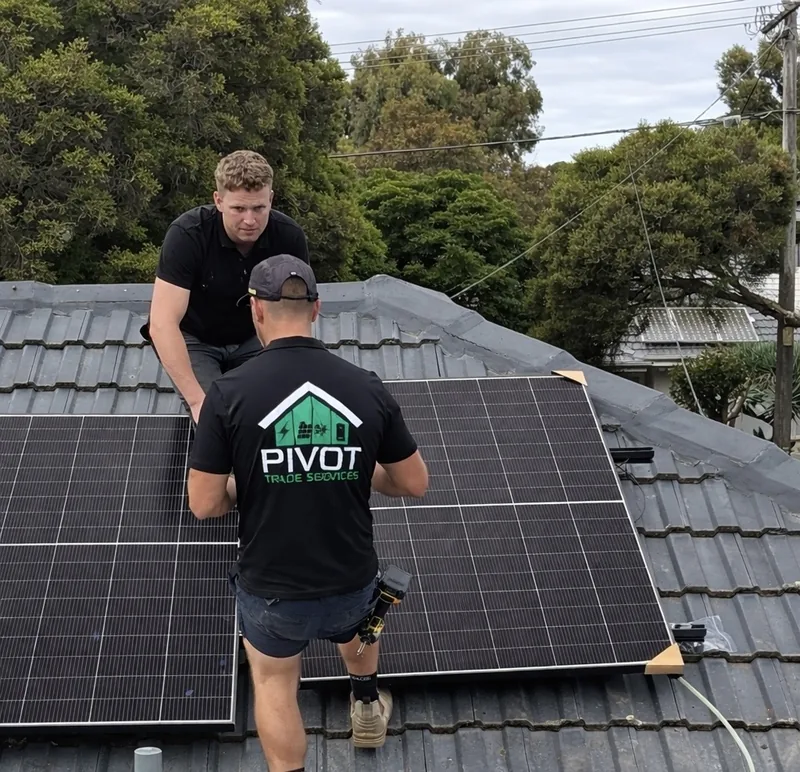
From one of our jobs
Panels going on over a tiled roof in Melbourne's west
Photographed on site in Melbourne’s west. REC 37223.
It is also the suburb where the network itself becomes part of the design. Werribee sits on longer distribution runs than the inner west, and on the fringes that produces voltage rise, which is the single most common reason a solar inverter in this area underperforms or trips off.
Voltage rise on the fringe
Grid-connected inverters have to comply with AS/NZS 4777.2, which includes shutting down or throttling when grid voltage climbs outside the allowed band. On long distribution runs with plenty of solar already connected, local voltage sits high, and a new inverter can spend summer afternoons curtailing itself.
Design choices help. Correctly sized AC cable between inverter and switchboard reduces the rise your own installation contributes. Inverter siting closer to the point of connection helps. On three-phase properties, a three-phase inverter spreads generation and reduces the rise on any one phase. None of these fix a network-wide issue, but together they are often the difference between a system that runs and one that keeps dropping out.
Short, generously sized AC runs
The single most effective thing an installer controls. Undersized AC cable adds voltage rise you then live with for a decade.
Three-phase where available
Spreading output across three phases lowers the rise on each one and usually improves what Powercor will approve.
Monitor, do not assume
If output looks wrong on hot afternoons, the inverter log will show voltage-related curtailment. That is diagnosable, not mysterious.
Town centre, estate and acreage
Around Watton Street and the older town centre, roofs are smaller tiled hips on tighter blocks, often with mature trees nearby. Systems here are typically 5kW to 6.6kW and shading assessment matters more than orientation.
The estates are the opposite. Large modern roofs, generous unbroken planes, and enough area for 10kW where consumption justifies it. Acreage and market-garden properties toward Werribee South add another layer again, with sheds, outbuildings and sub-mains that can either host the array or need a supply of their own.
Sheds, sub-mains and where the array goes
On rural and semi-rural Werribee blocks, the shed often has the best roof: large, simple, one orientation, and usually unshaded. Putting the array there is frequently the right call, but it makes the sub-main between shed and house part of the solar design rather than an afterthought.
That sub-main has to be adequately sized for the generation flowing back toward the house, and it may need upgrading. It is a cost that does not exist on a standard suburban job, and it is the reason acreage quotes here look different from estate quotes two kilometres away.
Powercor, boards and rebates
Werribee is Powercor. Pre-approval, connection acceptance and any export limit all sit with them, and on the fringe where network capacity is more constrained, limits are more likely. We lodge before booking and confirm the outcome first.
Werribee also has the widest spread of switchboard vintages of anywhere we work, from 1950s fuse boards in the town centre to last-year estate boards. That means the board assessment genuinely changes the price here, from nothing at all to $800 to $3,500 or more. On rebates, STCs are worth $2,000 to $3,000 on a 6.6kW system and Solar Homes adds up to $1,400 for eligible households under the $150,000 combined income cap from 1 July 2026.
On the ground
Werribee specifics
- Voltage rise is a genuine issue on the outer edges of Werribee. It affects inverter uptime on hot afternoons, and AC cable sizing and inverter siting are the parts of it an installer can actually control.
- Werribee South and the market-garden blocks often need the array on a shed, which pulls the sub-main between shed and house into the design and sometimes into the budget.
- Switchboard vintages here span seventy years. Two neighbouring streets can produce completely different quotes purely on what is behind the board cover.
- The town centre has mature trees and smaller roofs, so shading modelling matters more there than in the estates where the constraint is consumption rather than area.
Licensed and accredited work by a local team. Read about Pivot Trade Services or see recent jobs across the western suburbs.
Answers
Werribee questions
Almost always grid voltage. Inverters must comply with AS/NZS 4777.2, which requires them to curtail or disconnect when voltage climbs outside the allowed range. On long distribution runs with a lot of solar connected, local voltage rises. Correct AC cable sizing and inverter siting reduce your own contribution, and the inverter log confirms whether this is what is happening.
Often that is the better roof: larger, simpler and unshaded. The catch is the sub-main between shed and house, which has to be adequately sized for the generation and may need upgrading. That is a real cost that a standard suburban install does not have, so we assess the existing sub-main before quoting rather than after.
Powercor, the same as Point Cook, Hoppers Crossing and Laverton. Powercor runs pre-approval and applies any export limit based on capacity in your local network. On the outer fringes of Werribee that capacity is more constrained, so limits are somewhat more common here than in the inner suburbs.
Frequently 10kW or more, because modern estate roofs offer large continuous planes. Whether you should is a separate question. With exports paying under 5 cents and peak imports at 30 to 45 cents, capacity above 6.6kW only pays if you can consume it, through ducted cooling, hot water, a pool or daytime EV charging.
A solar circuit cannot be added to a ceramic-fuse board, so an upgrade becomes part of the scope. Depending on the supply arrangement and what is found behind the cover, that runs $800 to $3,500 or more. We inspect at quote stage so it is priced upfront, and the work is certified with a Certificate of Electrical Safety.
Other work we do in Werribee
- Electrician in WerribeeTown centre, estate and acreage, three different jobs
- Home battery in WerribeeWhere backup earns its keep
- EV charger in WerribeeThree different suburbs wearing one postcode
- Split system in WerribeeThree housing types, three different sizing conversations
- Heat pump hot water in WerribeeThree different suburbs wearing one postcode
Get a Werribee quote
Tell us the address and what you need. We quote Werribee 3030 and the surrounding western suburbs in writing, with no obligation.
- Free
- On-site quotes
- Fixed
- Written pricing
- 100%
- Workmanship guarantee
- 5.0★
- 69 Google reviews