
Estate roofs, EVs and second systems
Solar Panel Installation in Point Cook
Point Cook is where we most often do the full stack: existing solar on the roof, a battery going in, and an EV charger that has to share capacity with both. It is also the suburb where the roof shape does the most to complicate an otherwise simple job.
- Point Cook 3030
- Powercor network
- REC 37223
The short answer
Solar installation in Point Cook usually means working with complex modern hip-and-valley tile roofs that have several orientations and short unbroken runs, so arrays are often split across three or four faces. Point Cook is a Powercor address for pre-approval and export limits. Many homes already have solar and are expanding or replacing an ageing inverter, and EV ownership is high, which makes daytime charging the strongest argument for a larger array. A 6.6kW system costs $3,000 to $6,000 after STCs.
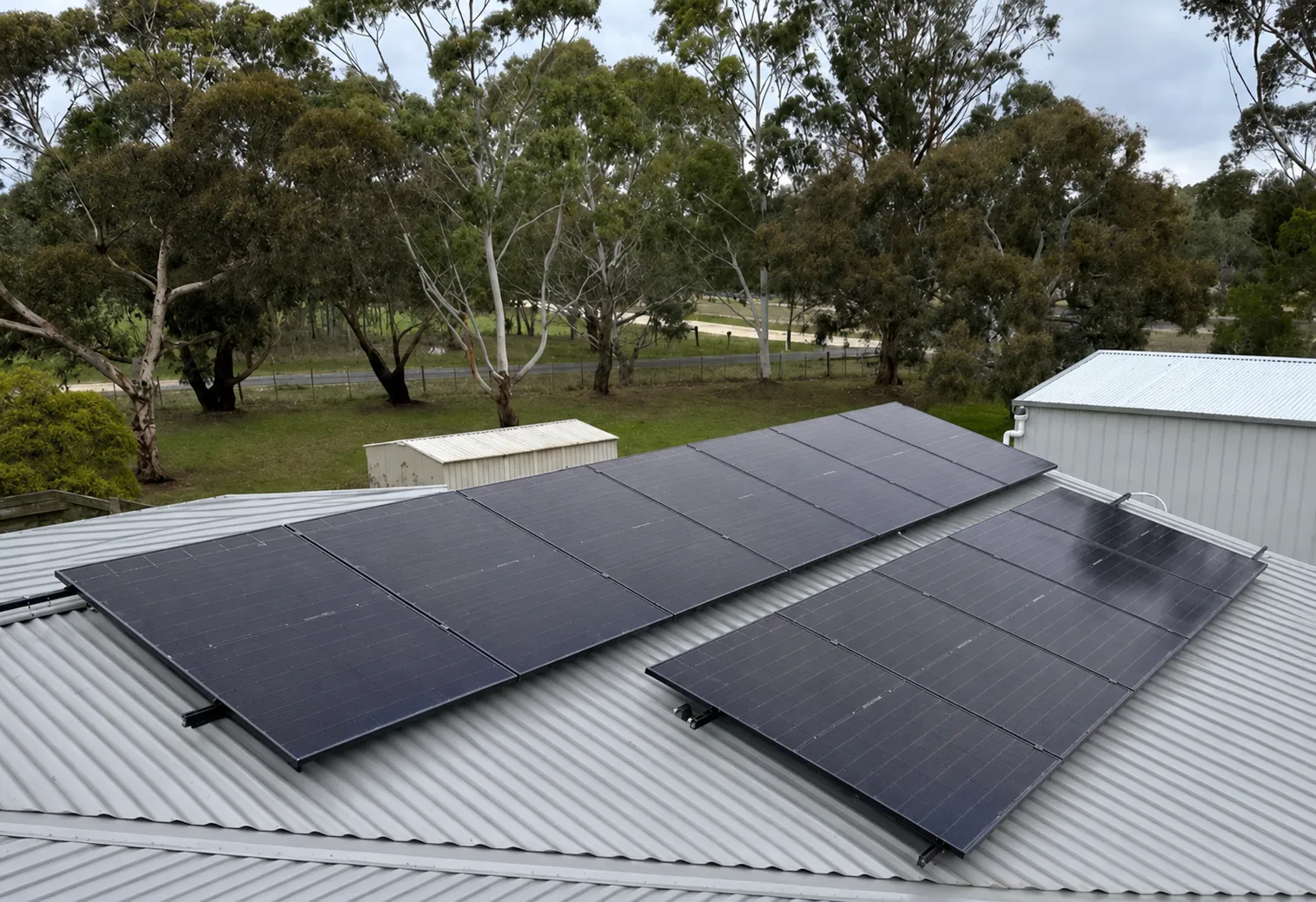
Estate homes built from the early 2000s onward have hip-and-valley tile roofs with multiple faces, tight setbacks and short unbroken runs. There is often plenty of total area and very little of it in one continuous piece, which is a different design problem to the one you get in Altona Meadows or Hoppers Crossing.
Designing around a hip-and-valley roof
A modern estate roof rarely offers one big clean plane. It offers four or five medium ones facing different directions, separated by valleys and hips, with limited eaves and short runs. Panels have to be laid out across several faces, which brings mismatch between strings as the sun moves.
That is where optimisers or microinverters earn their cost, and it is also where they are most often oversold. On a genuinely multi-orientation Point Cook roof, module-level electronics usually pay for themselves. On a simple single-plane roof they usually do not. We use them where the layout justifies it and say so when it does not.
Multiple orientations, multiple strings
Panels on different faces should not share a string unless the inverter has enough independent MPPT inputs.
Double-storey access
Two-storey estate homes mean more setup, edge protection and sometimes scaffold, which is a real line in the quote.
Limited eaves
Short eave overhangs on estate homes leave less room for cable entry and isolator placement than older housing.
Adding to a system you already have
A large share of Point Cook homes already have solar, often installed in the early to mid 2010s. Two questions come up constantly: can I add panels, and should I replace the inverter.
Adding capacity usually needs a fresh application to Powercor, and if the existing inverter is already at its DC limit it means replacing it, not just clipping on more modules. Where the original inverter is approaching end of life anyway, replacing it with a modern unit that complies with the current AS/NZS 4777.2 requirements and adding capacity in one job is usually cheaper than doing them two years apart.
EVs, daytime charging and array size
Point Cook has very high EV ownership relative to the rest of the west. That single fact changes the solar maths more than anything else, because an EV is the largest controllable daytime load most households will ever have.
If a car can charge between 10am and 3pm, even a couple of days a week, it converts solar you would have exported at under 5 cents into transport energy that would otherwise cost 30 to 45 cents from the grid or considerably more from a public charger. That is the case for going above 6.6kW here, and it is a much better argument than roof area.
Powercor approval and modern switchboards
Point Cook is Powercor. Powercor runs pre-approval and applies any export limit, and in newer estates where a lot of neighbours already export, limits are more common than in older suburbs with less installed capacity. We lodge early and tell you the outcome before install day.
Switchboards here are modern and generally compliant, so the question is spare capacity rather than safety. With solar, a battery and an EV charger all wanting a home, the board fills up quickly, and planning the final layout once beats reworking it three times.
On the ground
Point Cook site observations
- Complex hip-and-valley roofs mean arrays are commonly split across three or four orientations, which is the main case for optimisers or a multi-MPPT inverter here.
- Powercor export limits show up more often in newer Point Cook estates because a high proportion of neighbouring homes already export into the same local network.
- Many homes are on their second solar conversation, not their first. Expansion usually requires a new distributor application and often an inverter replacement.
- High EV ownership makes daytime charging the strongest justification for going above 6.6kW. Without a controllable daytime load, a big array here mostly exports at under 5 cents.
Licensed and accredited work by a local team. Read about Pivot Trade Services or see recent jobs across the western suburbs.
Answers
Point Cook questions
No, it just changes the design. Panels on different faces need separate strings or module-level electronics so one shaded or lower-producing face does not drag the others down. Total annual yield is a little lower than a perfect north roof, but the generation curve is flatter, which suits self-consumption well under current Victorian tariffs.
Sometimes. It depends on your inverter’s remaining DC headroom, string configuration and your existing Powercor approval. Adding capacity requires a new application, and if the inverter is at capacity it needs replacing. If it is approaching end of life, combining the replacement and the expansion into one job is usually the cheaper path.
Yes, if you can charge during the day. An EV is the largest controllable daytime load most homes have, and daytime charging turns solar worth under 5 cents as an export into energy worth 30 to 45 cents as avoided import. If the car only ever charges overnight, the case for a bigger array weakens considerably.
More common than in older suburbs. Powercor sets limits based on capacity already committed in your local network, and in newer estates where many neighbours already export, that capacity fills up. It is not a reflection on your system. Under current tariffs, with exports under 5 cents, a limit costs a self-consumption-focused system very little.
Sometimes, depending on roof pitch, height and available anchor points. Where it is required it is a genuine cost, not a padding exercise, and it should appear in the quote before install day rather than as a variation. Single-storey Point Cook homes generally do not need it.
Other work we do in Point Cook
- Electrician in Point CookSolar on the roof, a battery going in and a car to charge
- Home battery in Point CookThe suburb where the full stack happens
- EV charger in Point CookWhere the charger has to share the house with solar and a battery
- Split system in Point CookDouble storey estate homes and the upstairs problem
- Heat pump hot water in Point CookAdding one more load to an already busy switchboard
Get a Point Cook quote
Tell us the address and what you need. We quote Point Cook 3030 and the surrounding western suburbs in writing, with no obligation.
- Free
- On-site quotes
- Fixed
- Written pricing
- 100%
- Workmanship guarantee
- 5.0★
- 69 Google reviews