
Board vintage tracks the build year here
Heat Pump Hot Water Systems in Highton
Highton was rural until the mid 1950s and has been building ever since, so the housing runs from 1960s brick veneer through to current work on the north west edge. That continuous spread is genuinely useful when quoting a hot water changeover, because in Highton the switchboard behind the meter box door tracks the build year more reliably than it does anywhere else in the region.
- Highton 3216
- Powercor network
- REC 37223
The short answer
Heat pump hot water in Highton 3216 costs $3,000 to $4,500 supplied and installed before incentives and uses roughly one third of the electricity of conventional electric storage. Powercor is the distributor. Highton has been building continuously since the late 1950s, so switchboard vintage tracks the build year more reliably here than anywhere else in Geelong, and the elevated Barrabool Hills position means wind exposure and long runs from the street to the meter both affect the quote.
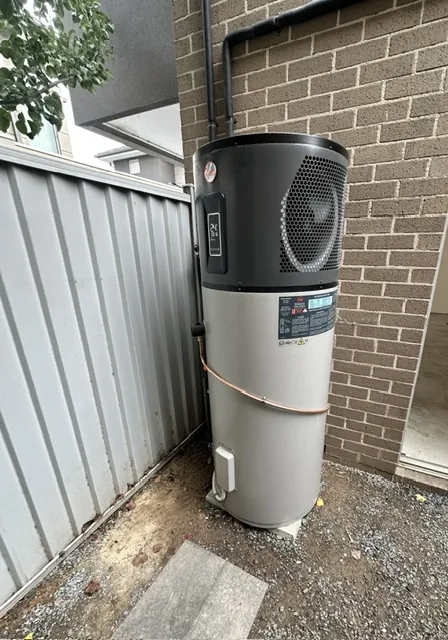
From one of our jobs
Heat pumps sit outside, in the same spot the old gas unit had
Photographed on site in Melbourne’s west. REC 37223.
The other Highton factor is the escarpment. The elevated position on the Barrabool Hills is why solar performs well here and why there is almost no overshadowing from neighbours, and it is also why the wind matters and why homes on the slope often have a long run from the street to the meter position.
What the build year tells us before we arrive
A 1960s Highton brick veneer usually has an original board, often with ceramic fuses, and a 250 to 315 litre electric storage tank on controlled load quietly running an element every night. A 1980s house typically has a serviceable board with no spare ways left. A 2010s house on the north west edge has a modern board with residual current protection and capacity to spare, and the hot water job is a straight addition.
That is not a rule, it is a starting point that gets confirmed on site. What it does mean is that a Highton quote can be scoped sensibly over the phone before the visit, which is not true in Geelong West or the Bellarine holiday suburbs. A heat pump needs its own dedicated circuit and isolator regardless of which of those three houses you own.
1960s stock
Original board, ceramic fuses common, controlled load electric tank. Board replacement $800 to $3,500 is often the first line on the quote.
1970s and 80s stock
Serviceable board, no spare ways. Usually a smaller job than a full replacement, but it still has to be sorted before the circuit exists.
Post 2000 north west
Modern board with capacity. The hot water changeover is the whole job, and it lands at the bottom of the price range.
Wind on the escarpment and where the unit sits
The elevation that makes Highton good for solar also makes it windier than the flat suburbs down on the plain. For a heat pump that is not a structural problem the way it is for roof-mounted rail, but it does affect placement. A unit sited on an exposed western corner has cold air driven across the coil all winter, which is not the same as having warm air drawn through it deliberately.
We put the unit on the sheltered side where the block allows, out of the prevailing wind, with the discharge pointed into open space rather than back at a wall. Highton blocks from the 1960s to the 1980s have real side access, so there is usually a choice of position, which is a luxury compared with the inner suburbs. On the newer north west subdivisions where garages run to the boundary the choice narrows.
Sheltered side preferred
Out of the prevailing westerly where the block allows. Exposure costs efficiency across a winter rather than causing a fault.
Real side access on older blocks
1960s to 1980s Highton blocks give a genuine choice of position, which is rare in this region.
Newer subdivisions are tighter
On the north west edge garages run to the boundary and the usable position is often a single narrow path.
Long runs from the street on escarpment blocks
Homes on the slope often have a long run from the street to the meter position, and that is the single biggest cost variable on any supply upgrade in Highton. For a heat pump alone it usually does not come up, because the load is modest and it goes on a new final subcircuit at the existing board.
Where it does come up is on a house that is electrifying more than one thing at once. A heat pump plus an EV charger plus reverse cycle heating on a 1960s board with original consumer mains is a different conversation to a hot water swap, and it is worth having once rather than three times. We calculate the maximum demand against the real appliance list rather than a rule of thumb.
Heat pump alone
A modest load on its own dedicated circuit. It rarely triggers a supply upgrade by itself.
Electrifying several things
Hot water plus a charger plus reverse cycle is where the consumer mains and the long escarpment run start to matter.
Maximum demand calculated
Against the actual appliance list in the house, before anything is committed to, not after the board is open.
Solar, timers and what it costs to run
Highton solar numbers are usually better than the Geelong average, because the elevated position on the Barrabool Hills means very little overshadowing from neighbours and concrete tile or Colorbond hips at 20 to 25 degrees give usable planes. If you already have panels, the heat pump is the best load you can put under them.
Set the heating cycle for the early afternoon and the tank fills on generation that would otherwise export for a few cents, while the compressor runs in the warmest air of the day when it is most efficient. Against a conventional electric storage tank a heat pump uses roughly one third of the electricity for the same hot water. Against gas, the difference is less about a single efficiency number and more about the fact that gas cannot use your solar at all, and that the daily supply charge keeps being paid.
One third of electric storage
That is the core proposition and it applies with or without panels on the roof.
Afternoon window
Warmest air, best efficiency, and it soaks up generation that exports for a few cents otherwise.
The gas supply charge
If hot water is your last gas appliance, disconnecting removes the daily supply charge as well as the usage.
Incentives and how the work is scheduled
Solar Homes contributes up to $1,000, or up to $1,400 for a locally made product, subject to a combined household income cap of $150,000 from 1 July 2026. Victorian Energy Upgrades applies a discount directly to the invoice with no income test, on a property at least two years old, with a minimum customer contribution of $200 including GST. Federal STCs are worth roughly $300 to $600. Most Highton households end up paying from a few hundred dollars up to about $1,500 against an installed cost of $3,000 to $4,500.
The two year property age test is the one to watch on the newest north west streets, because a house completed last year does not qualify for VEU. Highton is about 65km from our Altona base, so we book work here in scheduled blocks and nominate the week rather than the hour. No same-day attendance and no emergency response, because at that distance we could not deliver either.
Property age test
VEU requires two years. It catches new houses on the north west edge, which is exactly where the boards are best.
Income cap
Solar Homes is capped at $150,000 combined household income from 1 July 2026. VEU and STCs have no income test.
Scheduled blocks
About 65km from us. We nominate the week, order the unit in advance and do the job in one visit.
On the ground
Highton specifics
- Sixty years of continuous building means the switchboard age tracks the build year more reliably here than anywhere else in Geelong, which makes scoping a changeover unusually predictable
- The elevated Barrabool Hills position is windier than the flat suburbs, so we site the outdoor unit out of the prevailing westerly rather than on an exposed corner
- Escarpment homes often have long runs from the street to the meter position, which is the biggest cost variable if the house is electrifying several things at once
- 1960s to 1980s blocks have real side access and a genuine choice of position, while the newer north west subdivisions run garages to the boundary and narrow it to one path
Licensed and accredited work by a local team. Read about Pivot Trade Services or see recent jobs across the western suburbs.
Answers
Highton questions
The build year is a good first indicator here. A 1960s house usually has an original board, often with ceramic fuses. A 1970s or 80s house usually has a serviceable board with no spare ways. Post 2000 houses on the north west edge generally have capacity to spare. We confirm it on site, but Highton scopes more predictably than most suburbs.
Not structurally, but it affects where we put it. A unit on an exposed western corner has cold air driven across the coil all winter, which costs efficiency across a season. We site it on the sheltered side with the discharge pointed into open space. Older Highton blocks have enough side access to give us that choice.
Usually not any more. Controlled load heats overnight, which means running the compressor in the coldest air of the day, and if you have panels it also means exporting your own generation for a few cents while you buy overnight power. A daytime timer on a normal circuit almost always works out better. It is a metering change as well as an electrical one.
Worth doing as one conversation, particularly in Highton. Individually a heat pump rarely triggers a supply upgrade. Combined with a charger and reverse cycle heating on a 1960s board with original consumer mains and a long escarpment run to the street, it can. We calculate maximum demand against your actual appliance list before committing to anything.
Check the date carefully, because Victorian Energy Upgrades requires the property to be at least two years old and the newest north west streets fall just outside. Solar Homes and federal STCs have no property age test, so those still apply subject to their own criteria including the $150,000 combined household income cap from 1 July 2026.
Highton is about 65km from our Altona base, so we book it into scheduled Geelong blocks and nominate the week rather than the hour. No same-day attendance and no emergency response, because at that distance we could not deliver it honestly. The unit is ordered before we travel so the changeover happens in a single visit.
Other work we do in Highton
- Electrician in HightonSixty years of building, and a hill that changes the spec
- Solar installation in HightonThe best yield in Geelong, and the most wind
- Home battery in HightonGood generation, long cable runs
- EV charger in HightonThe build year decides the board, and the board decides the price
- Split system in HightonElevated, windier, and the sizing follows the view
Get a Highton quote
Tell us the address and what you need. We quote Highton 3216 and the surrounding western suburbs in writing, with no obligation.
- Free
- On-site quotes
- Fixed
- Written pricing
- 100%
- Workmanship guarantee
- 5.0★
- 69 Google reviews