
Good generation, long cable runs
Home Battery Installation in Highton
Highton was rural until the mid 1950s and has been building ever since, which gives it sixty years of continuous housing stock on elevated land. For storage that combination is unusually favourable. Very little overshadowing means the array fills the battery, and a battery that fills and empties daily is the only kind that repays itself.
- Highton 3216
- Powercor network
- REC 37223
The short answer
Highton 3216 sits high on the Barrabool Hills with very little overshadowing, so arrays here generate a genuine daily surplus and a battery has something to charge from. That is the strongest predictor of whether storage pays. Highton is a Powercor address, so the battery inverter needs a Powercor application. The housing runs from 1960s brick veneer to current building, and switchboard age tracks the build year more reliably here than anywhere else in Geelong, so the board gets checked against the year.
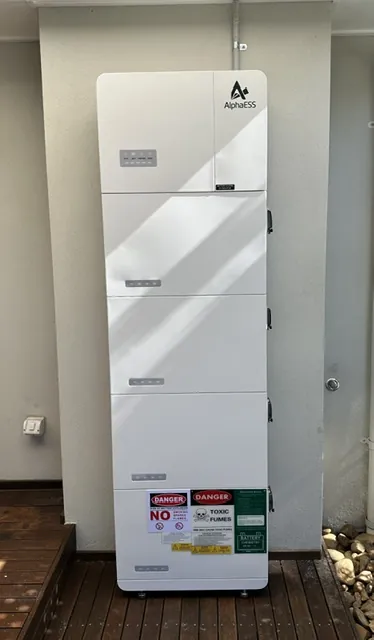
From one of our jobs
A completed home battery cabinet with isolation labelling
Photographed on site in Melbourne’s west. REC 37223.
The constraints are physical rather than electrical. Homes on the escarpment often have long runs from the street to the meter position, and the same elevation that gives good sun gives more wind than the flat suburbs. Both change the numbers on a quote.
A real surplus to charge from
Battery economics fail when there is nothing spare to store. On the Barrabool Hills that is rarely the problem. Elevated blocks with very little overshadowing from neighbours mean an array here produces a genuine midday excess even in a household that has already moved its hot water and laundry into daylight.
That surplus is worth almost nothing exported, under 5 cents a kilowatt hour, and 30 to 45 cents avoided when you use it at 7pm instead. The gap is the entire business case, and Highton is one of the better suburbs in the region for capturing it because the battery actually fills most days rather than half filling.
Full cycles pay
A battery that fills and empties daily repays itself roughly twice as fast as one that only half fills.
Little overshadowing
The elevated position means neighbouring rooflines rarely cut into the generation window here.
Shift loads first
Hot water and laundry moved into daylight cost nothing and reduce the capacity the battery has to carry.
Switchboard age tracks the build year
Sixty years of continuous building means genuinely mixed stock, but Highton has a useful property: the board age follows the build year more reliably here than in suburbs with a lot of Housing Commission or renovation history. A 1968 house on the older streets and a 2015 house on the north west edge are different jobs from the start.
On the older end, a battery adds circuits and normally a backup sub-board, and an original board will not carry that. Upgrades run $800 to $3,500 or more. On the newer end the board is usually fine and the whole conversation moves to siting and cable length instead.
Ask the build year first
In Highton the year the house was built is a better predictor of board condition than anywhere else in the region.
Backup needs spare ways
A backup sub-board needs somewhere to land. On 1960s and 70s boards there is often nothing left.
Newer estates are simpler
Homes on the north west subdivisions usually have a modern board, so the job becomes siting rather than remediation.
Long runs from the street and the meter position
Homes on the escarpment frequently have long runs between the street, the meter position and where the equipment goes. That is the single biggest cost variable on a supply upgrade here, and it matters on a battery job for the same reason: the cable route between the switchboard, the inverter and the battery is real work.
Where the garage is detached or the block falls away behind the house, the run gets longer again. It is worth measuring at quote stage, because the difference between a 6 metre run and a 25 metre run is a visible number on the price and it explains most of the variation between two quotes for the same equipment.
Measure switchboard to battery
The physical distance between the board and the battery position drives cable, conduit and labour cost.
Sloping blocks add length
A block that falls away behind the house makes the route to a rear garage longer than the plan suggests.
Bundle future work
If an EV charger is likely, planning both routes at once avoids paying twice for the same access.
Sizing for a Highton household
Capacity is set by evening consumption between roughly 5pm and midnight, not by array size. Highton homes on the older streets are generally larger and detached with reverse cycle heating, which puts most households in the 10 to 15kWh usable range that suits the region.
Because the array here genuinely fills a battery, Highton is one of the suburbs where going toward the upper end of that range is defensible rather than optimistic. The stopping point is the federal taper above 14kWh usable, where the support per kilowatt hour reduces and extra capacity has to justify itself purely on how often you cycle it.
Count the evening
Twelve months of interval data from your retailer answers the sizing question better than any rule of thumb.
Upper range is defensible here
Unlike shaded inner suburbs, a Highton array can realistically fill a larger battery most days of the year.
Stop at the taper
Federal support reduces above 14kWh usable, which is a natural ceiling for most households.
Wind exposure, backup and Powercor
The elevation that makes Highton good for solar also makes it windier than the flat suburbs, which matters for anything mounted outside. An outdoor battery enclosure and its weather cover need to be fixed for that exposure rather than to a generic specification, and a garage position sidesteps the question entirely.
Highton is Powercor, the same distributor we lodge with in the western suburbs of Melbourne, so the battery inverter application is routine. Backup, if you want it, is a backup-capable battery plus a gateway and a sub-board carrying nominated circuits, decided at design. We are 65km away in Altona and book Highton work into scheduled blocks with a nominated week.
Garage solves wind and heat
An internal garage wall removes wind loading, UV and temperature swing in one decision.
Backup is designed, not switched on
Backup circuits are wired at installation. It is not a feature that can be enabled later in an app.
Approval before energising
The Powercor application is lodged and approved before the system is energised, not afterwards.
On the ground
Highton battery notes
- The elevated position on the Barrabool Hills gives very little overshadowing, so arrays here produce a genuine daily surplus and a battery cycles fully most days.
- Switchboard age tracks the build year more reliably in Highton than anywhere else in the region, which makes the first question the year the house went up.
- Escarpment homes often have long runs between the street, the meter position and the equipment, and that distance is a visible cost line on a battery quote.
- The same elevation brings more wind than the flat suburbs, so outdoor mounting and weather covers get specified for exposure rather than generically.
Licensed and accredited work by a local team. Read about Pivot Trade Services or see recent jobs across the western suburbs.
Answers
Highton questions
On the fundamentals, yes. The elevated position on the Barrabool Hills means very little overshadowing, so arrays here generate a real daily surplus. A battery that fills and empties most days repays itself roughly twice as fast as one that half fills. That single factor matters more than equipment brand or any other variable.
Start with the build year. Highton has sixty years of continuous building and board age follows it closely here. A 1960s or 70s home usually has no spare ways for battery circuits and a backup sub-board, so an upgrade at $800 to $3,500 or more comes first. Homes on the newer north west subdivisions are usually fine.
Because of the block. Homes on the escarpment often have long runs between the street, the meter position and where the equipment goes, and sloping blocks make the route to a rear garage longer again. The difference between a 6 metre and a 25 metre run is real labour and material, and it explains most of the gap between quotes.
It can, but a garage is better. Highton is windier than the flat suburbs because of its elevation, and an outdoor position also takes UV and temperature swing. An internal garage wall removes all three at once. Where outdoors is unavoidable, the enclosure, its weather cover and the fixings are specified for that exposure.
A 10kWh system is $8,000 to $12,000 installed before rebates and $5,500 to $9,500 after the federal Cheaper Home Batteries discount, roughly 30 percent at about $250 per usable kWh from 1 May 2026. It tapers above 14kWh. Board work and long cable runs sit outside those ranges and are quoted separately.
Yes, on a scheduled basis. We are in Altona, about 65km away, and we book Geelong work in blocks, so we will give you a week rather than an hour. A battery is planned equipment with a Powercor approval in front of it, so nothing about the way we schedule it disadvantages the job.
Other work we do in Highton
- Electrician in HightonSixty years of building, and a hill that changes the spec
- Solar installation in HightonThe best yield in Geelong, and the most wind
- EV charger in HightonThe build year decides the board, and the board decides the price
- Split system in HightonElevated, windier, and the sizing follows the view
- Heat pump hot water in HightonBoard vintage tracks the build year here
Get a Highton quote
Tell us the address and what you need. We quote Highton 3216 and the surrounding western suburbs in writing, with no obligation.
- Free
- On-site quotes
- Fixed
- Written pricing
- 100%
- Workmanship guarantee
- 5.0★
- 69 Google reviews